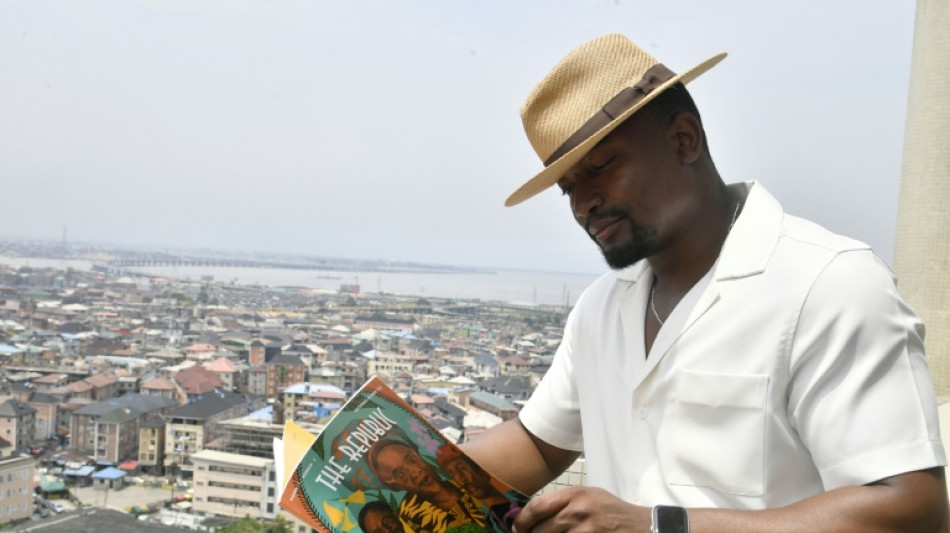
Nigeria's new media seeks to cover Africa's ignored stories / Photo: © AFP

 German far-right aims to lead Saxony-Anhalt govt in December
 Little damage as Hurricane Polo sweeps over Mexico's Pacific coast
 Manchester City guilty of breaking financial rules - Premier League
 FIFA boss Infantino blasted as would-be 'emperor' by UEFA's Ceferin

 Stocks move lower despite oil prices dropping
 AI driving up innovation investment: UN

 UN Security Council extends Haiti mission by 6 months

 Man Utd do not deserve medals if Man City stripped of titles: Rooney

 Vana Completes Expanded Staking as Part of the Vega Upgrade, Publishes Expanded VANA Token Economics
 Spain to cap gas price hikes, extend fuel discounts

 'We just need rain': Germany's Rhine river hits new low

 Yemen health system at 'breaking point': WHO

 Ireland undecided on second Israel match: coach
 France's Le Pen defiant after top ally hit by antisemitism claims

 Tom Cruise trades stunts for satire as toxic tycoon 'Digger'

 MEXC Unveils "WE SEE YOU" Brand Visual Refresh, Putting People Behind Every Trade in Focus
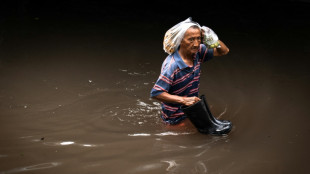 Thai capital cleans up after deadly floods

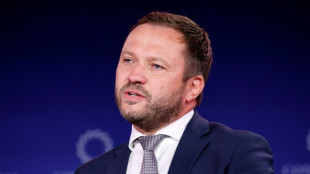 NATO, EU allies rally to Estonia after 'sabotage' blamed on Russia
 Families demand justice for Cameroon's 'nightmare' wave of murdered women

 Tebas says Man City should face 'most severe' sanctions if guilty of rule breaches
 Pochettino calls Man City success 'a period of deception'

 Settler attack on West Bank village injures Israeli forces, drawing rare rebuke

 Mystery over UK airbase scare after reports no explosives found
 Spanish govt races to adopt housing law under protest pressure

 Estonia slams Russian 'sabotage' after arson attack on defence company
Nigeria, a nation of conflicts, corruption and poverty?
That narrative is what a new breed of local media created by young Nigerians hopes to counter by getting away from the stereotypes they say are too often perpetuated by the foreign press.
Over the last decade, several online publications such as The Republic, Culture Custodian and Stears Business have emerged in fields as varied as politics, culture, and economy providing more in-depth investigations.
Their ambition: to offer more independent and innovative journalism closer to the interests of the youth than that offered by the traditional local press.
"A new publication exploring and rewriting the Nigerian story," is how The Republic presents its mission since it was launched in 2016 by Wale Lawal, a 30-year-old author and entrepreneur.
Eager for news from his country while studying in England, Lawal became aware of the difficulty of accessing reliable, consistent and independent news sources.
"Foreign press is more to serve foreign audiences who have their own interest ... local media was not just enough credible because of their links with politicians," he said.
The Republic was launched to provide "serious journalism with an African worldview," he said.
As social media expanded and demands for more democracy grew, a class of wealthier Nigerians emerged at the start of the 2000s, more demanding of their government and ready to pay for information.
"Local media and traditional media has not met that demand. It's created this gap that new media founders realised that they can play a role here," Lawal said.
- 'African renaissance' -
The flourishing of this new media, more widely seen in English-speaking countries, is touted by some as an "African renaissance."
Many traditional newspapers were born at the end of colonial rule and the arrival of democracy but ensuing military rule and economic troubles weakened them.
Lawal said politicians started controlling what was published by the media, "as they became one of the main financial contributors."
The Western media thus became a primary source of reliable information about Africa but not without consequences.
"We are looking at a continent that for the most part of modern history has always had its stories being told by people who are not from the continent and that has its own implication about the perception of the continent."
According to a study carried out by the non-profit organization Africa No Filter, a third of the articles dealing with Africa and published by local media come from foreign press services, primarily Agence France-Presse (AFP) and the BBC.
- 'Stereotypical narratives' -
Despite progress, foreign press coverage "continues to contribute to the stereotypical narratives of a broken, dependent continent lacking in agency," said Moky Makura, executive director of Africa No Filter, which wants to change the discourse on Africa in the arts and media.
"We are missing out on the stories of creativity, innovation and the opportunities that exist," she said.
"Not only does the current framing inform how the world sees and treats us, it also affects how we as Africans see ourselves."
Makura said the constant negative narrative contributes to some of the economic migration from Africa.
Critics say the foreign press reduces Nigeria to just a country battling the jihadist insurgency of Boko Haram for more than 14 years in the northeast.
This imbalance eclipses, for example, the phenomenal global success of Afrobeats, a musical genre born in Nigeria's economic and cultural capital Lagos.
"It's not about good and bad coverage, our life is just more complicated than what we might see in papers," Lawal said.
The Republic focuses instead, for example, on the future of basketball in Nigeria or the new foreign policy of the African giant.
It publishes portraits, essays, reports and interviews that show the complexity of the country of 215 million inhabitants.
- 'Human face' -
That field reporting is also the strength of the online media HumAngle. Since 2020, it has covered conflicts and humanitarian crises in Nigeria but given them "a human face", says managing editor Hauwa Shaffii Nuhu.
"We cannot reduce conflicts to statistics, residents to victims, we must build archives that tell their story and their resilience," she said.
While Nigeria has more than 25,000 missing people, HumAngle strives, for example, to document their cases as well as the fight of their loved ones to find them.
HumAngle has had numerous scoops, particularly on the jihadist conflict, and also started training young people in journalism in remote villages in the volatile northeast.
Who can better inform us, the site asks, "than young people, who can build trust because they speak the local languages, understand the culture, and are already established in communities difficult to access due to insecurity?"
R.Adler--BTB