How a Bronze Age rock became a 'treasure map' for researchers / Photo: © AFP

 UN to hold fourth informal poll of secretary-general candidates
 Who are the Emiratis behind crisis-hit Manchester City?

 Singer Angelique Kidjo urges Africans to 'create together'

 Alleged Rihanna mansion shooter mentally fit for trial, says judge
 Mystery over UK airbase scare as police find petrol not explosives

 OpenAI unveils low-cost AI model, a day after shelving Astra upgrade

 Premier League confirms Man City guilty of serious financial breaches
 Brazil's Lula turns to Bad Bunny tune to criticise Trump ahead of polls
 Nigerian dancer eyes world record after seven-day marathon

 Swiss regulator concludes Julius Baer bank probe
 Brazil's patron saint pulled into latest election scrap

 Football overload leaves players near 'breaking point', warns Tebas
 Paris Eiffel Tower says chief to step down after uproar over removing women staff

 Amaze Holdings (NYSE: AMZE) Executes Binding LOI to Acquire BullionFX | Alchemy, a Decentralized Gold-Backed Financial Ecosystem for Valued at US$155 Million
 Clashes between French teens, police as school blockades intensify

 Stocks move sideways despite oil moving lower
 African leaders to gather in Egypt for business summit

 UK decides against charging foreign visitors for museums

 Dallaglio to sell England World Cup winners' medal

 Brazil come from behind to beat Australia 4-2 in friendly

 Ruthless An retains Asian Games badminton crown as Kunlavut triumphs

 Alonso to stay with F1 team Aston Martin in 2027
 China badminton 'still strong' despite Asian Games slump

 'Exceptional' Turner painting shown in Rome before sale
 European stocks climb as oil dips

A piece of rock with mysterious markings that lay largely unstudied for 4,000 years is now being hailed as a "treasure map" for archaeologists, who are using it to hunt for ancient sites around north-western France.
The so-called Saint-Belec slab was claimed as Europe's oldest map by researchers in 2021 and they have been working ever since to understand its etchings -- both to help them date the slab, and to rediscover lost monuments.
"Using the map to try to find archaeological sites is a great approach. We never work like that," said Yvan Pailler, a professor at the University of Western Brittany (UBO).
Ancient sites are more commonly uncovered by sophisticated radar equipment, aerial photography or by accident in cities when the foundations for new buildings are being dug.
"It's a treasure map," said Pailler.
But the team are only just beginning their treasure hunt.
The ancient map marks an area roughly 30 by 21 kilometres and Pailler's colleague, Clement Nicolas from the CNRS research institute, said they would need to survey the entire territory and cross reference the markings on the slab.
That job could take 15 years, he said.
- Rivers and mountains -
Nicolas and Pailler were part of the team that rediscovered the slab in 2014 -- it was initially uncovered in 1900 by a local historian who did not understand its significance.
The French experts were joined by colleagues from other institutions in France and overseas as they began to decode its mysteries.
"There were a few engraved symbols that made sense right away," said Pailler.
In the coarse bumps and lines of the slab, they could see the rivers and mountains of Roudouallec, part of the Brittany region about 500 kilometres west of Paris.
The researchers scanned the slab and compared it with current maps, finding a roughly 80 percent match.
"We still have to identify all the geometric symbols, the legend that goes with them," said Nicolas.
The slab is pocked with tiny hollows, which researchers believe could point to burial mounds, dwellings or geological deposits.
Discovering their meaning could lead to a whole flood of new finds.
- 'Doomed' slab -
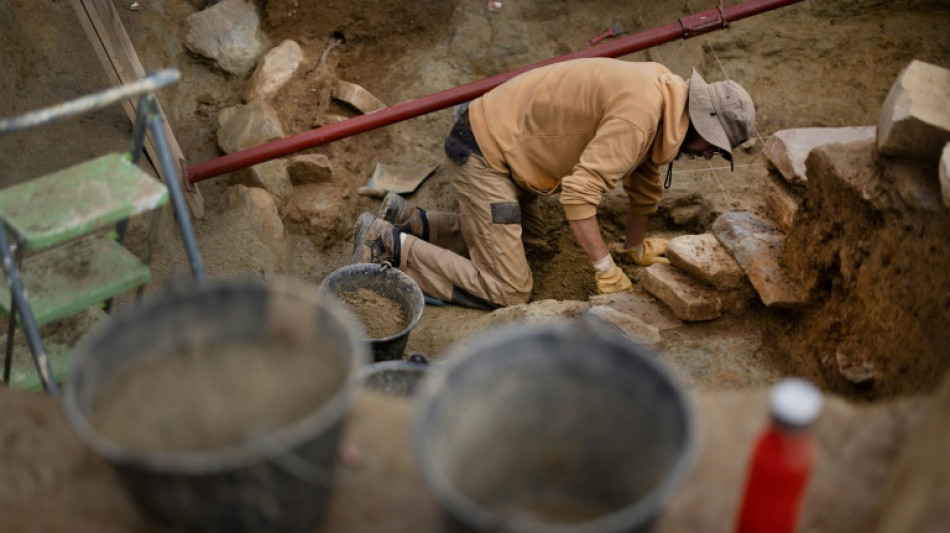
But first, the archaeologists have spent the past few weeks digging at the site where the slab was initially uncovered, which Pailler said was one of the biggest Bronze Age burial sites in Brittany.
"We are trying to better contextualise the discovery, to have a way to date the slab," said Pailler.
Their latest dig has already turned up a handful of previously undiscovered fragments from the slab.
The pieces had apparently been broken off and used as a tomb wall in what Nicolas suggests could signify the shifting power dynamics of Bronze Age settlements.
The area covered by the map probably corresponds to an ancient kingdom, perhaps one that collapsed in revolts and rebellions.
"The engraved slab no longer made sense and was doomed by being broken up and used as building material," said Nicolas.
Y.Bouchard--BTB