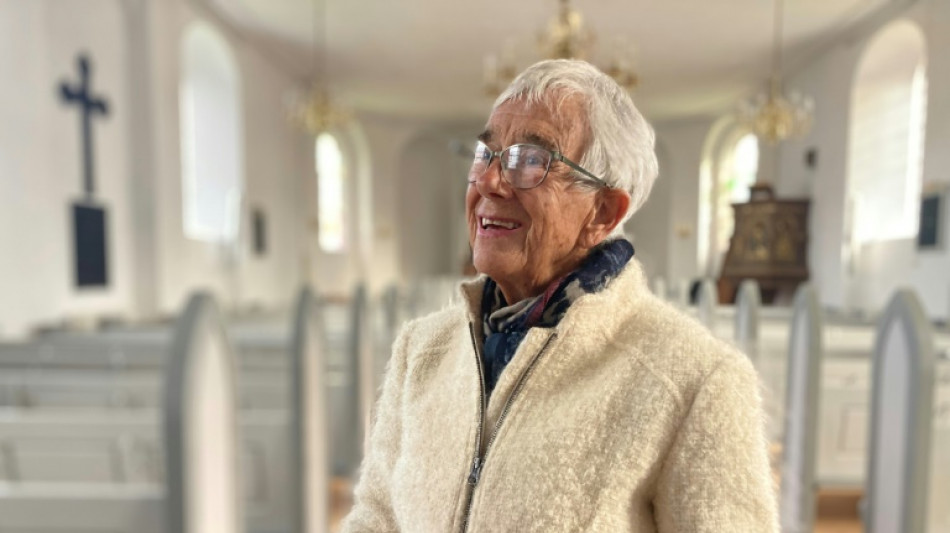
80 years on, Danish Jewish girl recalls life in hiding / Photo: © AFP

 Spain brush aside Croatia in Nations League, England down Czechs

 Trump hails 'morally binding' AI self-regulation pledge

 Yamal inspires Spain to Croatia romp on World Cup homecoming

 UN to hold fourth informal poll of secretary-general candidates
 Who are the Emiratis behind crisis-hit Manchester City?

 Singer Angelique Kidjo urges Africans to 'create together'

 Alleged Rihanna mansion shooter mentally fit for trial, says judge
 Mystery over UK airbase scare as police find petrol not explosives

 OpenAI unveils low-cost AI model, a day after shelving Astra upgrade
 Premier League confirms Man City guilty of serious financial breaches
 Brazil's Lula turns to Bad Bunny tune to criticise Trump ahead of polls

 Nigerian dancer eyes world record after seven-day marathon
 Swiss regulator concludes Julius Baer bank probe

 Brazil's patron saint pulled into latest election scrap

 Football overload leaves players near 'breaking point', warns Tebas
 Paris Eiffel Tower says chief to step down after uproar over removing women staff

 Amaze Holdings (NYSE: AMZE) Executes Binding LOI to Acquire BullionFX | Alchemy, a Decentralized Gold-Backed Financial Ecosystem for Valued at US$155 Million

 Clashes between French teens, police as school blockades intensify

 Stocks move sideways despite oil moving lower
 African leaders to gather in Egypt for business summit
 UK decides against charging foreign visitors for museums

 Dallaglio to sell England World Cup winners' medal
 Brazil come from behind to beat Australia 4-2 in friendly

 Ruthless An retains Asian Games badminton crown as Kunlavut triumphs

 Alonso to stay with F1 team Aston Martin in 2027
In October 1943 Tove Udsholt, who had just turned three, had fled Copenhagen with her mother to escape the Gestapo. She ended up alone, but a small fishing village took her in.
Around 95 percent of Denmark's 7,000 Jews escaped deportation, either by fleeing to neighbouring neutral Sweden by boat or, for around 150 children like Udsholt, by hiding in Denmark.
Many children were reunited with their loved ones after the country was liberated at the end of World War II.
Udsholt however, chose to stay in Gilleleje, the small village north of Copenhagen that adopted her. And years later, she would return there to retire.
Occupied by Nazi Germany in April 1940, Denmark chose to collaborate with the Nazis and maintained its own institutions until the end of the summer of 1943.
Danish Jews, who did not have to wear the yellow star Jews were forced to wear by the Nazis, were not at first worried.
But everything changed at the end of September 1943, when Berlin ordered a raid on the country's Jewish community.
The information was leaked and Denmark's Jews knew they had to act.
"My mother told me she had received a message on September 30 that she would have to flee with me," Udsholt told AFP in Gilleleje.
"Since my father was Christian he didn't have to come."
It was the first of several separations, and one which was never mended.
- Gestapo raid -
Carrying just one bag, Udsholt and her mother met up with most of her mother's side of the family at Copenhagen's train station.
Together they took the train to Gilleleje, a village facing the Swedish coast, where they were hidden away in a hay barn while waiting to make the crossing to Sweden.
But Udsholt's mother was concerned that her daughter's incessant chatter would get them caught.
A local fisherman, Svend Andreasen, took a liking to the talkative little girl.
From time to time, he offered to take her home to his wife for a few hours so she could play freely and escape the confined, chilly space.
He and his wife Ketty later offered to let the little girl stay with them so her mother, Paula Mortensen, could find a place for them to live in Sweden.
The Gestapo found and arrested 86 Jews stowed away in a Gilleleje church barn, which had until then turned a blind eye to the influx of refugees in the village.
Fearing an imminent raid, Mortensen had to act quickly.
"She told herself: 'This is what is best for my daughter'," Udsholt told AFP.
"I started to cry, I still remember," recalled the vivacious 83-year-old.
"At this moment I'm totally alone. I don't really know these people."
But Andreasen and his wife, both in their 40s and with no children, quickly gained the little girl's confidence.
From their modest home, they could see the Swedish coast.
They "told me: 'You see those lights over there, that's your mother'", said Udsholt.
"Holding my cuddly toy, I looked, and ... throughout the rest of the war, in the evenings I would stand on a chair in the window and tell my mother what I did that day."
- 'Good friends' -
The weeks passed and Udsholt blossomed, protected by the villagers.
Andreasen "went around to most homes to tell them they had taken in a little fair-haired girl. That was my saving grace, because no one knew I was Jewish."
As soon as soldiers approached when she was playing outdoors, villagers would call her to come inside.
"I was afraid (of the Germans), because Svend had warned me that I was never to talk to the men dressed in green or those with long black coats because those were the people who were going after my mother," she recalled.
When Denmark was liberated in May 1945, Udsholt's mother, who had had no contact with her daughter for almost two years, returned.
She came to collect her child on August 24 -- her fifth birthday.
But back in Copenhagen, Udsholt missed the sea air and village life.
The time apart took its toll on her parents, who never reunited. Udsholt ended up living with her mother, and the two fought a lot.
Finally, when she was seven, her mother agreed to let her go live in Gilleleje with Svend and Ketty Andreasen, who formally adopted her at age 18.
"My mother and I were good friends for most of her life, but we were not mother and daughter," she said with a heavy sigh.
Y.Bouchard--BTB