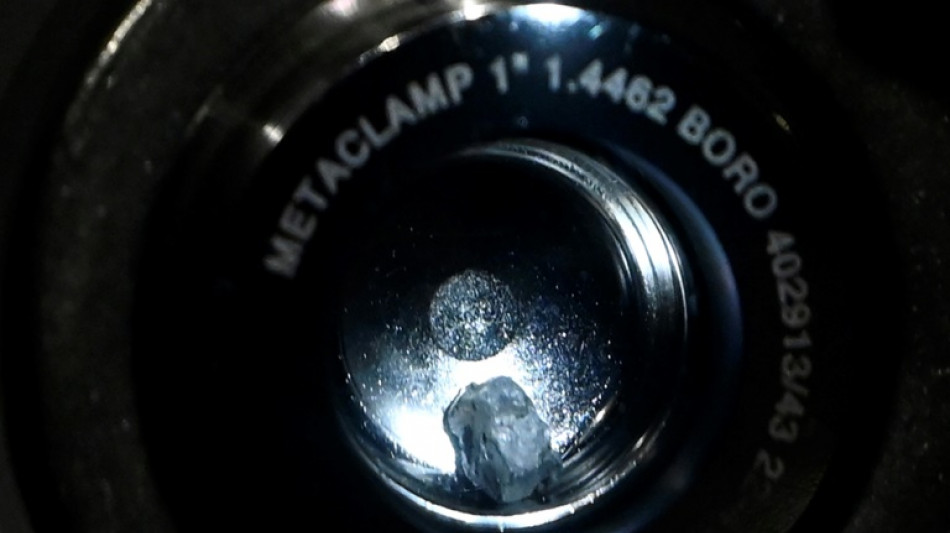
In US capital, selfies with asteroid hinting at Earth's origins / Photo: © AFP

 Spain brush aside Croatia in Nations League, England down Czechs

 Trump hails 'morally binding' AI self-regulation pledge

 Yamal inspires Spain to Croatia romp on World Cup homecoming

 UN to hold fourth informal poll of secretary-general candidates
 Who are the Emiratis behind crisis-hit Manchester City?

 Singer Angelique Kidjo urges Africans to 'create together'

 Alleged Rihanna mansion shooter mentally fit for trial, says judge
 Mystery over UK airbase scare as police find petrol not explosives

 OpenAI unveils low-cost AI model, a day after shelving Astra upgrade
 Premier League confirms Man City guilty of serious financial breaches
 Brazil's Lula turns to Bad Bunny tune to criticise Trump ahead of polls

 Nigerian dancer eyes world record after seven-day marathon

 Swiss regulator concludes Julius Baer bank probe
 Brazil's patron saint pulled into latest election scrap

 Football overload leaves players near 'breaking point', warns Tebas
 Paris Eiffel Tower says chief to step down after uproar over removing women staff

 Amaze Holdings (NYSE: AMZE) Executes Binding LOI to Acquire BullionFX | Alchemy, a Decentralized Gold-Backed Financial Ecosystem for Valued at US$155 Million

 Clashes between French teens, police as school blockades intensify

 Stocks move sideways despite oil moving lower

 African leaders to gather in Egypt for business summit

 UK decides against charging foreign visitors for museums

 Dallaglio to sell England World Cup winners' medal

 Brazil come from behind to beat Australia 4-2 in friendly

 Ruthless An retains Asian Games badminton crown as Kunlavut triumphs

 Alonso to stay with F1 team Aston Martin in 2027

In a hushed room of a museum in Washington, cameras and cell phones focus on a tiny piece of rock, no larger than a piece of gravel.
The fragment might seem insignificant, but it is a sample taken from the asteroid Bennu, which scientists are studying in the hope of discovering if asteroids actually brought the building blocks of life -- carbon and water -- to Earth.
Exhibited to the public on Friday for the first time at the Smithsonian in the US capital, the tiny stone is just visible inside its small capsule.
"This asteroid, now we know, has water crystals and carbon, two of the elements that produce ultimately life," said NASA boss Bill Nelson, a few minutes before the curtain rose on the dedication ceremony.
The new space venture is "part of our quest to understand, to try to understand, who we are, what we are, where we are, in the vastness of this cosmos," Nelson told journalists and space enthusiasts eager to whip out their cameras to snap an image of the rock fragment.
- 'Indescribable' -
Other museum visitors then come in and they too reach for their phones for a selfie with the little black rock.
Jenn Mann came from neighboring Virginia to take her grandson to "finally" see a piece of asteroid on Earth.
"I was afraid it was just a speck of dust, but it's actually much bigger than I thought," laughed the 64-year-old systems analyst.
"I was 10 years old when man first walked out on the Moon, and I think everyone in my generation is just really keen on all of that because you wouldn't remember all the excitement that was going on during that time," she said, before taking a photo for her daughter.
NASA's Osiris-Rex mission took the sample in 2020 from Bennu, an 4.5 billion-year-old asteroid 500 meters (1,640 feet) in diameter, which was more than 300 million kilometers (186 million miles) from Earth at the time.
The capsule containing the precious cargo returned successfully to Earth in September, landing in the American desert.
Since then, analysis has been underway at NASA's Johnson Space Center in Houston.
Even though she worked with the scientific team on the project, Nayi Castro, like the other visitors, was seeing a fragment of the sample with her own eyes for the first time.
"It's indescribable, I can't wait to bring my family and my friends to look at it," said the 36-year-old mission operations manager, proudly wearing the NASA logo on her t-shirt.
"To actually to look at this sample was super exciting cause it was so much work to get this sample back," she said, smiling.
- 'Dreamed of for 20 years' -
Tim McCoy, meteorite curator at the Smithsonian's National Museum of Natural History, described the discovery as a "milestone."
"Our planet has features that we haven't found on any other planet in the solar system or outside the solar system: we have continents, we have oceans, we have life," he told journalists.
"This is something I dreamed of for 20 years and today it comes to reality, but it's really just the first step," he said.
Even the operation to actually open the sample capsule is not complete. Due to the abundance of material found outside the collection mechanism itself, the main sample itself has not yet been opened.
The material already recovered was entrusted to a rapid analysis team, in order to obtain a first idea of the composition of Bennu.
K.Thomson--BTB