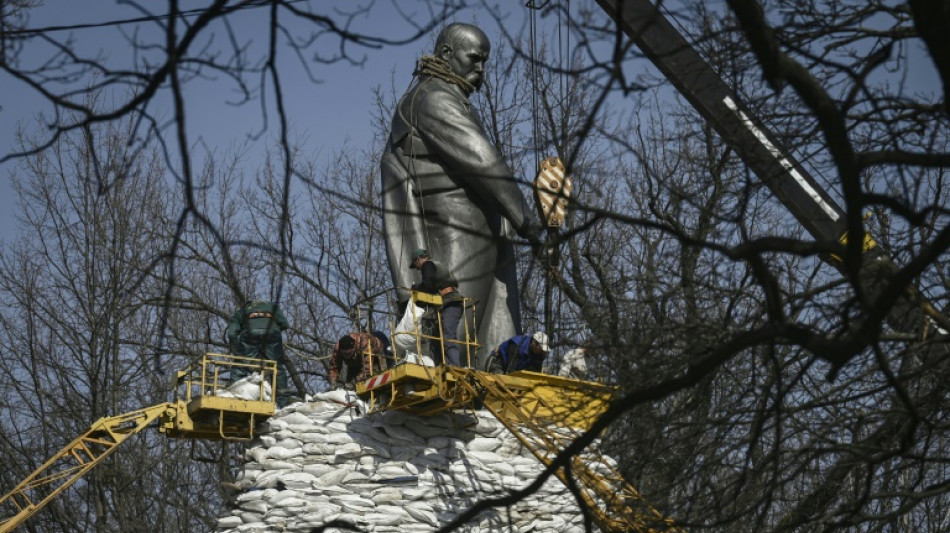
In Kharkiv, sandbags pile up to save Ukraine national poet's statue / Photo: ©

 Man City could face 'drastic' sanctions after reported guilty verdict: ex-chairman

 Furious Fury says row between rival promoters could scupper Joshua bout
 'Invincible' 223cm teen basketball player stars as China win bronze
 Tenth woman found dead in South Africa's string of killings
 Japan schoolboy, 11, wins gold while empty seats blight Asian Games
 Japan organisers 'not satisfied' as empty seats blight Asian Games
 Canals full, roads submerged as Bangkok declares flood disaster
 China, US to open AI 'communication channel' after summit
 Nepal tunnel survivor wants to help post-flood rebuild

 New China sprint star, 17, vows 'no limits' after Asian Games gold
 Japanese 11-year-old wins Asian Games eSports gold
 TikTok agrees to teen limits in US settlement following Meta
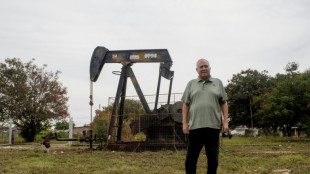 Venezuela's oil cradle pins hopes on US energy deals

 US, China buy time with trade truce as pressure builds
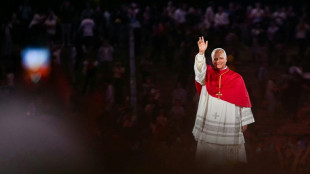
 'Leo, Leo': Young Catholics give pope rockstar welcome in France

 Lula bans sports betting days ahead of Brazil's election

 Guatemala ensures survival of vulnerable 'fossil' fish
 Mancini finds positives in Italy loss, accepts fans' jeers

 Alcaraz helps Europe into Laver Cup lead
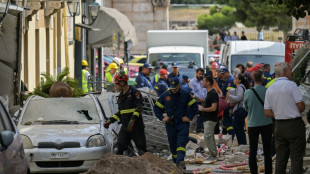 Six missing after building collapses in historic Athens district
 Mbappe scores but suffers knee injury as Zidane gets debut France win
 Mancini's Italy return spoiled by Belgium defeat

 Rodri confident in Man City innocence despite reported charges

 Jay-Z rape accuser says she made 'false accusations'
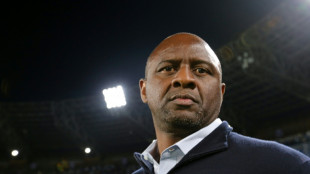
 Senegal draw first match under Vieira and Nigeria survive scare
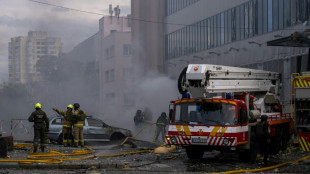
In Ukraine's second city of Kharkiv -- under daily Russian bombardment that has damaged or destroyed 1,000 buildings -- work has begun to erect sand barricades to protect its statues.
The most symbolic of them all sits enthroned in the heart of the town centre in a vast park filled with century-old trees: Taras Shevchenko, Ukraine's national poet, who was the country's foremost nineteenth-century bard and one of the first to write in Ukrainian.
Since the country's independence in 1991 with the collapse of the Soviet Union, not a single Ukrainian city has been without its own Shevchenko Avenue or Square. The country's largest university in Kyiv is named after him.
Workers with lifting equipment busy themselves around the imposing black cast-iron statue.
At 16 metres (52 feet) high, it is the biggest in Kharkiv since the statue of Lenin on a nearby esplanade was taken down in 1994.
"We must protect the city so that future generations know it as we have known it," says Petro, a 72-year-old retiree sporting a leather cap and gold teeth, who is taking part in the operation.
Put up in 1935, the statue of Shevchenko is a mixture of socialist realism and baroque Stalinism, with the central character surrounded by revolutionary soldiers at his feet.
It's an example of Ukrainian patriotism long suppressed by "brother" Russia during the Soviet era.
The sandstone plinth and the Stalinist fighters have now disappeared beneath sandbags that are already up to the poet's waist, obscuring his conquering gait, but not yet his fierce gaze and drooping moustache.
"It seems a bullet ricocheted off his head during World War II," says one of the council workers with a smirk.
"Back then, the city was devastated, but the centre was relatively well-preserved, not bombarded like now," says Volodymyr.
Since the start of the Russian invasion on February 24, Kharkiv in northeast Ukraine has, along with southern Mariupol, been the most bombed Ukrainian metropolis.
From just a few kilometres (miles) away, Russian artillery has bombarded the north and east of the city daily, as well as its historic centre, targeting in particular administrative buildings.
- 'Another 1,000 years!' -
More than a thousand buildings have been destroyed or damaged in a city emptied of around a third of its 1.5 million inhabitants, according to local authorities.
A city of culture and history, Kharkiv has around 50 important monuments which will be protected with sandbags, according to the town hall.
"We hope that these monuments will last another thousand years!" it said.
As the protective wall surrounding the Shevchenko statue nears completion, dozens of town hall employees and volunteers turn their attention to the positioning of sandbags around the independence monument, a goddess brandishing the laurels of victory, celebrating Ukraine's proclamation of independence on August 24, 1991.
For the moment, one can still read, engraved in the Cyrillic alphabet, the slogan that one now hears everywhere in this country at war: "Glory to Ukraine."
"At the moment, we mainly collect branches and trees brought down by rockets. This year we will not plant anything, there will be no flowers," says council worker Ilona Kalashnikova who normally tends the city's green spaces.
"These sandbags are a symbol of our attachment to our city. We can rebuild destroyed houses, but not historical monuments," she adds.
G.Schulte--BTB