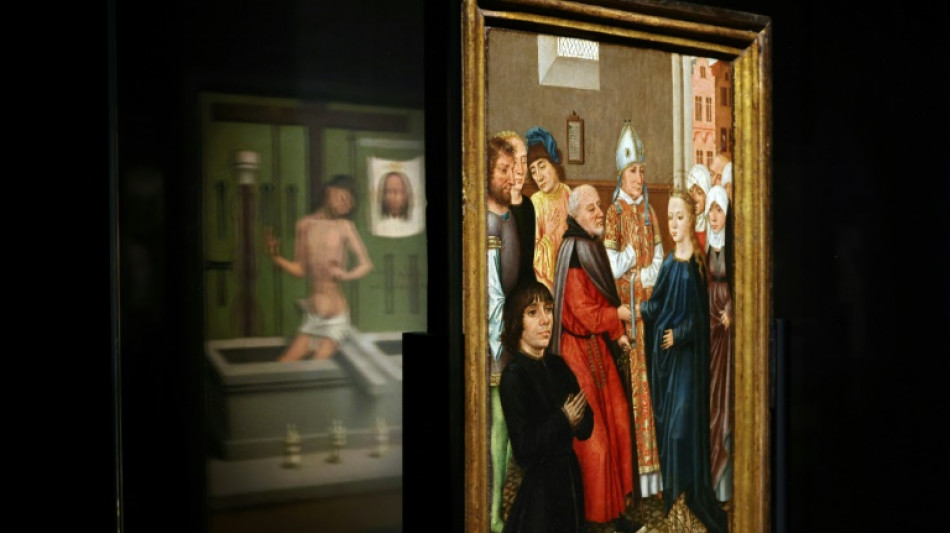
Madrid's Prado museum throws spotlight on reverse side of paintings / Photo: © AFP

 Brazil football clubs face massive sponsorship blow from betting ban

 ChatGPT maker wants to be the App Store for AI as safety concerns grow

 Women fight fires and sexism in Indonesian Borneo

 Forsling's OT blast lifts Florida over Carolina in NHL opener

 Hurricane Polo sweeps over Mexico's Pacific coast, heads inland
 Grynspan pulls ahead in race to lead UN: diplomat

 Trump touts AI boss pledge to self-regulate

 Oil down, but stocks lower as bond yields rise

 England break down stubborn Czechs to claim first Nations League win

 UN Security Council extends Haiti anti-gang force by 6 months

 Manchester City guilty of Premier League charges: What comes next?

 Man City chief Soriano slams Premier League 'conspiracy theory'

 Hurricane Polo sweeps over Mexico's Pacific coast

 Man City must be relegated after guilty verdict says club's former chairman

 German far-right aims to lead Saxony-Anhalt govt in December
 Little damage as Hurricane Polo sweeps over Mexico's Pacific coast

 Manchester City guilty of breaking financial rules - Premier League

 FIFA boss Infantino blasted as would-be 'emperor' by UEFA's Ceferin
 Stocks move lower despite oil prices dropping
 AI driving up innovation investment: UN

 UN Security Council extends Haiti mission by 6 months
 Man Utd do not deserve medals if Man City stripped of titles: Rooney

 Vana Completes Expanded Staking as Part of the Vega Upgrade, Publishes Expanded VANA Token Economics

 Spain to cap gas price hikes, extend fuel discounts

 'We just need rain': Germany's Rhine river hits new low
A new exhibition at Madrid's Prado museum is throwing a spotlight on the reverse side of paintings, letting visitors see labels, seals and sketches that are usually hidden from view.
The aim of the Reversos (On the Reverse) exhibition is to change the viewer's point of view and take them behind the scenes to open a "door to the secrets of art," said its curator, Miguel Angel Blanco.
"This exhibition goes far beyond simply turning the paintings over on the wall," he said.
About 100 works are on display in two rooms with black walls, including paintings on loan from 29 foreign museums and international collections such as the Van Gogh museum in Amsterdam and Boston's Museum of Fine Arts.
"We wanted to do an international project, not limit ourselves to the paintings of the Prado museum," he said.
In preparing the exhibit, Blanco said he has made an "in-depth exploration" of the Prado's vast collection over the past seven years and had seen "most of the paintings from the front and the back".
The inspiration was one of the Prado's most famous paintings, Diego Velazquez's 17th-century masterpiece "Las Meninas" depicting the Infanta Margarita and her courtiers.
In the picture, the artist himself is also visible, working on a large canvas placed on the floor. The back of the painting he is working on can be seen on the left side of "Las Meninas".
A life-size replica of the back of this huge painting forms the centrepiece of the exhibition, which opened last month and runs until March.
The rest of the works are originals. Some have their painted side to the wall while others can be seen from both sides such as Swedish-Austrian painter Martin van Meytens’ 18th-century "Kneeling Nun".
The front depicts a devout young nun, kneeling at prayer as an older nun watches over. The reverse has a surprise -- it shows the nun with her habit hitched up, revealing her naked bottom.
- 'Unknown brushstroke' -
In some cases, the backs of paintings contain labels, stamps or seals that were placed there at a later date which help trace the history of the works -- the collections they belonged to, the palaces where they were displayed or any restoration undertaken on them.
One section of the exhibition focuses on the materials that have been used over the centuries as supports for paintings, including copper, porcelain and even ivory.
The exhibition features the original stretcher frame -- the wooden structure over which a painting canvas is stretched -- of one of the world's most famous works: Pablo Picasso's 1937 masterpiece "Guernica", regarded by many critics as the most moving and powerful anti-war painting in history.
It was discovered two years ago at one of the warehouses of New York's Museum of Modern Art where the famous painting was moved for safekeeping when World War II broke out.
"They saw that there was a label that says 'Picasso, San Francisco'," he said, explaining that it was one of 30 cities the painting had been taken to.
"It was nailed onto the stretcher frame and unnailed 45 times," Blanco said, describing it as "the frame with the most nail holes in history".
The stretcher frame features a black stain which "is the unknown brushstroke of 'Guernica', it is a brushstroke that escaped Picasso and was captured here on this crossbeam," he added.
"Guernica" finally returned to Spain in 1981. Since 1992, it has been on display at the Reina Sofia museum in Madrid which is located near the Prado.
L.Dubois--BTB