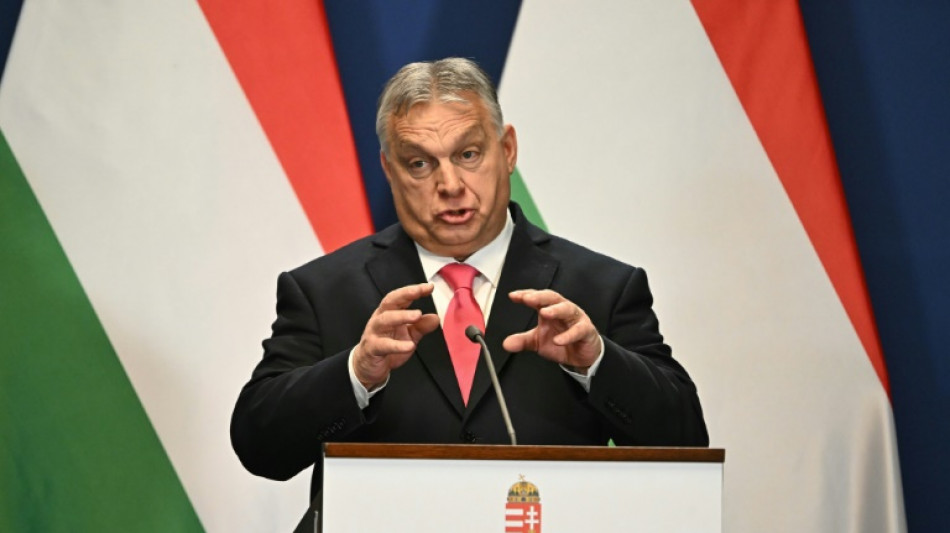
Hungary's 'chilling' foreign influence office starts up / Photo: © AFP

 Most equities rise after oil price plunge, US data in focus

 Polar oceans transformed as warming melts ice habitats: research

 Lost shark becomes viral star in South Korea

 Dangote to launch $16bn refinery in Kenya

 North Korean leader 'extremely obese': Seoul spy agency
 Yankees and pope-backed White Sox start MLB playoffs with wins

 Malaysia's ex-PM Mahathir in hospital for observation

 'No limits': Marathon world record holder Sawe chasing history

 Countdown begins to biggest-ever Rugby World Cup

 Bangladesh women lose ground after quota reform

 Vietnam admits 'differing opinions' on Hanoi development

 Stocks temper gains as oil pares heavy losses, US data in focus

 New Zealand denies breaching climate commitments to EU

 Albert becomes youngest US scorer in 4-2 win over Chile

 Pirate island's plunging population shows Greece's demographic decline
 With elections ahead, Latvia's Russian-speakers reject Moscow's help

 Brazil football clubs face massive sponsorship blow from betting ban

 ChatGPT maker wants to be the App Store for AI as safety concerns grow

 Women fight fires and sexism in Indonesian Borneo

 Forsling's OT blast lifts Florida over Carolina in NHL opener

 Hurricane Polo sweeps over Mexico's Pacific coast, heads inland

 Grynspan pulls ahead in race to lead UN: diplomat

 Trump touts AI boss pledge to self-regulate
 Oil down, but stocks lower as bond yields rise

 England break down stubborn Czechs to claim first Nations League win
A new government agency to "protect Hungary's sovereignty" which starts work Thursday will have a "chilling effect" on the country's democracy, critics warn.
Media watchdog Reporters Without Borders (RSF) branded it a "new, dangerous provocation by Prime Minister Viktor Orban", who has passed a slew of laws tightening his control and muzzling the press since he came back to power nearly 14 years ago.
The US ambassador to Budapest David Pressman said it "made Moscow's foreign agent law look mild and meek".
The latest laws to curb foreign influence come ahead of crucial EU and municipal elections in June.
They include a Sovereignty Protection Office with powers to "identify and investigate organisations that receive funding from abroad... aimed at influencing the will of voters".
Orban's ruling Fidesz party argues the law will "close a loophole" of "electoral trickery" after claims opposition parties received funds from a US-based NGO in the run-up to the 2022 elections.
But critics fear the law could be used to also hamper the work of rights groups and others dependent on funds from abroad.
"It creates an atmosphere where receiving money from abroad is presented as a question of legitimacy," Miklos Ligeti, head of legal at Transparency International Hungary, told AFP.
- 'Propagandist' at helm -
The new agency is headed by controversial political scientist Tamas Lanczi, notorious for his stint as editor-in-chief at a now-closed Orban-supporting economic weekly magazine.
In 2018 it published the names of some 200 civil society workers, academics and journalists, linking them -- some posthumously -- to US financier and philanthropist George Soros, a bete noire of Orban's.
A court later found the list to be "unlawful" and "intimidating".
"Lanczi is a well-trained, well-embedded propagandist," Zoltan Ranschburg, senior analyst of the liberal-leaning Republikon Institute, told AFP.
His agency has broad powers to gather information, cooperate with state agencies and make reports, raising fears Lanczi could oversee more smear campaigns.
But Lanczi, 46, who has spent his career in the orbit of Orban's party, brushed aside criticism as based on "preconceptions".
While his agency does not have the power to sanction anyone on its own, any candidate standing for election that accepts foreign funding could face up to three years in prison.
Another fear is that it could effectively "cripple" media companies by asking them for data "without limit", creating "a tremendous amount of work", according to Agnes Urban, an expert from Mertek Media Monitor watchdog.
"It could lead to a chilling effect with journalists steering clear of sensitive topics to avoid getting into its sights," she told AFP.
Ten Hungarian media outlets warned in a letter that the law "is capable of severely restricting the freedom of the press".
The central European country has fallen from 25th place in RSF's press freedom index when Orban came back to power to 72nd place.
- Dependant on foreign funds -
Watchdog organisations in Hungary need some foreign funding, according to Transparency's International Ligeti, because the public's willingness to donate is low and NGOs who criticise the government are unable to access state grants.
"They cannot imagine we get foreign grants for monitoring and doing anti-corruption advocacy without any instructions on the conclusions," Ligeti said.
The ruling coalition already passed a law in 2017 obliging NGOs to identify as "foreign-funded organisations" if they received funds from abroad.
But it was repealed after the European Court of Justice deemed it against EU law.
The Council of Europe called on Hungary to abandon the latest bill before it passed in December, saying it "poses a significant risk to human rights".
The European Commission has also expressed concern about the law in a letter to the Hungarian government in December, according to EU Justice Commissioner Didier Reynders.
He told the European Parliament last week that "in the absence of a satisfactory response, the Commission will not hesitate to take the necessary steps" to ensure compliance with EU law.
N.Fournier--BTB