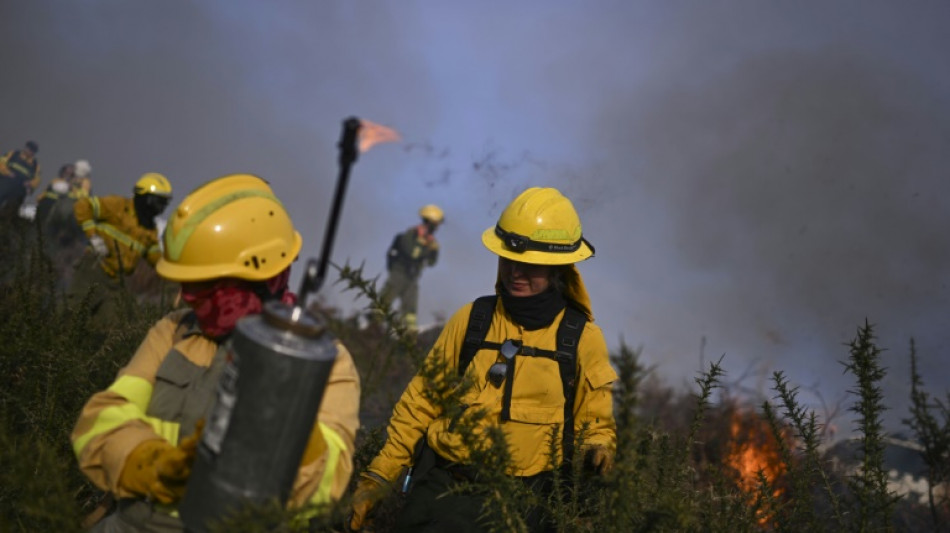
Women train to fight fire with fire in Portugal / Photo: © AFP

 South Korea break China hearts to reach Asian Games football final
 Eala storms into Asian Games semi-finals to thrill adoring fans

 Turkey freezes ex-minister's assets as fund crisis grows

 What we know about the North Korean POW dispute

 Most equities rise after oil price plunge, US data in focus

 Polar oceans transformed as warming melts ice habitats: research

 Lost shark becomes viral star in South Korea
 Dangote to launch $16bn refinery in Kenya
 North Korean leader 'extremely obese': Seoul spy agency

 Yankees and pope-backed White Sox start MLB playoffs with wins

 Malaysia's ex-PM Mahathir in hospital for observation

 'No limits': Marathon world record holder Sawe chasing history

 Countdown begins to biggest-ever Rugby World Cup

 Bangladesh women lose ground after quota reform
 Vietnam admits 'differing opinions' on Hanoi development

 Stocks temper gains as oil pares heavy losses, US data in focus
 New Zealand denies breaching climate commitments to EU

 Albert becomes youngest US scorer in 4-2 win over Chile

 Pirate island's plunging population shows Greece's demographic decline
 With elections ahead, Latvia's Russian-speakers reject Moscow's help
 Brazil football clubs face massive sponsorship blow from betting ban
 ChatGPT maker wants to be the App Store for AI as safety concerns grow

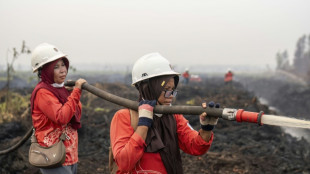 Women fight fires and sexism in Indonesian Borneo

 Forsling's OT blast lifts Florida over Carolina in NHL opener

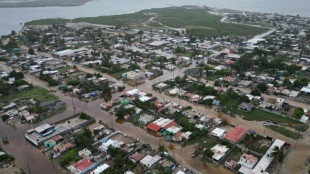 Hurricane Polo sweeps over Mexico's Pacific coast, heads inland
Women from around the world gathered in northwest Portugal this week to practise a traditional technique of deliberately burning land to prevent the kind of wildfires -- intensified by climate change -- that have killed hundreds across Europe.
In the hills above the Portuguese town of Paredes de Coura, women used drip torches to set fire to thorny patches of scrubland, creating grazing areas for livestock.
"What these women are learning here is essentially the use of traditional fire. The fire that our ancestors used to renew the pastures and also as a means of controlling combustible materials," says Cristina Azurara, northern regional coordinator for the Portuguese fire-management agency AGIF.
Wildfires killed more than 100 people in Portugal in 2017 and burned through hills covered in pine and eucalyptus trees. Across Europe, increasingly intense heatwaves have blackened thousands of acres of land over the past two years.
Compared to wildfires, the so-called prescribed or controlled fires have a "smaller impact on the earth while creating greater biodiversity", says rural fire specialist and trainer Emmanuel Oliveira.
The technique identifies which trees to burn based on weather conditions, vegetation moisture and how well smoke disperses.
Some 40 firefighters and researchers came from 20 countries for Europe's first Women's Traditional Fire Training Exchange (WTREX), an initiative established in the United States in 2016.
- Growing women's roles -
WTREX also aims to increase the role of women in fire management, traditionally dominated by men.
"I come from a country where, for a long time, women were only allowed to work in confined spaces such as offices or in places that weren't outdoors," says Mexican student Laura Ponce, 39. "Here we are bringing about a change... and that's important."
The programme allows women to network and mentor each other, as well as providing practical training, says WTREX director Lenya Quinn-Davidson.
"It's a hard job to work in, especially if you don't fit the mould," Quinn-Davidson says, dressed in her yellow fireproof jacket and red helmet.
"But each time we host one of these events, someone comes forward and says, 'I want to do that where I live.' So last year we had events in South Africa, Canada, the US."
Australian firefighter Martine Parker, 41, chimes in: "Although we have good practices and lots of expertise, I think going international and in such a diverse group, I can gain more experience and knowledge."
AGIF's data indicated it reduced the area burned by wildfires by a third between 2018 and 2022.
D.Schneider--BTB