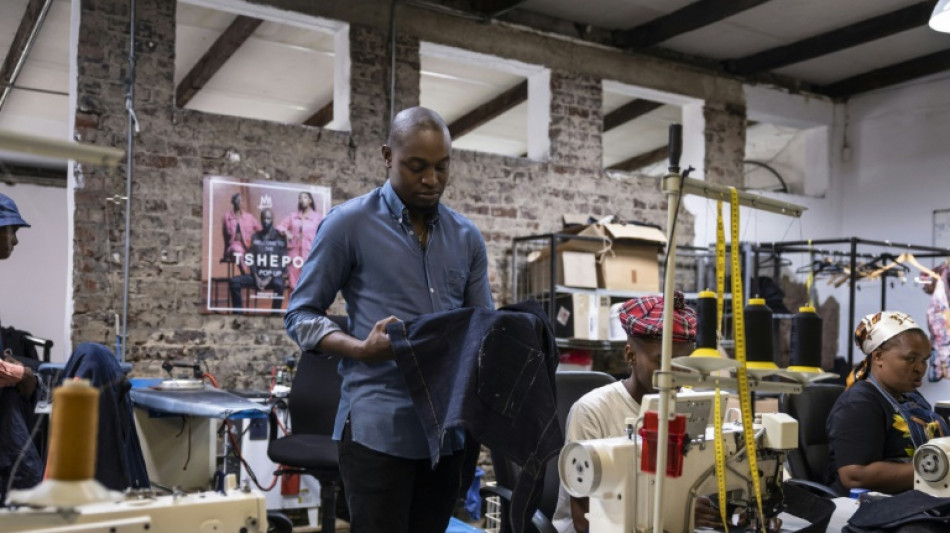
S. Africa's Tshepo Jeans, from township to stars' closets / Photo: © AFP

 South Korea break China hearts to reach Asian Games football final

 Eala storms into Asian Games semi-finals to thrill adoring fans

 Turkey freezes ex-minister's assets as fund crisis grows

 What we know about the North Korean POW dispute

 Most equities rise after oil price plunge, US data in focus

 Polar oceans transformed as warming melts ice habitats: research
 Lost shark becomes viral star in South Korea
 Dangote to launch $16bn refinery in Kenya
 North Korean leader 'extremely obese': Seoul spy agency

 Yankees and pope-backed White Sox start MLB playoffs with wins
 Malaysia's ex-PM Mahathir in hospital for observation

 'No limits': Marathon world record holder Sawe chasing history

 Countdown begins to biggest-ever Rugby World Cup
 Bangladesh women lose ground after quota reform

 Vietnam admits 'differing opinions' on Hanoi development
 Stocks temper gains as oil pares heavy losses, US data in focus

 New Zealand denies breaching climate commitments to EU

 Albert becomes youngest US scorer in 4-2 win over Chile
 Pirate island's plunging population shows Greece's demographic decline
 With elections ahead, Latvia's Russian-speakers reject Moscow's help

 Brazil football clubs face massive sponsorship blow from betting ban
 ChatGPT maker wants to be the App Store for AI as safety concerns grow
 Women fight fires and sexism in Indonesian Borneo

 Forsling's OT blast lifts Florida over Carolina in NHL opener

 Hurricane Polo sweeps over Mexico's Pacific coast, heads inland

Growing up in a rough township outside Johannesburg, Tshepo Mohlala was mocked for wearing skinny jeans before they were popular.
More than a decade later, ridicule has turned into admiration as the 32-year-old is now a successful fashion designer making denim praised by global celebrities including Beyonce and Meghan Markle.
"The township was never ready for my sense of style," he quips, sitting in his atelier in a trendy redeveloped industrial building in Johannesburg.
The South African entrepreneur has made a name for himself in recent years with tailor-made jeans targeting African women who, poorly served by Western brands, struggled to find a perfect fit.
"A whole lot of African women have a tiny waist and big booties and big hips and tiny legs," says Mohlala, a slender man with close-cropped hair and a goatee framing a broad smile.
"We created a range of jeans using raw denim with no stretch that is super tailored for women."
Before they were clients, women were a source of inspiration for Mohlala.
The logo of Tshepo Jeans, his firm, is a stylised crown with three spikes representing the three women who marked his life.
His mother taught him resourcefulness, his grandmother to behave like a gentleman, and a stylish aunt introduced him to fashion.
- 'Dude, listen' -
Later, when he was short of money and forced to drop out of fashion school, it was a fourth woman he was dating who helped him set up his business in 2015.
"She was like: 'Yo, dude, listen, I see you're obsessed with this thing, here is access to 8,000 (rand) and go ahead and start your business'," he recalls.
"I took that loan and went to buy myself some fabric and created the first range of jeans."
The line got traction as he cleverly advertised it on social media, creating anticipation -- "Something big is coming" -- and telling his own story.
Now about 10 tailors sew away behind large windows under the high ceiling of his workshop.
Tshepo Jeans' top range denim is made from cotton produced in neighbouring Zimbabwe, which is then sent to a mill in Japan before being cut and assembled back in Johannesburg.
Many local customers like a light denim "with a bit of stretch" that is "comfortable" and "breathable", making it well suited for the hot African weather, he says.
Personalised pairs sell for around $375, a small fortune in South Africa.
- Royal jeans -
But orders come from all over the world.
In 2019 the brand got a massive boost from Meghan Markle, who bought a pair during a trip to the continent.
"A lot of South Africans at the time would say: 'why would I buy Tshepo?' and then you have the Duchess of Sussex coming here, really calling me and begging, 'I need to get a pair of jeans from you before I leave the country'," Mohlala recalls.
A year later, US pop star Beyonce listed Tshepo Jeans among brands she admired.
"Celebrity endorsement has really helped build our brand and opened up doors for us on a global scale," says Mohlala, sporting a denim shirt and leather shoes.
"He is winning hearts abroad and in South Africa," says denim fanatic Thando Made, who runs a fashion blog about jeans.
Decades ago, jeans were considered a worker's clothing in South Africa, as miners would don overalls when digging gold, copper, coal and other minerals, he says.
Things changed after the advent of democracy with the election of Nelson Mandela as president in 1994.
The country opened up and US and Italian brands finally established themselves, turning denim into urban wear.
"Denim is like religion: you choose the one that works for you," says Made.
"In this space that Tshepo is in, he speaks to somebody who wants to embody the pride of being South African."
M.Ouellet--BTB