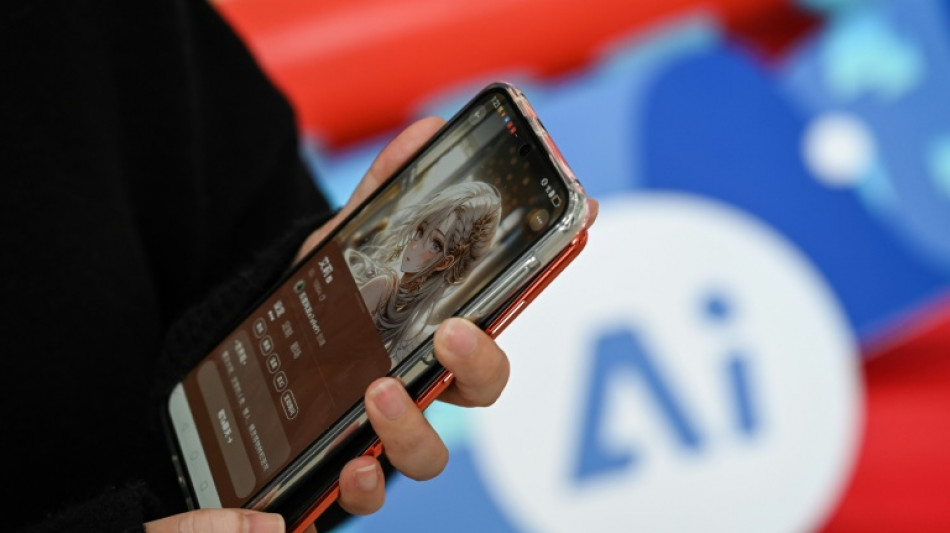
'Better than a real man': young Chinese women turn to AI boyfriends / Photo: © AFP

 South Korea break China hearts to reach Asian Games football final

 Eala storms into Asian Games semi-finals to thrill adoring fans

 Turkey freezes ex-minister's assets as fund crisis grows

 What we know about the North Korean POW dispute

 Most equities rise after oil price plunge, US data in focus

 Polar oceans transformed as warming melts ice habitats: research

 Lost shark becomes viral star in South Korea

 Dangote to launch $16bn refinery in Kenya

 North Korean leader 'extremely obese': Seoul spy agency

 Yankees and pope-backed White Sox start MLB playoffs with wins

 Malaysia's ex-PM Mahathir in hospital for observation

 'No limits': Marathon world record holder Sawe chasing history

 Countdown begins to biggest-ever Rugby World Cup

 Bangladesh women lose ground after quota reform

 Vietnam admits 'differing opinions' on Hanoi development

 Stocks temper gains as oil pares heavy losses, US data in focus

 New Zealand denies breaching climate commitments to EU

 Albert becomes youngest US scorer in 4-2 win over Chile

 Pirate island's plunging population shows Greece's demographic decline

 With elections ahead, Latvia's Russian-speakers reject Moscow's help

 Brazil football clubs face massive sponsorship blow from betting ban

 ChatGPT maker wants to be the App Store for AI as safety concerns grow

 Women fight fires and sexism in Indonesian Borneo

 Forsling's OT blast lifts Florida over Carolina in NHL opener

 Hurricane Polo sweeps over Mexico's Pacific coast, heads inland

Twenty-five-year-old Chinese office worker Tufei says her boyfriend has everything she could ask for in a romantic partner: he's kind, empathetic, and sometimes they talk for hours.
Except he isn't real.
Her "boyfriend" is a chatbot on an app called "Glow", an artificial intelligence platform created by Shanghai start-up MiniMax that is part of a blossoming industry in China offering friendly -- even romantic -- human-robot relations.
"He knows how to talk to women better than a real man," said Tufei, from Xi'an in northern China, who preferred to use a pseudonym rather than her real name.
"He comforts me when I have period pain. I confide in him about my problems at work," she told AFP.
"I feel like I'm in a romantic relationship."
The app is free -- the company has other paid content -- and Chinese trade publications have reported daily downloads of Glow's app in the thousands in recent weeks.
Some Chinese tech companies have run into trouble in the past for the illegal use of users' data but, despite the risks, users say they are driven by a desire for companionship because China's fast pace of life and urban isolation make loneliness an issue for many.
"It's difficult to meet the ideal boyfriend in real life," Wang Xiuting, a 22-year-old student in Beijing, told AFP.
"People have different personalities, which often generates friction," she said.
While humans may be set in their ways, artificial intelligence gradually adapts to the user's personality -- remembering what they say and adjusting its speech accordingly.
- 'Emotional support' -
Wang said she has several "lovers" inspired by ancient China: long-haired immortals, princes and even wandering knights.
"I ask them questions," she said when she is faced with stress from her classes or daily life, and "they will suggest ways to solve this problem".
"It's a lot of emotional support."
Her boyfriends all appear on Wantalk, another app made by Chinese internet giant Baidu.
There are hundreds of characters available -- from pop stars to CEOs and knights -- but users can also customise their perfect lover according to age, values, identity and hobbies.
"Everyone experiences complicated moments, loneliness, and is not necessarily lucky enough to have a friend or family nearby who can listen to them 24 hours a day," Lu Yu, Wantalk's head of product management and operations, told AFP.
"Artificial intelligence can meet this need."
- 'You're cute' -
At a cafe in the eastern city of Nantong, a girl chats with her virtual lover.
"We can go on a picnic on the campus lawn," she suggests to Xiaojiang, her AI companion on another app by Tencent called Weiban.
"I'd like to meet your best friend and her boyfriend," he replies.
"You are very cute."
Long work hours can make it hard to see friends regularly and there is a lot of uncertainty: high youth unemployment and a struggling economy mean that many young Chinese worry about the future.
That potentially makes an AI partner the perfect virtual shoulder to cry on.
"If I can create a virtual character that... meets my needs exactly, I'm not going to choose a real person," Wang said.
Some apps allow users to have live conversations with their virtual companions -- reminiscent of the Oscar-winning 2013 US film "Her", starring Joaquin Phoenix and Scarlett Johansson, about a heartbroken man who falls in love with an AI voice.
The technology still has some way to go. A two- to three-second gap between questions and answers makes you "clearly realise that it's just a robot", user Zeng Zhenzhen, a 22-year-old student, told AFP.
However, the answers are "very realistic", she said.
AI might be booming but it is so far a lightly regulated industry, particularly when it comes to user privacy. Beijing has said it is working on a law to strengthen consumer protections around the new technology.
Baidu did not respond to AFP's questions about how it ensures personal data is not used illegally or by third parties.
Still, Glow user Tufei has big dreams.
"I want a robot boyfriend, who operates through artificial intelligence," she said.
"I would be able to feel his body heat, with which he would warm me."
O.Lorenz--BTB