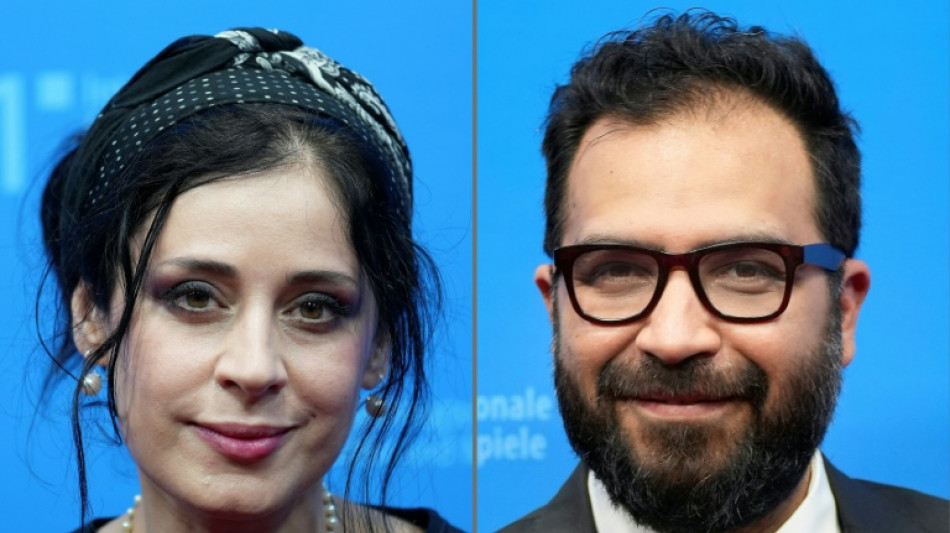
Dissident directors hold up 'mirror' to Iranian women's desire / Photo: © POOL/AFP/File

 South Korea break China hearts to reach Asian Games football final

 Eala storms into Asian Games semi-finals to thrill adoring fans

 Turkey freezes ex-minister's assets as fund crisis grows

 What we know about the North Korean POW dispute

 Most equities rise after oil price plunge, US data in focus

 Polar oceans transformed as warming melts ice habitats: research

 Lost shark becomes viral star in South Korea
 Dangote to launch $16bn refinery in Kenya
 North Korean leader 'extremely obese': Seoul spy agency
 Yankees and pope-backed White Sox start MLB playoffs with wins
 Malaysia's ex-PM Mahathir in hospital for observation

 'No limits': Marathon world record holder Sawe chasing history

 Countdown begins to biggest-ever Rugby World Cup

 Bangladesh women lose ground after quota reform

 Vietnam admits 'differing opinions' on Hanoi development
 Stocks temper gains as oil pares heavy losses, US data in focus
 New Zealand denies breaching climate commitments to EU

 Albert becomes youngest US scorer in 4-2 win over Chile
 Pirate island's plunging population shows Greece's demographic decline
 With elections ahead, Latvia's Russian-speakers reject Moscow's help

 Brazil football clubs face massive sponsorship blow from betting ban
 ChatGPT maker wants to be the App Store for AI as safety concerns grow
 Women fight fires and sexism in Indonesian Borneo

 Forsling's OT blast lifts Florida over Carolina in NHL opener

 Hurricane Polo sweeps over Mexico's Pacific coast, heads inland

Two Iranian directors said they have been barred from travelling to the Berlin film festival for their new movie's premiere Friday for breaking one of their country's biggest taboos: showing a woman pursuing a "normal life".
Maryam Moghaddam and Behtash Sanaeeha told AFP from Tehran that they knew they were playing with fire with "My Favourite Cake", one of 20 films vying for the Golden Bear top prize.
Nevertheless the crackdown came as a shock last autumn.
"They raided our editor's place and took all the hard drives and computers of the project," Sanaeeha, 43, said by videolink, calling the last months "the most stressful time of our life".
"Then when we wanted to leave Tehran to go to Paris to finish the post-production, at the airport they took our passports."
Moghaddam, 52, said their crime was, with the film, "crossing so many red lines which have been forbidden in Iran for 45 years".
"It's about the woman living her life, who wants to have a normal life, which is forbidden for women in Iran."
- 'Plunging necklines' -
The bittersweet story spotlights 70-year-old Mahin, a retired nurse played by acclaimed culture journalist Lily Farhadpour.
After 30 years on her own following her husband's death, Mahin finds a man who catches her fancy while they are both dining alone at a pensioners' restaurant.
When she learns that the man, Faramarz, is a taxi driver, she books a ride with him and boldly sits next to him in the passenger seat.
They strike up a friendly rapport and are soon recalling their more permissive youth -- before the 1979 Islamic Revolution -- when drinking, dancing and "plunging necklines" were part of city life.
Mahin invites Faramarz to her home and, dodging the prying eyes of her neighbours, removes her hijab, pours two tall glasses of wine and pulls out her beloved "oldies" CDs.
"Showing a woman without her hijab is forbidden. But most women, even religious women, are without hijab at home," Moghaddam said.
"Drinking alcohol or dancing or meeting a partner -- everything happens in Iran, but inside the walls because it's forbidden outside. We wanted to be dedicated to reality and show it."
- 'Risk everything' -
The scenes mark "a new thing for Iranian cinema," she said, holding up a "mirror" to a way of life many still long for.
Sanaeeha noted that the case of Mahsa Amini, the young Iranian-Kurdish woman whose custody death sparked months of anti-government protests, came while the film was already in pre-production.
"We were depressed about the situation happening in our country," Sanaeeha said.
"But we talked, all the crew, and we explained (to) them what we are doing in this film -- it's about women, it's about life and it's about freedom. So it was our duty to finish this film."
In a harrowing scene, Mahin confronts officers from the Morality Police arresting young women for not properly covering their hair -- the same offence that put Amini in their crosshairs.
"You'd kill her over a few strands of hair," Mahin screams.
The late-in-life love story of Mahin and Faramarz feels revolutionary as they escape their deeply conservative society's strictures -- at least for one night.
"We wanted to tell a deeper story about life, about seizing the moment," Moghaddam said.
The Berlin film festival, which has long championed Iran's embattled directors, urged authorities to allow the filmmakers to travel. As has become customary, it will leave two seats empty for them at the premiere.
Moghaddam and Sanaeeha's previous film "Ballad of a White Cow", a drama about the death penalty, premiered at the 2021 Berlinale, as the event is known.
They said it has been banned since then in Iran but is available for downloads on European and US platforms.
"With the internet, you cannot censor the art so the film will come out" at home and abroad, Sanaeeh said.
However the stakes for independent filmmakers remain daunting.
"The punishments are so big," Moghaddam said. "You have to risk your career, your income, your everything."
M.Ouellet--BTB