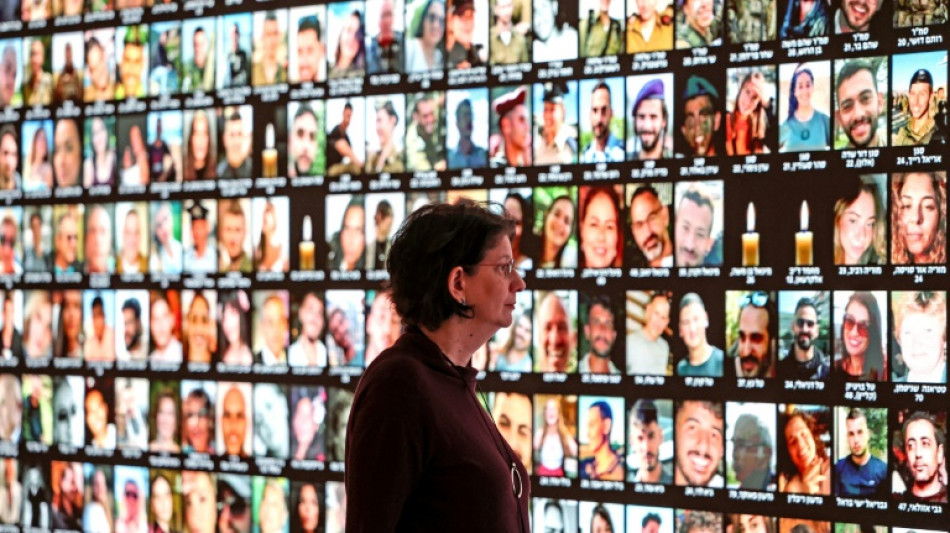
October 7 evidence pieced together in Israel, one terabyte at a time / Photo: © AFP

 In Manchester, people say City scandal is 'shame for football'

 Stocks lacklustre as inflation data weighs on sentiment
 Israel-bound plane rerouted, pilots wounded in reported fight

 Truth commission on Sweden's Sami people seeks redress

 Energy costs spark inflation surges in France, Italy

 South Korea break China hearts to reach Asian Games football final
 Eala storms into Asian Games semi-finals to thrill adoring fans

 Turkey freezes ex-minister's assets as fund crisis grows

 What we know about the North Korean POW dispute

 Most equities rise after oil price plunge, US data in focus

 Polar oceans transformed as warming melts ice habitats: research

 Lost shark becomes viral star in South Korea
 Dangote to launch $16bn refinery in Kenya
 North Korean leader 'extremely obese': Seoul spy agency
 Yankees and pope-backed White Sox start MLB playoffs with wins
 Malaysia's ex-PM Mahathir in hospital for observation
 'No limits': Marathon world record holder Sawe chasing history
 Countdown begins to biggest-ever Rugby World Cup

 Bangladesh women lose ground after quota reform
 Vietnam admits 'differing opinions' on Hanoi development
 Stocks temper gains as oil pares heavy losses, US data in focus
 New Zealand denies breaching climate commitments to EU

 Albert becomes youngest US scorer in 4-2 win over Chile

 Pirate island's plunging population shows Greece's demographic decline
 With elections ahead, Latvia's Russian-speakers reject Moscow's help
Rockets at dawn, gunfire outside, hours of anxiety: a survivor of the October 7 attack shared his account of the day Gaza militants stormed his southern Israeli community, speaking into a video camera.
Arnon Avni's story is one of several hundred witness accounts of the deadly Hamas attack being collected by Israel's national library in partnership with local and international initiatives.
He was speaking recently at Nirim kibbutz, about two kilometres (a mile) from the Gaza Strip, often interrupted by the sound of nearby fighting more than four months into the Israel-Hamas war.
Avni, 70, a graphic designer and caricaturist, said he had spent 10 hours hiding in a safe room with his grandchildren as militants rampaged through the small village, killing five kibbutz residents, kidnapping five others and torching homes.
Three of those captives have been freed, while Nirim -- like most Israeli communities near the Gaza border -- has remained largely deserted since the devastating attack.
Avni, who had spent his entire life in Nirim, chose to return more than a month ago, joining just a handful of kibbutz residents.
"I'm not a hero," Avni told AFP. "It's my place here."
He was sharing his story with volunteers with "Edut 710", or "Testimony October 7", one of several projects gathering witness accounts, online videos, photographs and even WhatsApp messages that tell the story of the attack.
During the interview, Avni recalled a moment of joy, snapping a selfie with his granddaughter on his shoulders right after Israeli soldiers had finally rescued them.
"We were smiling, because we still didn't know what had happened," he said. A few minutes later, he saw other survivors crying at the kibbutz's community centre.
- 200,000 videos -
The "Edut 710" project is one of several dozen initiatives feeding a "massive" database set up by the National Library of Israel, said Raquel Ukeles, the institution's head of collections.
"After October 7, when we recovered from the initial shock and we realised the enormity of the catastrophe that had befallen this country, we started to collect," Ukeles told AFP.
On that day, Palestinian militants breached the heavily militarised Gaza border, launching an attack that resulted in the deaths of more than 1,160 people, mostly civilians, in Israeli towns, villages, army bases, a desert rave and other sites, according to an AFP tally based on official figures.
About 250 Israelis and foreigners were abducted into Gaza, of whom Israel says 130 remain in captivity including two from Nirim. Thirty are presumed dead.
Israel responded with a massive military campaign in the Hamas-ruled Gaza Strip which has killed more than 29,000 people, most of them women and children, according to the territory's health ministry.
Testimonies of the October 7 attack -- the deadliest in Israel's 75-year history -- as well as images of torture and killing captured on Hamas fighters' body cameras and phones were widely shared on social media almost instantly.
Collecting the vast online material was an urgent task "because we realised that they were disappearing", said Ukeles.
In the first three weeks after October 7, the library had received 200,000 video clips, she said.
Ukeles expects a total of around 60 terabytes of material to be collected, analysed and archived -- a task that would take years to complete.
- Battling 'denial' online -
Some of the digital evidence includes messages sent by victims as the attack unfolded.
One of the projects partnering with the national library, "Memorial 710", has also collated some of the frenzy of WhatsApp messages sent by panicked residents moments before they were killed in Beeri kibbutz, the hardest hit community with nearly 100 deaths.
As times passes and the initial shock gradually subsides, more witnesses are willing to speak.
Steven Spielberg's USC Shoah Foundation, one of the Israeli national library's international partners, has recorded the testimonies of about 400 people who had witnessed mass killings and abductions.
It was "a mass atrocity", said Robert Williams, executive director of the foundation and UNESCO chair on anti-Semitism and Holocaust research.
"It's the largest anti-Semitic attack since the Shoah," he said, using another term for the Holocaust.
To him, it is imperative to collect evidence of the brutality of the attack, saying he was "shocked and surprised at how quickly denial of these events began to appear on social media".
Ukeles said that the "massive amount of documentary evidence of what actually happened is in itself the evidence against those who deny".
"If we do our work well", she added, "the people who want to make the case for history can do their work well".
G.Schulte--BTB