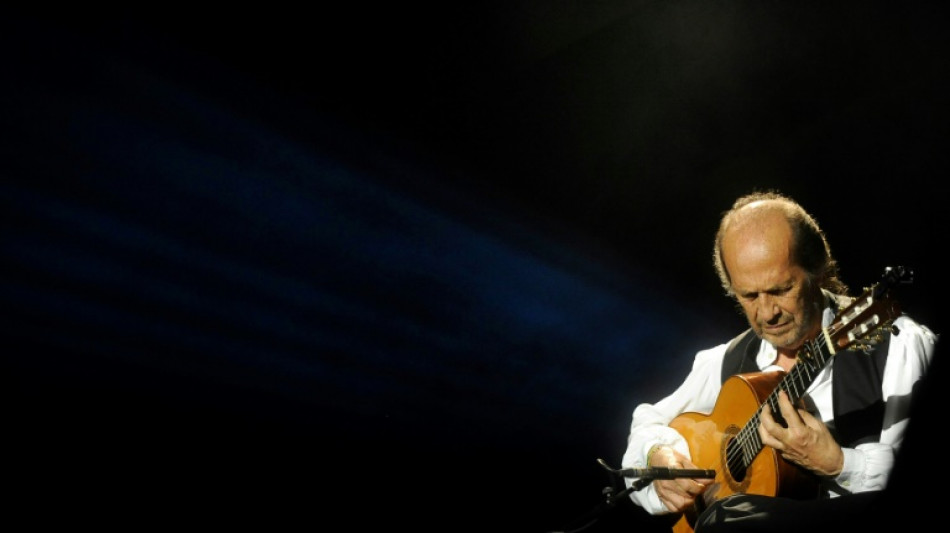
10 years on, the legend of flamenco icon Paco de Lucia lives on / Photo: © AFP/File

 In Manchester, people say City scandal is 'shame for football'

 Stocks lacklustre as inflation data weighs on sentiment

 Israel-bound plane rerouted, pilots wounded in reported fight

 Truth commission on Sweden's Sami people seeks redress

 Energy costs spark inflation surges in France, Italy

 South Korea break China hearts to reach Asian Games football final

 Eala storms into Asian Games semi-finals to thrill adoring fans

 Turkey freezes ex-minister's assets as fund crisis grows

 What we know about the North Korean POW dispute

 Most equities rise after oil price plunge, US data in focus

 Polar oceans transformed as warming melts ice habitats: research

 Lost shark becomes viral star in South Korea
 Dangote to launch $16bn refinery in Kenya

 North Korean leader 'extremely obese': Seoul spy agency
 Yankees and pope-backed White Sox start MLB playoffs with wins

 Malaysia's ex-PM Mahathir in hospital for observation

 'No limits': Marathon world record holder Sawe chasing history

 Countdown begins to biggest-ever Rugby World Cup

 Bangladesh women lose ground after quota reform

 Vietnam admits 'differing opinions' on Hanoi development

 Stocks temper gains as oil pares heavy losses, US data in focus

 New Zealand denies breaching climate commitments to EU

 Albert becomes youngest US scorer in 4-2 win over Chile
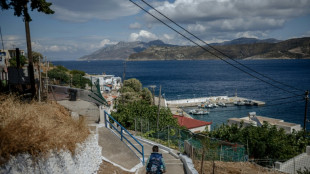 Pirate island's plunging population shows Greece's demographic decline

 With elections ahead, Latvia's Russian-speakers reject Moscow's help

Spanish guitar legend Paco de Lucia, who died 10 years ago on Sunday, couldn't read music but his talent revolutionised flamenco, causing its popularity to spread around the world.
Wherever he played, he filled theatres and concert halls around the world, from London to New York, Paris and Moscow, San Francisco and Tokyo, shattering the image of flamenco as something complex and only of interest to a fringe audience.
"Flamenco was always marginalised in Spain because it was the music of gypsies, of Andalusians, of poor and working-class people," he once said, referring to the southern Andalusia region where was born and raised.
But his virtuosity brought the dramatic rhythms and passion of flamenco to the most prestigious music halls and this week, the main tribute event was held in New York's Carnegie Hall, bringing together the world's best flamenco artists with others like Panamanian salsa legend Ruben Blades.
The secret of de Lucia's success was his capacity "to make beautiful melodies and then dress these up with the best harmonies," guitarist Jose Carlos Gomez told AFP in the southern port town of Algeciras.
"That's why Paco is so popular both with music connoisseurs and ordinary people."
He died of a heart attack on February 25, 2014 at the age of 66 while he was "playing with his children on the beach" at Playa del Carmen in the Mexican Caribbean where he had a house, reflecting his love of the sea, swimming and fishing.
Such were the passions he had growing up in Algeciras where he was born in 1947, spending his childhood in places like El Rinconcillo beach where AFP met Gomez, a close friend of the family, whose own latest album "Las Huellas de Dios" ("God's Fingerprints") is a tribute to his idol.
It was here that de Lucia used to frequent a beachfront bar called Casa Bernardo where he would drink beer and eat fried fish, which inspired him to write a rumba by the same name.
- ' Born to play guitar' -
Born Francisco Sanchez Gomez to a Portuguese mother and a Spanish father, he was known as Paco -- the short form of Francisco -- "de Lucia" meaning "of Lucia", his mother.
Growing up in a gypsy neighbourhood, it was his father, also a guitarist, who introduced him to music and encouraged him to practise for hours.
When he was eight, his father put a guitar in his hands and told him: "I can't send you to school, I can't teach you a career, the only thing I can give you is this guitar," he once said in an interview. The same thing happened to his brothers, Ramon and Pepe, who also went on to have careers in flamenco.
De Lucia took to it so well that it was as if he had "been born to play the guitar," says Gomez, saying he was such a natural that he could concentrate on experimenting and composing more than others.
By the time he was 12, he was earning at flamenco "tablaos" -- the intimate bars that are home to the authentic form of the tragic gypsy lament and dancing. Despite having no formal training, he moved to Madrid at 15 and by 18 had released his first album.
He was the first flamenco artist to obtain a chart topper with his instrumental rumba "Entre dos aguas" which was released in 1973 and saw him bringing flamenco closer to jazz with a sextet including wind instruments and an electric bass, in a major break with tradition.
Also revolutionary was his introduction of a cajon, a Peruvian box drum instead of two or three palmeros (rhythmic clappers) which made flamenco "more acoustic" and "more intimate in terms of staging", explains top percussionist Paquito Gonzalez who recorded an album with him.
- 'Orphaned by his death' -
When de Lucia played in Madrid's Teatro Real in 1975, it stoked controversy for being the first flamenco performance in the Spanish capital's prestigious opera house, but also because he played with crossed legs rather than the traditional posture with the guitar resting on one leg, steeply angled upwards.
He was like "one of those explorers with a machete in hand who went into the Amazon and began cutting down branches and making a path," guitarist Jose Quevedo 'Bolita' told AFP at Pena La Buena Gente, a club in Jerez de la Frontera that draws flamenco fans, of which there are many across Andalusia.
And it was after one drunken night in Jerez that de Lucia and the singer Camaron de la Isla decided to work together, going on to produce several legendary albums.
When Paco de Lucía "became a global star, almost without realising it, he created what is now the flamenco industry", says Quevedo.
"It was a total turning point which brought about the 'professionalisation' of flamenco, creating a more rewarding life for many artists", he said.
And when he died, "the flamenco world felt very orphaned", says dancer Monika Bellido who runs a flamenco academy in Algeciras.
"The whole world loved Paco."
G.Schulte--BTB