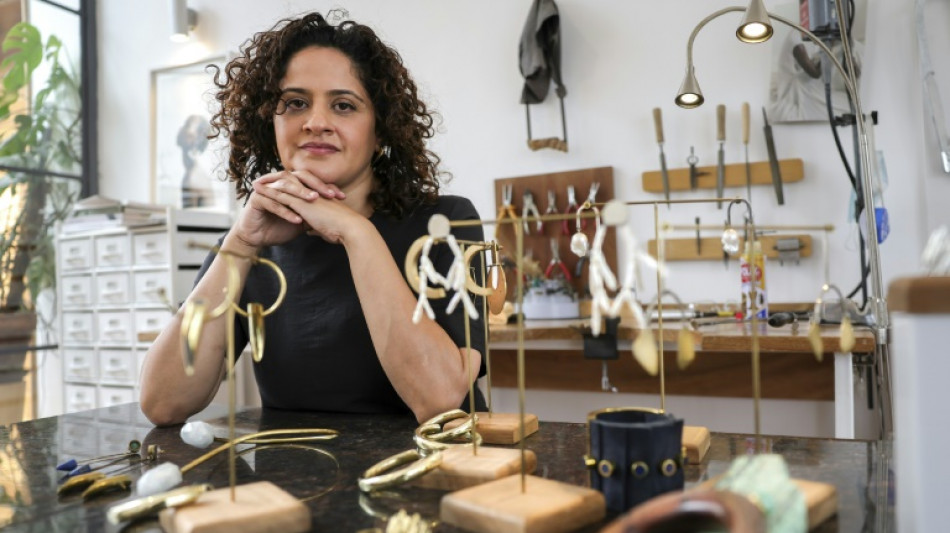
Ropes, brass, salt, stone: Reinventing jewellery in Kenya / Photo: © AFP

 Oil companies close in on Venezuela despite hurdles
 Turkey freezes ex-minister's assets as fund scandal grows

 Guardiola backs Man City after bombshell guilty verdicts

 G20 trade ministers open talks under strain of Trump tariffs

 France in talks with UK to end 2025 migrant accord: ministry

 Europe's surging inflation spreads gloom in stock markets

 Truth commission demands compensation for Sweden's Sami people
 Japan win marathon penalty shootout to set up South Korea gold-medal clash

 Djokovic grinds out opening-round win at China Open

 Northern Ireland police probe blockade of disputed parade

 UK PM Burnham reopens divisive debate on rejoining EU

 Man City future in doubt after guilty verdict
 'Do something,' begs Iranian woman after death sentence over protests

 China extends 52-year unbeaten record as Games organisers say sorry
 In Manchester, people say City scandal is 'shame for football'

 Stocks lacklustre as inflation data weighs on sentiment

 Israel-bound plane rerouted, pilots wounded in reported fight

 Truth commission on Sweden's Sami people seeks redress

 Energy costs spark inflation surges in France, Italy

 South Korea break China hearts to reach Asian Games football final
 Eala storms into Asian Games semi-finals to thrill adoring fans

 Turkey freezes ex-minister's assets as fund crisis grows

 What we know about the North Korean POW dispute

 Most equities rise after oil price plunge, US data in focus

 Polar oceans transformed as warming melts ice habitats: research

Sisal ropes, salt crystals, volcanic rocks and aged brass: award-winning Kenyan designer Ami Doshi Shah has always chosen unlikely materials to make sophisticated jewellery that redefines value in a carat-obsessed industry.
"As a child, I was always finding beauty in unusual things like stones and fossils," Shah, 44, told AFP in an interview at her rooftop studio in Kenya's capital Nairobi, where she crafts her pieces by hand.
Her 2019 collection Salt of the Earth featured ropes, salt crystals and patinated blue-green brass, and was showcased in exhibitions at London's Victoria and Albert Museum and New York's Brooklyn Museum.
But despite earning a university degree in jewellery and silversmithing in the British city of Birmingham and the prestigious Goldsmiths award for best apprentice designer, Shah said it took her years to fully commit to her metier.
A third-generation Kenyan of South Asian origin, she interned at Indian jewellers such as The Gem Palace, whose patrons have included Princess Diana, Oprah Winfrey and Gwyneth Paltrow.
Traditional Indian ideas of jewellery as a luxury investment did not resonate with her. And she wasn't wholly sure of how to marry her experimental sensibility with commercial pressures.
So Shah joined an advertising firm and spent the next 12 years there, working in London and Nairobi.
"I knew it wasn't my calling," she said.
She took a sabbatical during her second pregnancy and began a year-long artist residency at the non-profit Kuona Trust in Nairobi in 2014-15.
It was a cathartic period, yet one also "filled with self-doubt", she said.
"I was worried whether people would like my work... it is hard to accept that you might not be a commercial success, especially when you have spent so many years focused on making money."
- Personal and political -
She established her brand in 2015, with a view to creating bold, sculptural pieces that reflect the talismanic role of jewellery in Kenyan culture, where it is used in rites of passage, for protection and to imbue the wearer with strength.
Her body of work ranges from sisal neckpieces to cuffs inlaid with stones and brass earrings that sway with every movement.
A striking departure from the precious metals and gemstones that dominate traditional Indian jewellery, her design process is driven by materials found in Kenya and every piece is made to order.
She uses brass -- which dominates Kenya's jewellery landscape -- but also materials such as leather, mango wood and zoisite, a cast-off from ruby mining in the East African country.
The result is jewellery that is deeply personal and sometimes political, with prices ranging from $75 to $375.
"Not everyone's going to love my work, not everyone's going to understand it and that's ok," she said, emphasising that she approaches jewellery-making as "a labour of love", not a business venture.
Her acclaimed 2019 collection explored salt's dual nature as a life-giving mineral that is also destructive and corrosive.
It also reflected on Britain's colonial past, with punitive salt taxes prompting Mahatma Gandhi to stage a historic protest march in 1930 in the Indian state of Gujarat, where Shah's grandparents emigrated from.
"That was the first time I felt like jewellery could be political, like it could be a thread connecting so many things," she said.
- 'Tell our own story' -
Her latest collection Memento Mori was born out of grief, reflecting on the loss of her father in 2021 and their final days together in the Indian Ocean town of Watamu along Kenya's coast.
Even though her work is sold and celebrated in the West,her focus is firmly on the continent she calls home, both as the inspiration and the market for her refined designs, which are stocked in boutiques in Nigeria, Ghana, South Africa, Ivory Coast and Kenya.
"I feel far more Kenyan than Indian," she said, urging her South Asian-origin compatriots to embrace integration, instead of finding safety in self-segregation, decades after the traumatic 1972 expulsion of South Asians from Uganda.
With recent forays into furniture, her dream is to build a multi-disciplinary studio with "predominantly Kenyan" designers.
"It's important to be able to tell our own story in our own way instead of having a narrative projected onto us."
N.Fournier--BTB