Ramadan culinary traditions defy crisis to bring Libyans together / Photo: © AFP

 Oil companies close in on Venezuela despite hurdles

 Turkey freezes ex-minister's assets as fund scandal grows

 Guardiola backs Man City after bombshell guilty verdicts
 G20 trade ministers open talks under strain of Trump tariffs

 France in talks with UK to end 2025 migrant accord: ministry
 Europe's surging inflation spreads gloom in stock markets

 Truth commission demands compensation for Sweden's Sami people

 Japan win marathon penalty shootout to set up South Korea gold-medal clash

 Djokovic grinds out opening-round win at China Open

 Northern Ireland police probe blockade of disputed parade

 UK PM Burnham reopens divisive debate on rejoining EU

 Man City future in doubt after guilty verdict

 'Do something,' begs Iranian woman after death sentence over protests
 China extends 52-year unbeaten record as Games organisers say sorry

 In Manchester, people say City scandal is 'shame for football'

 Stocks lacklustre as inflation data weighs on sentiment

 Israel-bound plane rerouted, pilots wounded in reported fight

 Truth commission on Sweden's Sami people seeks redress

 Energy costs spark inflation surges in France, Italy

 South Korea break China hearts to reach Asian Games football final

 Eala storms into Asian Games semi-finals to thrill adoring fans

 Turkey freezes ex-minister's assets as fund crisis grows

 What we know about the North Korean POW dispute

 Most equities rise after oil price plunge, US data in focus

 Polar oceans transformed as warming melts ice habitats: research

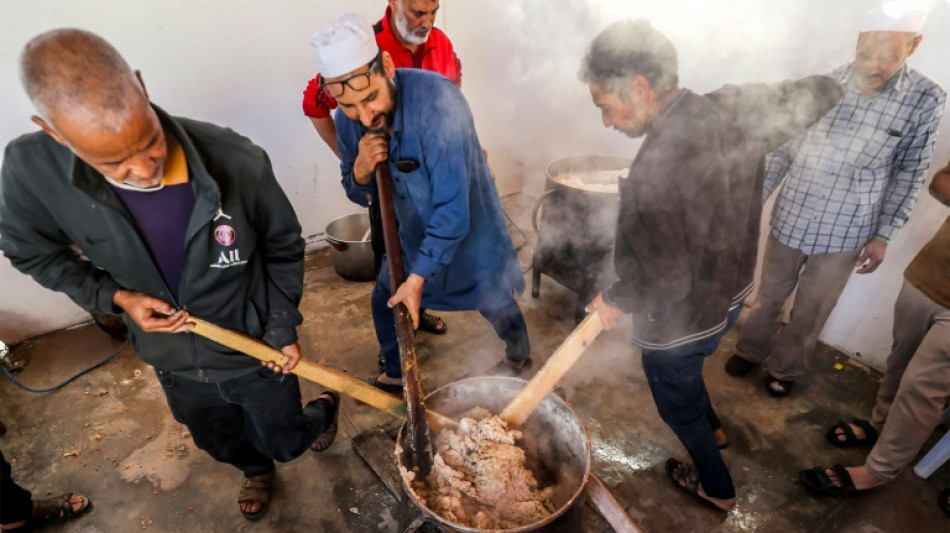
Dressed in tracksuits with their sleeves rolled up, about 30 residents in Tajura, a suburb east of Libya's capital, volunteer every day to cook and give away some 300 meals during Ramadan.
The men of all ages join efforts to make Bazin -- a Libyan barley-based dough served with a stew -- as part of a campaign coupling social solidarity with culinary tradition to provide free meals for people fasting during the Muslim holy month.
Akin to Italian polenta or West African fufu, bazin, an originally Berber dish, is a classic family meal from Tripolitania, the historic northwestern region of Libya.
It is also a symbol of sharing for Libyans, typically eaten by hand from a shared platter around which guests sit on the ground.
"In the old days, this dish was limited to the homes" where it was prepared by women and served "to relatives and neighbours," said Salem Omrane, a chef at the initiative which took shape after the 2011 uprising that overthrew longtime dictator Moamer Kadhafi.
"We offer these meals to everyone who comes," the 60-year-old told AFP.
Next to him, men in groups of three revolve around a large pot with long sticks in hand, mixing the barley flour in boiling salted water.
Once cooked, for at least an hour, the steaming-hot dough is kneaded and divided into smaller pieces, which are turned into dome-like shapes, then placed in a bowl with a stew of beans, tomatoes and spices.
Meat, once essential, is absent due to its soaring prices. But the volunteers make do.
"We went from a saucepan to a pot, then from a pot to two, and now we serve between 300 and 400 meals per day," said Issam al-Tayeb, a 57-year-old resident of Tajura who came to help.
- Doughnuts -
In the capital Tripoli, around 22 kilometres (14 miles) away, another culinary delicacy is making a resurgence this Ramadan: sfinz, a deep-fried, soft doughnut made with leavened dough, usually filled with an egg or dipped in honey.
Once an affordable street food eaten on the go, sfinz has become a luxury for many Libyans amid the soaring cost of living.
The country is still struggling to recover from the years of war that followed the death of Kadhafi in 2011.
The North African country remains split between two rival administrations in Tripoli, in the west, and Benghazi in the east.
Despite having the continent's largest oil reserves and abundant natural gas deposits, enduring instability has undermined the economy and weighed heavily on the standard of living in Libya.
"Customers buy within their means," said Mohamad Saber, who runs a sfinz shop on the outskirts of Tripoli.
"Today, a tray of eggs costs 20 dinars (around $4), which has raised the price of egg sfinz to 3.5 dinars" from just a few pennies, he said.
Saber, a Tunisian who has lived and worked long enough in Libya to master its dialect, said "life for Libyans is hard now".
Sfinz merchants like Saber have traditionally come from neighbouring Tunisia, home of the popular bambalouni doughnut, but in recent years they have become scarce in Libya.
Now they are staging a comeback, despite competition from hamburger and shawarma vendors, for those who can afford it.
Young and old queue up in front of Saber's small shop.
"It smells very good," Mohamad al-Bouechi, a 69-year-old customer, said with a playfully remorseful tone.
"But to be honest with you, it's not ideal for your health."
K.Thomson--BTB