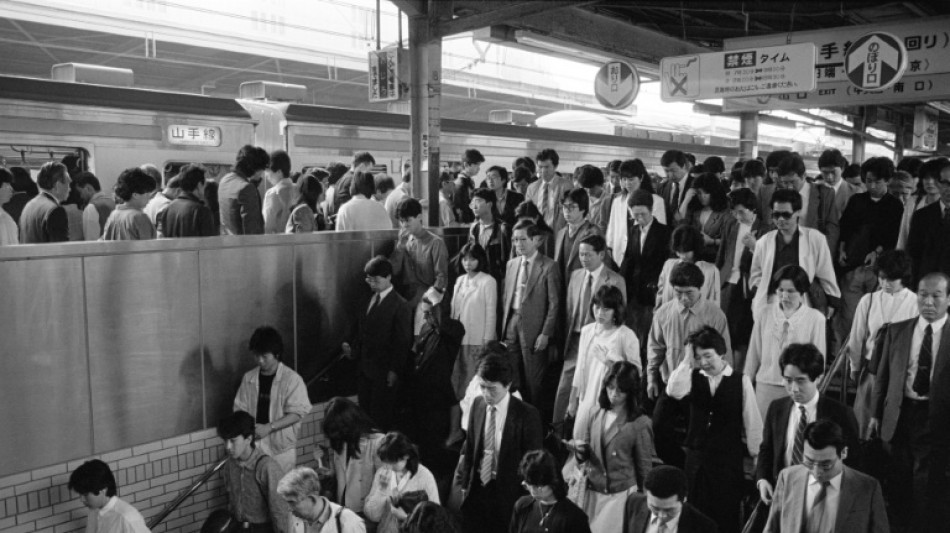
Hit TV satire reveals how Japanese society has changed / Photo: © AFP

 Oil companies close in on Venezuela despite hurdles
 Turkey freezes ex-minister's assets as fund scandal grows

 Guardiola backs Man City after bombshell guilty verdicts

 G20 trade ministers open talks under strain of Trump tariffs

 France in talks with UK to end 2025 migrant accord: ministry

 Europe's surging inflation spreads gloom in stock markets

 Truth commission demands compensation for Sweden's Sami people
 Japan win marathon penalty shootout to set up South Korea gold-medal clash

 Djokovic grinds out opening-round win at China Open

 Northern Ireland police probe blockade of disputed parade
 UK PM Burnham reopens divisive debate on rejoining EU

 Man City future in doubt after guilty verdict
 'Do something,' begs Iranian woman after death sentence over protests

 China extends 52-year unbeaten record as Games organisers say sorry

 In Manchester, people say City scandal is 'shame for football'
 Stocks lacklustre as inflation data weighs on sentiment

 Israel-bound plane rerouted, pilots wounded in reported fight

 Truth commission on Sweden's Sami people seeks redress

 Energy costs spark inflation surges in France, Italy

 South Korea break China hearts to reach Asian Games football final

 Eala storms into Asian Games semi-finals to thrill adoring fans

 Turkey freezes ex-minister's assets as fund crisis grows

 What we know about the North Korean POW dispute

 Most equities rise after oil price plunge, US data in focus

 Polar oceans transformed as warming melts ice habitats: research

A time-travelling TV comedy with a bawdy middle-aged hero has become a big hit in Japan, juxtaposing the country's brash 1980s boom years with its more politically correct present day.
In the series, titled "Extremely Inappropriate", the past isn't rose-tinted: there's smoking on the bus, boobs on television and corporal punishment galore.
But modern Japan doesn't get a free pass either.
When schoolteacher and father Ichiro Ogawa is catapulted from 1986 to 2024, he scandalises millennials and Gen Z-ers with his disregard for their views on gender, family and labour rights.
Implicit in his candid words is a question: is society today, with its good intentions around issues like diversity and work-life balance, really all it's cracked up to be?
The show's satire of how Japan has changed over the decades has struck a chord with viewers young and old.
Last month, it became the first programme made by major broadcaster TBS to top Netflix's most-watched list in Japan for three weeks running.
Producer Aki Isoyama, who is 56, initially thought it would be "very challenging" to poke fun at today's progressive values without triggering a backlash from the public.
The show isn't meant as a verdict on the superiority of one era over the other, she told AFP.
But one inspiration for her and screenwriter Kankuro Kudo, 53, was the idea that "life has become more difficult in some aspects today".
"Our society has certainly gotten better, but in a way more restrictive, too, with everything dictated by compliance and protocols," Isoyama said.
Today, when something is pronounced unacceptable, "we often unquestioningly accept that explanation and refrain from saying or doing it," she added.
"The show will hopefully make viewers stop and ask themselves: 'Why was it banned in the first place?'"
- Harassment and sexism -
One 25-year-old fan, Mao Yamada, said the show is a reminder that "our society has become more accepting of diversity, including LGBTQ rights".
"It's good we're now more mindful of things like sexual harassment," she told AFP, adding that she understands why some might feel "too many things are perhaps restricted and kept unsaid".
Workplace pep talks to Gen-Z hires are denounced as harassment in "Extremely Inappropriate", and an exasperated TV producer tries to censor everything said on air.
Meanwhile, freewheeling Ogawa -- who in his own bygone world yells "grow a pair!" at male students and teases women about menopause -- is lambasted by today's generation, including a feminist sociologist.
He is enlightened on the concepts of gender neutrality and sexual consent. Marriage, he learns, is no longer the definition of happiness.
Viewer Kyo Maeda, 68, called the show's 1980s scenes an accurate portrayal of "what our everyday life used to be like".
"Our life was full of what could easily be seen as harassment and sexism by today's morals," he told AFP.
In 1986, Japan was basking in the glow of its post-war evolution into an economic superpower, with many workers fixated on success, no matter the hours required.
On "Extremely Inappropriate", young recruits -- a generation shaped by Japan's "lost decades" of stagnation from the early 1990s -- matter-of-factly clock off on time.
In the 80s, "I loved going to work, you know," Maeda reminisced, chuckling. "The economy was still picking up and we were all-out at work."
"I feel like there was more hope and excitement about the future in the 80s than there is now," he said.
- Bold themes -
"Extremely Inappropriate", whose final episode airs Friday, has received its share of criticism in the real world.
Some say concepts like feminism or discrimination based on appearance are oversimplified, and that political correctness is treated as little more than a shackle on free speech.
Interspersed throughout the show are musical performances and jokey disclaimers excusing Ogawa's gaffes and insults.
But beneath the levity is a serious message, said Takahiko Kageyama, a media studies professor at Doshisha Women's College of Liberal Arts.
"The creators obviously wanted us to reflect on the status quo of our society," he told AFP.
"But if this intent had come off too straightforward or preachy, it would've just fallen flat."
The show's themes are "bold" given the sensitive landscape of Japan's entertainment industry today, he said.
Boy-band empire Johnny's and Associates faced an existential crisis last year over a sexual abuse scandal involving its late founder.
Allegations of workplace bullying have also disgraced the prestigious theatre troupe Takarazuka Revue.
Producer Isoyama said that making the show in parallel with these events had sometimes felt uncanny.
"With Johnny's and Takarazuka, it was like facts far stranger than fiction were unfolding around us," she said.
But "this made us feel that the timing of the release would be fitting, considering how the industry is changing, the way it should".
B.Shevchenko--BTB