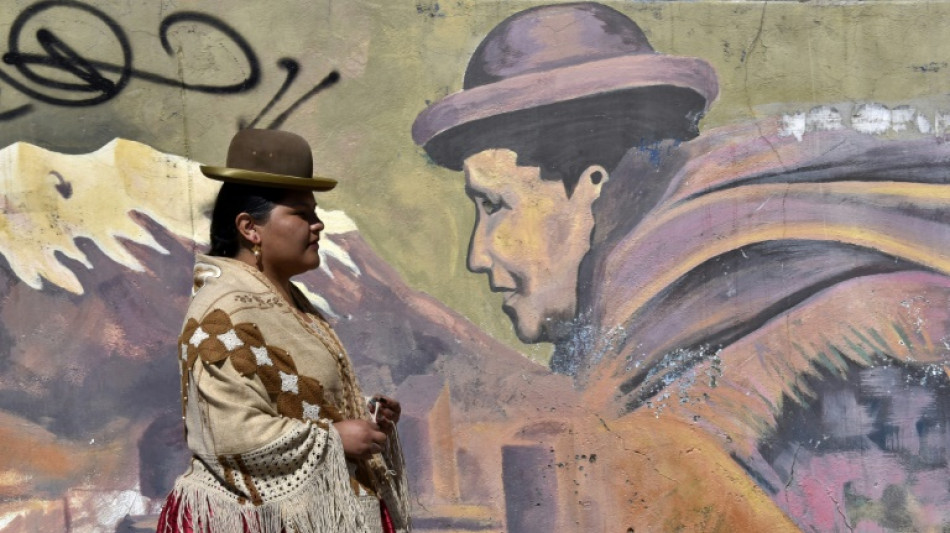
Alwa: the Indigenous Bolivian rapper breaking down barriers / Photo: © AFP

 Far-Right Extremists Claim Opportunity to Seize Control of GOP After Midterms

 New Campaign Highlights Knowledge Gaps on Carbon Monoxide Safety Among Americans

 JR East Launches 'teppay' to Integrate Suica Balance with Mobile Payments

 Phil Spencer on Housing Market Fairness: How Buyers and Sellers Navigate Falling Prices

 Beirut Cinema Festival Draws Thousands Despite War Fatigue

 AMD Forecasts First-Ever Revenue Lead Over Intel on AI Chip Surge

 GoodData.AI Launches the Agentic Serving Plane, a New Category of Enterprise Data Infrastructure for AI Agents

 Abu Dhabi Demand Response Project Achieves 401 MW Peak Reduction in 2025

 Panthers expected to begin 2027 NRL season away from new stadium
Alwa stands rigidly in front of a microphone, wearing a traditional puffy "pollera" skirt, a picture of serious concentration as Andean panpipe music starts up in the background.
The scene is set for a typical melancholic traditional Bolivian song but suddenly, the 26-year-old breaks out into a rap, lifting up her arms with jerky hand movements.
Alwa says she is the first Aymara rapper from Bolivia and one day wants to make a living from her voice.
"I don't care if people like my music. Just tell my mother that fear won't stop me. She won't beat me. Tell her also that I'm going to live off rap," she sings in her first song, "Endless Beginning."
Alwa, whose name means "dawn" in the Aymara language, has just performed her second concert in the atrium of La Paz's public university.
Her first album should come out in the middle of this year, she tells AFP.
Born in El Alto, the sprawling satellite town overlooking La Paz, Alwa is the first indigenous woman to dedicate herself to a style of music that has little in common with the melancholic sounds of traditional songs.
"In my lyrics I express my feelings about things, my opinion about the things we're going through right now, we've all suffered injustice," she tells AFP.
Even though indigenous people make up almost half of Bolivia's population, the community's women, or "cholas" still face discrimination and disdain from some parts of society.
"I think rap comes from this, feeling this rebelliousness, rebelling against something you disagree with, but it has to be coherent," says Alwa, who only uses her first name.
- 'Lifting up the name of Bolivia' -
Born into a traditional family, Alwa's mother "does not like rap" and her father wants her to continue studying marketing and advertising at the public university of La Paz.
But, she says, her "dream was always to sing."
During her performance at the university, a group of around 50 people approach the stage, lifting up their arms and applauding.
"She's great, she's an incredible artist, in her being, in the way she dresses," says Jesus Choque, 23, a student who is hearing Alwa for the first time.
"This is the first time I've seen a woman in a pollera singing on a stage, lifting up the name of Bolivia, it's awesome, it's really beautiful," adds Carlos Jonas Sirpa.
Alwa is starting to make a name for herself, and even gets stopped in the street by people wanting to take a selfie with her.
"She's brilliant, I heard her for the first time in Chile, I thought she was Peruvian but it turns out she's Bolivian, I saw her on Tik Tok and she's great," says Kevin Coronel, 22.
Alwa, though, believes she has a long way to go to emulate her rap heroes Warrior from Peru and Argentine Alika.
"I'm in the process of becoming a rapper, I'm not there yet," she says.
But she's adamant that there is no turning back from here.
"What I really want now is to make music."
D.Schneider--BTB
