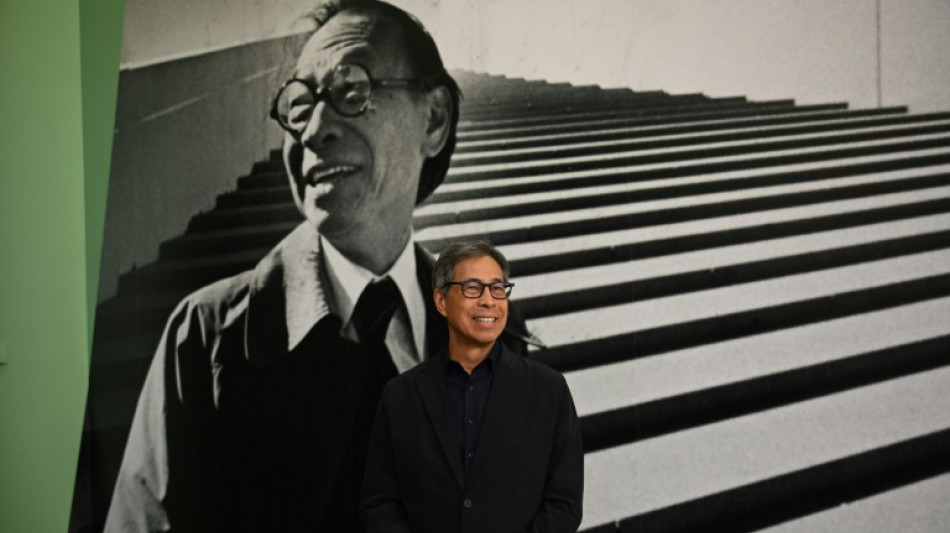
Hong Kong museum celebrates life of architect I.M. Pei / Photo: © AFP

 In Manchester, people say City scandal is 'shame for football'
 Stocks lacklustre as inflation data weighs on sentiment

 Israel-bound plane rerouted, pilots wounded in reported fight

 Truth commission on Sweden's Sami people seeks redress

 Energy costs spark inflation surges in France, Italy

 South Korea break China hearts to reach Asian Games football final
 Eala storms into Asian Games semi-finals to thrill adoring fans

 Turkey freezes ex-minister's assets as fund crisis grows

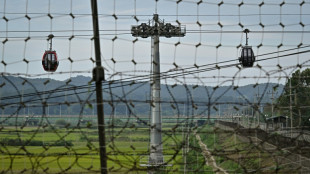 What we know about the North Korean POW dispute

 Most equities rise after oil price plunge, US data in focus

 Polar oceans transformed as warming melts ice habitats: research

 Lost shark becomes viral star in South Korea

 Dangote to launch $16bn refinery in Kenya

 North Korean leader 'extremely obese': Seoul spy agency

 Yankees and pope-backed White Sox start MLB playoffs with wins
 Malaysia's ex-PM Mahathir in hospital for observation

 'No limits': Marathon world record holder Sawe chasing history
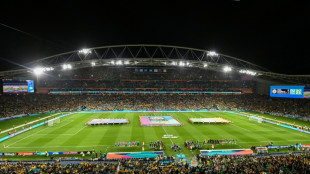
 Countdown begins to biggest-ever Rugby World Cup

 Bangladesh women lose ground after quota reform

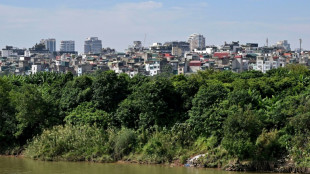 Vietnam admits 'differing opinions' on Hanoi development

 Stocks temper gains as oil pares heavy losses, US data in focus
 New Zealand denies breaching climate commitments to EU

 Albert becomes youngest US scorer in 4-2 win over Chile

 Pirate island's plunging population shows Greece's demographic decline

 With elections ahead, Latvia's Russian-speakers reject Moscow's help

More than 30 years after I.M. Pei reshaped Hong Kong's skyline with a jagged tower of steel and glass, the Chinese-American architect is once again the talk of the town as a museum celebrates his life and legacy.
From the controversial Louvre Pyramid in Paris to the Bank of China Tower in Hong Kong, Pei created world landmarks that blended modernity with history, often using stark structures and sharp lines.
His work earned the 1983 Pritzker Prize, considered architecture's Nobel. Of his nearly 50 designs in the United States and abroad, more than half won major awards.
"He had a unique career... having been able to work with world leaders and do buildings of significance," his son Sandi Pei told AFP.
"The projects that he did are of a consequence, a scale and a reputation that is very difficult to match."
Pei, who died in 2019 at age 102, is the focus of a retrospective at Hong Kong's M+ museum that opens Saturday after seven years of preparation.
The exhibit features over 400 objects, from original drawings and photographs to architectural models and Pei's trademark round glasses.
Pei became a household name in the United States after being commissioned for the John F. Kennedy Library in 1964, with the president's widow reportedly won over by Pei's charisma.
His star rose even further when French president Francois Mitterrand in 1981 tapped Pei for the Grand Louvre project, with his design for a giant glass pyramid infuriating Parisians at first.
"My father was very charming," said Sandi, also an architect. "He always said you don't pick your projects, you pick your clients -- but not everybody can pick Francois Mitterrand or Jacqueline Kennedy."
- 'Community' via architecture -
Born in southern China in 1917, banker's son Ieoh Ming Pei spent his childhood in Hong Kong before moving to the United States in his late teens to study architecture.
After graduating from the Massachusetts Institute of Technology and Harvard University's Graduate School of Design, Pei began his career working for a real estate developer.
Pei's cross-cultural heritage had been an asset, bringing Chinese elements of "family, community and landscape" to the West -- paired with a love for early modernist art and sculpture, according to Sandi.
His early urban housing projects honed his method, emphasising each location's "time, place and purpose" over ostentatious style.
"One of the things that I did learn from my father is you just don't come with an idea and plop it onto the site," Sandi said. "The design comes from within."
In the 1980s, Sandi worked with his father on the Bank of China Tower, a design made up of four triangular shafts with a blade-like silhouette -- which continues to stand out amid Hong Kong's forest of high-rises.
Pei is also admired in China. He set up a scholarship fund for Chinese students to study the craft in the United States, on the condition they return home to design and build.
Chinese architects today can still draw lessons from Pei's thoughtful, analytical approach, said Sandi, adding that the country holds great potential.
But construction often moves forward at breakneck pace and "China needs to slow down, be more careful and deliberate," he told AFP.
"They will find that the buildings (that are) better built will last longer, serve their communities better and will not be so wasteful of resources."
Despite being larger-than-life monuments, Pei's works are about harmony between a community and its environment, Sandi said -- an aspect highlighted in the Hong Kong show.
"That's why his buildings will continue to survive and be appreciated, because I think people enjoy being within them, because he enjoyed the opportunity to bring community together through his architecture."
Y.Bouchard--BTB