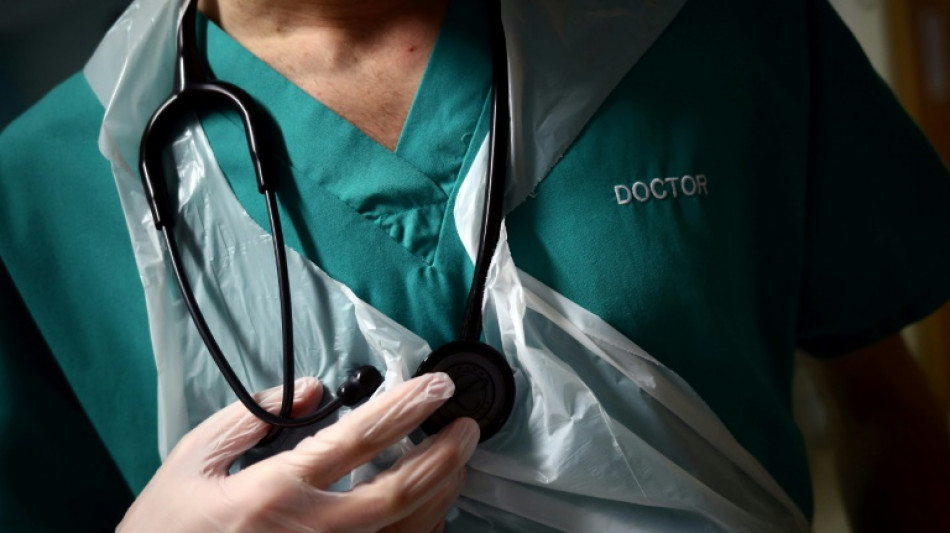
Beware 'deepfakes' of famous doctors promoting scams: experts / Photo: © POOL/AFP/File

 Brazil football clubs face massive sponsorship blow from betting ban

 ChatGPT maker wants to be the App Store for AI as safety concerns grow

 Women fight fires and sexism in Indonesian Borneo

 Forsling's OT blast lifts Florida over Carolina in NHL opener

 Hurricane Polo sweeps over Mexico's Pacific coast, heads inland

 Grynspan pulls ahead in race to lead UN: diplomat

 Trump touts AI boss pledge to self-regulate
 Oil down, but stocks lower as bond yields rise

 England break down stubborn Czechs to claim first Nations League win
 UN Security Council extends Haiti anti-gang force by 6 months

 Manchester City guilty of Premier League charges: What comes next?
 Man City chief Soriano slams Premier League 'conspiracy theory'
 Hurricane Polo sweeps over Mexico's Pacific coast

 Man City must be relegated after guilty verdict says club's former chairman

 German far-right aims to lead Saxony-Anhalt govt in December

 Little damage as Hurricane Polo sweeps over Mexico's Pacific coast
 Manchester City guilty of breaking financial rules - Premier League

 FIFA boss Infantino blasted as would-be 'emperor' by UEFA's Ceferin
 Stocks move lower despite oil prices dropping

 AI driving up innovation investment: UN

 UN Security Council extends Haiti mission by 6 months
 Man Utd do not deserve medals if Man City stripped of titles: Rooney

 Vana Completes Expanded Staking as Part of the Vega Upgrade, Publishes Expanded VANA Token Economics

 Spain to cap gas price hikes, extend fuel discounts

 'We just need rain': Germany's Rhine river hits new low

Social media is being flooded by digitally created "deepfake" videos using the trusted identities of famous doctors to promote dangerous miracle cures for serious health problems, experts warn.
Videos on Facebook and Instagram have taken advantage of the credibility of star TV doctors to advertise untested "natural" syrups for diabetes, even claiming that the proven, first-line drug metformin "could kill" patients.
These scams risk endangering lives, experts said, particularly because they deploy the likenesses of popular health experts such as British TV presenter Michael Mosley, who died earlier this year.
"People do seem to trust these videos," British doctor John Cormack told AFP.
"A lot of these media doctors have spent a great deal of time creating an image of trustworthiness, so they are believed even when they make incredible claims," said Cormack, who has worked with the British Medical Journal (BMJ) on the subject.
Artificial intelligence (AI) expert Henry Ajder said that doctor deepfakes "really took off this year".
The AI videos typically target older audiences by faking the identity of doctors who appear regularly on daytime television, Ajder said.
French doctor Michel Cymes, who often appears on TV in France, told AFP in May that he was taking legal action against Facebook owner Meta about "scams" using his image.
British doctor Hilary Jones even hired an investigator to track deepfakes that featured his likeness.
One video depicted Jones selling a false cure for high blood pressure -- as well as weed gummies -- on a UK TV show on which he regularly appears.
"Even if they're taken down, they just pop up the next day under a different name," Jones lamented in the BMJ.
- 'Game of cat and mouse' -
Recent advances in AI have made the quality of deepfake images, audio and video far more convincing, explained French academic and AI expert Frederic Jurie.
"Today we have access to tens of billions of images, and we are able to build algorithms that can model everything that appears in the images and regenerate them. This is what we call generative AI," he said.
It is not just the likenesses of widely respected doctors being misused.
The appearance of controversial French researcher Didier Raoult -- who has been accused of spreading misleading information about Covid drugs -- has also been used in several deepfake videos.
Australian naturopath Barbara O'Neill, who has been roundly condemned for claiming that baking soda can cure cancer, has been falsely depicted selling pills that "clean blood vessels" in TikTok videos.
Contacted by AFP, her husband Michael O'Neill deplored that "a lot of unethical people" were using his wife's name "to sell products that she does not recommend, and in some cases they are just outright scams".
Some fake videos spiral even further down the rabbit hole, falsely claiming that O'Neill died from a miracle oil sold on Amazon.
AI expert Adjer was not surprised that such controversial health figures were also falling victim to deepfakes.
"They are highly trusted by people in circles that, let's say, are unorthodox or conspiratorial," he said.
The experts were not optimistic that newly developed AI detection tools were capable of fighting back against the onslaught of deepfakes.
"It's a game of cat and mouse," Jurie said.
Rather than trying to find all the fake videos out there, he pointed to technology that can "guarantee that content has not been altered, such as for messaging, thanks to software that produces digital signatures like a certificate", he said.
L.Janezki--BTB