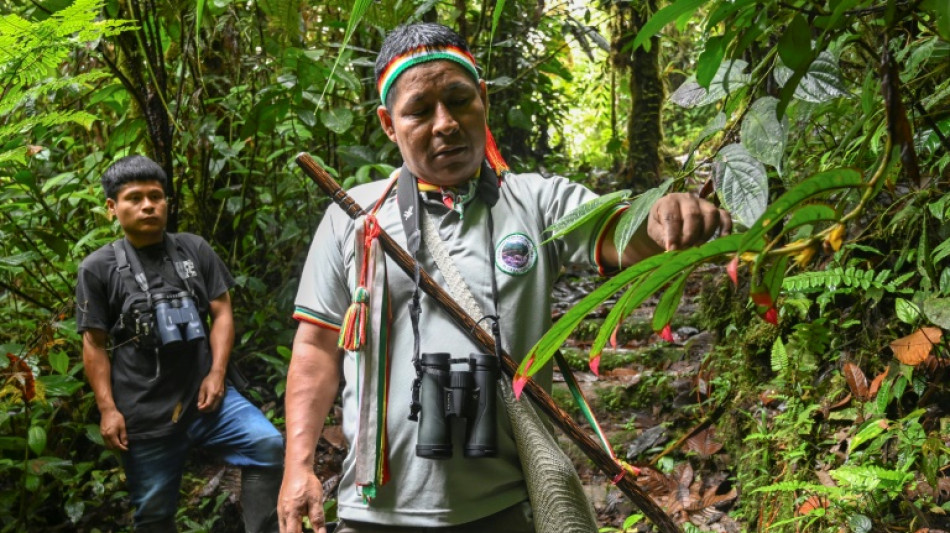
Colombia's Awa people resist violence, maintain 'spiritual bond' with nature / Photo: © AFP

 Spain brush aside Croatia in Nations League, England down Czechs

 Trump hails 'morally binding' AI self-regulation pledge

 Yamal inspires Spain to Croatia romp on World Cup homecoming

 UN to hold fourth informal poll of secretary-general candidates
 Who are the Emiratis behind crisis-hit Manchester City?

 Singer Angelique Kidjo urges Africans to 'create together'

 Alleged Rihanna mansion shooter mentally fit for trial, says judge
 Mystery over UK airbase scare as police find petrol not explosives

 OpenAI unveils low-cost AI model, a day after shelving Astra upgrade

 Premier League confirms Man City guilty of serious financial breaches
 Brazil's Lula turns to Bad Bunny tune to criticise Trump ahead of polls

 Nigerian dancer eyes world record after seven-day marathon

 Swiss regulator concludes Julius Baer bank probe
 Brazil's patron saint pulled into latest election scrap

 Football overload leaves players near 'breaking point', warns Tebas
 Paris Eiffel Tower says chief to step down after uproar over removing women staff

 Amaze Holdings (NYSE: AMZE) Executes Binding LOI to Acquire BullionFX | Alchemy, a Decentralized Gold-Backed Financial Ecosystem for Valued at US$155 Million

 Clashes between French teens, police as school blockades intensify

 Stocks move sideways despite oil moving lower
 African leaders to gather in Egypt for business summit
 UK decides against charging foreign visitors for museums

 Dallaglio to sell England World Cup winners' medal

 Brazil come from behind to beat Australia 4-2 in friendly

 Ruthless An retains Asian Games badminton crown as Kunlavut triumphs

 Alonso to stay with F1 team Aston Martin in 2027
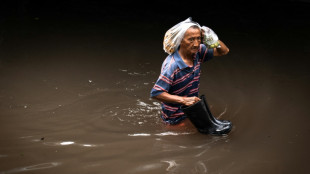
The Awa of Colombia are an Indigenous people who have been threatened by armed groups in the country's southwestern rainforests for decades, but insist on protecting the environment they say they are "connected" to.
As environmental policy leaders gather for a major biodiversity meeting in the South American nation, the Awas embody the struggle for survival of native peoples and the defense of the jungle.
"The Awa people have been resisting for 500 years. Against invasion, discrimination, armed groups, forced recruitment and displacement, acculturation," said Olivio Bisbicus, one of the leaders of this community of nearly 50,000.
"Being an Awa chief is complicated and dangerous," he said. "Drug trafficking brings vice, territorial disharmony and the destruction of our culture and nature."
The group's full name, Inkal Awa, means "People of the jungle" in their ancestral language.
They live in the mountainous rainforest of Colombia and in neighboring Ecuador.
"Three armed groups are fighting over this strategic border region, a drug trafficking corridor to the Pacific" that is also dotted with illegal gold mines, Alex Javier Gonzalez, an official with the Narino governorate, told AFP.
The situation is "critical for the Awas," he said.
- 'Risk of extinction' -
The Colombian justice system has documented 25 years of violence against the Awas, who have been caught up in the conflict with the FARC guerrilla army, warning of a "risk of physical, cultural and spiritual extermination."
Between 1990 and 2016, the guerrillas killed 185 Awas. The murders continued after a 2016 peace agreement.
At least 22 members of the group were killed in 2022, including a prominent leader who was shot dead by the men with whom he was supposed to negotiate.
Many of Colombia's Indigenous communities "are at risk of extinction" due to pressure from criminal groups involved in drug cultivation and trafficking, Jan Egeland, secretary general of the Norwegian Refugee Council, told AFP.
"The violent competition for the land is so fierce," he said.
In early 2023, the ombudsman's offices of Colombia and Ecuador issued a joint warning regarding the future of the Awa people.
The Colombian Constitutional Court has repeatedly called for their protection.
But fresh violence claimed the lives of three more Awa men at the end of August, according to Unipa, an organization representing them.
"And yet they are holding on," Gonzalez said. "The Awas have managed to maintain control over their lands."
- 'Spiritual bond' -
Gilles Bertrand, the European Union ambassador to Colombia, describes their group's struggle as "emblematic."
"They show great courage," he said.
Armed with only sticks and an ethos of non-violence, the Unipa Indigenous guard, made up of 2,000 volunteers, works to protect nature.
"In the face of weapons, we are empty-handed. But we have dialogue, and our ancestral knowledge, our identity, our authorities, our presence here for centuries," Bisbicus said.
"We have been able to maintain the unity of our people, and demand respect for our territory. Our land is not a battlefield," he added.
The Awas are also characterized by what they call a "spiritual bond" with their land.
"The territory is a living space, where we coexist with nature, animals and spirits. Nature is our mother," said Wilmer Rigoberto Bisbicus, a coordinator in Nutria, a private nature reserve.
At almost 1,000 meters (3,300 feet) above sea level, La Nutria hides an enchanting waterfall overlooking a lush valley.
"Here it rains a lot. This water is life," said Alvaro Pai, a guide at the reserve.
"The waterfall listens and heals you," he said.
Described by the European Union's ambassador as an "ambitious peace and ecotourism project," Nutria's 365 hectares are home to 185 species of birds, butterflies and frogs.
"We must take care of the earth, because we come from it, learn from it, and we will return to it," Olivio Bisbicus said.
"The further we move away from it, the more we harm ourselves."
M.Odermatt--BTB