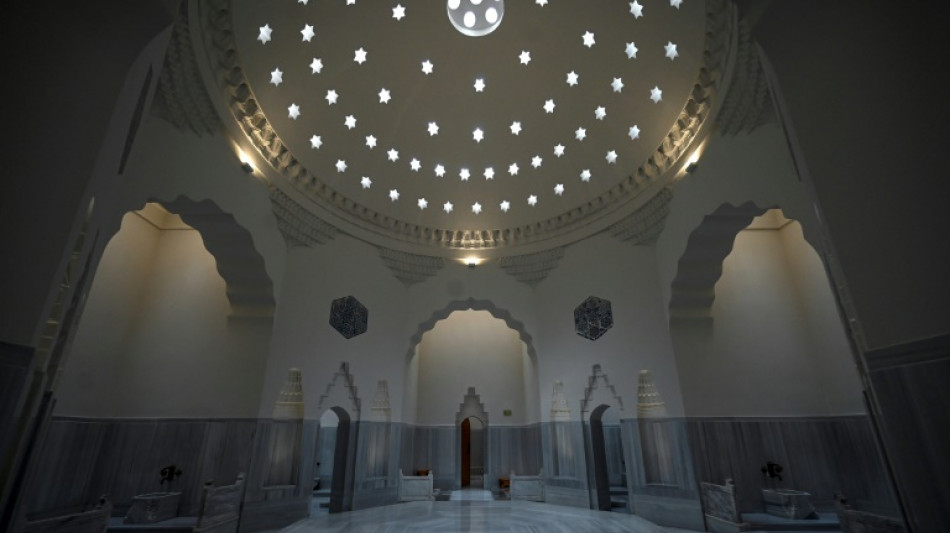
Istanbul's historic baths keep hammam tradition alive / Photo: © AFP

 UN to hold fourth informal poll of secretary-general candidates
 Who are the Emiratis behind crisis-hit Manchester City?

 Singer Angelique Kidjo urges Africans to 'create together'

 Alleged Rihanna mansion shooter mentally fit for trial, says judge

 Mystery over UK airbase scare as police find petrol not explosives

 OpenAI unveils low-cost AI model, a day after shelving Astra upgrade

 Premier League confirms Man City guilty of serious financial breaches

 Brazil's Lula turns to Bad Bunny tune to criticise Trump ahead of polls

 Nigerian dancer eyes world record after seven-day marathon

 Swiss regulator concludes Julius Baer bank probe

 Brazil's patron saint pulled into latest election scrap

 Football overload leaves players near 'breaking point', warns Tebas
 Paris Eiffel Tower says chief to step down after uproar over removing women staff

 Amaze Holdings (NYSE: AMZE) Executes Binding LOI to Acquire BullionFX | Alchemy, a Decentralized Gold-Backed Financial Ecosystem for Valued at US$155 Million

 Clashes between French teens, police as school blockades intensify

 Stocks move sideways despite oil moving lower
 African leaders to gather in Egypt for business summit

 UK decides against charging foreign visitors for museums

 Dallaglio to sell England World Cup winners' medal

 Brazil come from behind to beat Australia 4-2 in friendly

 Ruthless An retains Asian Games badminton crown as Kunlavut triumphs

 Alonso to stay with F1 team Aston Martin in 2027
 China badminton 'still strong' despite Asian Games slump

 'Exceptional' Turner painting shown in Rome before sale
 European stocks climb as oil dips

For centuries, hammams were central to Ottoman society, and while they fell out of use in Turkey with the advent of running water, many are being restored to revive an ancient ritual bathing tradition.
Often featured in older Turkish films, hammam scenes are highly entertaining, with women not only bathing but enjoying these historical bathhouses as a place to socialise, eat, drink and even dance.
Last year, the 500-year-old Zeyrek Cinili Hammam -- built during the reign of Suleiman the Magnificent by the celebrated Ottoman architect Sinan -- reopened to the public after a painstaking 13-year restoration.
Alongside a functioning hammam, it also houses a museum explaining its history and the Ottoman ritual of bathing.
"The restoration somehow turned into an archaeological dig" that gave insight into how the hammam once looked, museum manager Beril Gur Tanyeli told AFP.
"Around 3,000 pieces of missing tiles were found which helped solve the puzzle of why this hammam was called Cinili" -- Turkish for "covered with tiles".
The beautiful Iznik tiles that once lined its walls were exclusively produced for the hammam, with no other bathhouse having such a rich interior, museum officials say.
Although most were damaged by fires or earthquakes, or sold off to European antique dealers in the 19th century, some are still visible.
The restoration also exposed several Byzantine cisterns beneath the hammam.
"Sinan the Architect is believed to have built the hammam on top of these cisterns to use them as a foundation and as a source of water," Tanyeli said.
- From cleansing to celebration -
In ancient Rome, bathing culture was very important and it was "traditional for traders to wash before entering the city, especially in baths at the (city) entrance," archaeologist Gurol Tali told AFP.
During the Ottoman empire, bathing culture had its golden age, with the ritual symbolising both bodily cleanliness and purity of soul.
In Islam, a Muslim must wash before praying, in an act known as ablution.
Hammams were also a place for celebrating births and weddings.
"Baths were used not only for cleansing the body but for socialising, relaxing, healing and even celebrating important life events," with special rites for brides, soldiers and those who had undergone circumcision, Tali said.
Since households at the time did not have running water, hammams were an essential part of life until the 19th century, with census figures from 1638 showing there were 14,536 public and private baths in Istanbul, the museum says.
And that tradition has survived until today.
"You come here to get clean and leave handsome," said Zafer Akgul, who was visiting one of the city's hammams in the city with his son, telling AFP he visited often, particularly during religious feasts or for a wedding.
"We don't want this tradition to die."
- 'Passing on cultural heritage' -
That is where Istanbul's ancient hammams can serve a bigger purpose, Tali said.
"Restoring historical baths in Istanbul and putting them to use may be the most effective way to transfer cultural heritage to future generations," he said.
Another nearby bath house from the same era, the Beyazid II Hammam, underwent years of restoration and reopened as a museum in 2015.
One of the largest hammams in the city at the time, some historians believe it was where a notorious male bathing attendant, or "tellak", called Halil plotted an uprising that in 1730 overthrew Sultan Ahmed III.
For Manolya Gokgoz, who does publicity for Cemberlitas Hammam, another 16th-century bathhouse built by the royal architect Sinan, the connection is more personal: her grandmother worked there as a "natir" -- a woman's bathing attendant.
"When I was two or three years old, I would go to the baths in the morning, wash and play by myself until the evening without getting bored," she told AFP.
For Gokgoz, the tradition lives on -- although mostly among tourists, which for her is a shame.
"In the past, we used to go to the hammam with our mothers and grandmothers. Now 70 percent of our customers are foreign tourists and 30 percent locals," she said.
These days, the hammam experience -- which lets bathers relax in hot, warm or cool pools alongside extras like massages or peeling -- is quite expensive, with the basic service costing around $100.
Celebrities, both Turkish and international, often visit Cemberlitas, with the last being Spanish actor Pedro Alonso -- the character Berlin in the Netflix hit "Money Heist" -- who visited in September.
"Hammam is not a luxury, but a need," Gokgoz said.
"Yes, it's not like in the past because we have hot water at our fingertips, but we need to keep this tradition alive."
L.Janezki--BTB