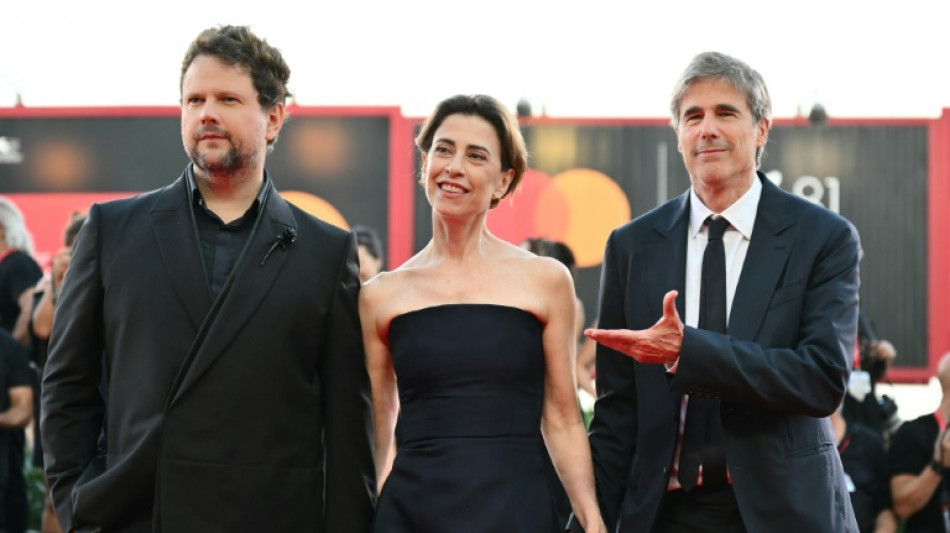
'I'm Still Here': an ode to Brazil resistance / Photo: © AFP/File

 Spain to cap gas price hikes, extend fuel discounts

 'We just need rain': Germany's Rhine river hits new low
 Yemen health system at 'breaking point': WHO

 Ireland undecided on second Israel match: coach

 France's Le Pen defiant after top ally hit by antisemitism claims

 Tom Cruise trades stunts for satire as toxic tycoon 'Digger'

 MEXC Unveils "WE SEE YOU" Brand Visual Refresh, Putting People Behind Every Trade in Focus
 Thai capital cleans up after deadly floods

 NATO, EU allies rally to Estonia after 'sabotage' blamed on Russia

 Families demand justice for Cameroon's 'nightmare' wave of murdered women

 Tebas says Man City should face 'most severe' sanctions if guilty of rule breaches
 Pochettino calls Man City success 'a period of deception'

 Settler attack on West Bank village injures Israeli forces, drawing rare rebuke

 Mystery over UK airbase scare after reports no explosives found
 Spanish govt races to adopt housing law under protest pressure

 Estonia slams Russian 'sabotage' after arson attack on defence company
 Slovenia sees surge in '.si' sites after Trump hypes 'super intelligence'

 'Like a dream' for An as Games organisers 'sorry' for latest mix-up
 Tokyo suffers longest streak of rainy days on record

 Indonesia charges train driver over crash that killed 16 women
 Ruthless An makes history to retain Asian Games badminton crown
 Australian central bank lifts key interest rate to 15-year high
 Polo makes landfall in Mexico as Category 3 hurricane
 South Korea team latest to be bussed to wrong Asian Games venue

 Bears thrash Eagles 27-7 as third-string QB Keenum shines
"I'm Still Here," Brazil's hope for Oscars glory, focuses on the country's military dictatorship years (1965-1985) but is also very much "a film about the present," its lead actress Fernanda Torres told AFP.
The movie, which won for best screenplay at the 2024 Venice film festival, has proved popular with Brazilian audiences, and scores a lofty 90 percent on the Rotten Tomatoes review aggregation website.
The Oscar nominations will be announced on January 17. "I'm Still Here" is on the shortlist to compete in the Best International Film category. It is also up for a Golden Globe award on Sunday.
The movie is based on the true story of Rubens Paiva, a leftist politician who disappeared under the dictatorship he opposed.
It looks at the fight his wife Eunice Paiva waged to find out what happened to him after he was abducted by regime agents in 1971.
Brazil's military dictatorship was responsible for the deaths and disappearances of more than 400 people, according to the National Truth Commission that investigated its rights violations.
With "I'm Still Here," director Walter Salles makes a return after a decade-long absence, and amid much anticipation after the critical success of his 1998 film "Central Station" and 2004's "The Motorcycle Diaries."
Torres's own mother, 95-year-old Oscar nominee Fernanda Montenegro, makes an appearance at the end of the film portraying an elderly Eunice Paiva.
Here is what Salles and Torres told AFP about the film in a joint interview as Hollywood's awards season kicks into high gear:
- Past and present -
Salles: "When we started the project in 2016, we thought it would be an opportunity to look at the past to understand where we come from. But given the far right's rise in Brazil, from 2017, we realized the film also works to understand the present."
Torres: "It's a film about the present. We had a president (Jair Bolsonaro, between 2019 and 2022) who praised a regime torturer and believed the military saved Brazil from communism.... Whoever sees the film thinks, 'This is wrong, there was no reason to persecute this family'."
- Reception abroad -
Salles: "In international festivals we got similar reactions as in Brazil, because we're not the only country seeing how fragile democracy is, or living or having lived through the trauma of having an extreme right wing.
"Sean Penn saw the film the day of Donald Trump's election, and when he presented it in Los Angeles, he said Eunice Paiva's smile was an example of resistance for what's coming in the United States."
Torres: "We live in a volatile world, where new technologies are changing social relationships. In moments like these, we see an uptick in a desire for an authoritarian government to bring back order.
"Through the perspective of this family, the film shows what that means in a country with a violent government that suspends civil rights."
- Flashbacks -
Salles (on the 1970s setting): "These were memories of my teenage years. My girlfriend around age 13 or 14 was friends with one of Paiva's daughters so I spent a lot of time with them.
"In their house, it was another world, with free political discussion, where you could talk about censored books and records, where you dreamed of a more inclusive country."
"But I also discovered a violence I didn't know about. The day Rubens was abducted, never to be seen again, left a stark impression when everything changed for everybody who was in that microcosm. Whatever innocence we had we lost that day."
- Oscars nomination -
Salles: "Awards work to bring more people in to see movies, so I'm happy in that sense. If it happens (that we get nominated), it would be great. If not, life goes on. My principle is that someone who is optimistic is badly informed."
I.Meyer--BTB