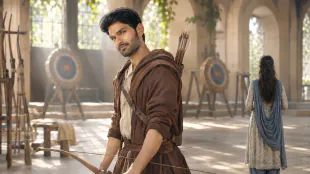
Gael Garcia Bernal retells Philippines history in new film / Photo: © AFP

 Info Edge’s Naukri Hits Rs 240 Crore Annualized AI Revenue Run Rate

 Honda Recalls 635,000 Vehicles Over Software-Induced Power Steering Failure

 Digi Power X Reports Q3 2026 Revenue Up 85% and AI Revenue Up Over 400% Compared to Q2

 Below Deck alumnus João Franco and brother arrested after fatal Turkey fight

 Ole Miss inquiry expands after video and monkey-noise allegations

 Senators Push for Sports Betting Ad Ban as Bill S-211 Advances

 London museum removes Russell Brand hair exhibit after rape conviction

 RBI Gold Loan Rules 2026: Key Changes for Auctions, Renewals, and Valuation

 Kylie Jenner employee describes closet ordeal and pepper-spray incident

Mexican actor Gael Garcia Bernal stars in a new film which re-examines the discovery of the Philippines by European explorers and questions the existence of a national resistance hero.
"Magellan", which premiered at the Cannes film festival on Sunday, is the latest feature from Filipino director Lav Diaz, who acknowledges he is tackling sensitive issues.
The film takes its title from Portuguese explorer Ferdinand Magellan, played by Bernal, who set sail in the early 1500s across the Atlantic in search of Far East riches.
"He is the first European to be able to set foot in the Philippines. And at the same time, the conversion (to Christianity) of the Filipinos started with him," Diaz told AFP.
"And, of course, colonisation eventually."
Magellan, who was sponsored by the Spanish crown, died at the Battle of Mactan on April 27, 1521, killed in combat by warriors said to be led by Lapulapu.
Diaz puts forward a theory in his film that Lapulapu, who is now revered for his resistance, was in fact an invention of Humabon, the monarch of a neighbouring island.
The Battle of Mactan "was a trap" for the explorer, who was told that people on Mactan island were resisting the arrival of Christianity.
"No-one ever saw Lapulapu," Diaz says, adding that his conclusions are based on "years of research" into this key episode in Philippine history.
Evidence for him is only found in the writings of Antonio Pigafetta, an Italian who accompanied Magellan and whose testimony Diaz considers unreliable.
"There will be people who accuse me of revisionism," added the Filipino filmmaker, who won the Golden Lion top prize in Venice in 2016 for "The Woman Who Left".
Diaz is part of the "slow cinema" movement, which has a contemplative and minimalist style.
He has described his film-making as a way for his fellow citizens to find their national identity after centuries of colonisation by Spain and the United States.
Known for his lengthy works -- he once said his movies were so long no-one would buy them -- this latest feature is a relatively brisk two hours and 40 minutes.
"I'm just an observer. I don't like being an intruder," he said of his directing style.
His longest film runs to 11 hours and his 2016 entry for the Berlin film festival "A Lullaby to the Sorrowful Mystery" was eight.
Diaz's filmmaking is strongly influenced by his tumultuous childhood, growing up in the conflict-plagued southern town of Datu Paglas.
His parents, both state school teachers, uprooted themselves from the peaceful north to teach children in war zones how to read and write.
H.Seidel--BTB