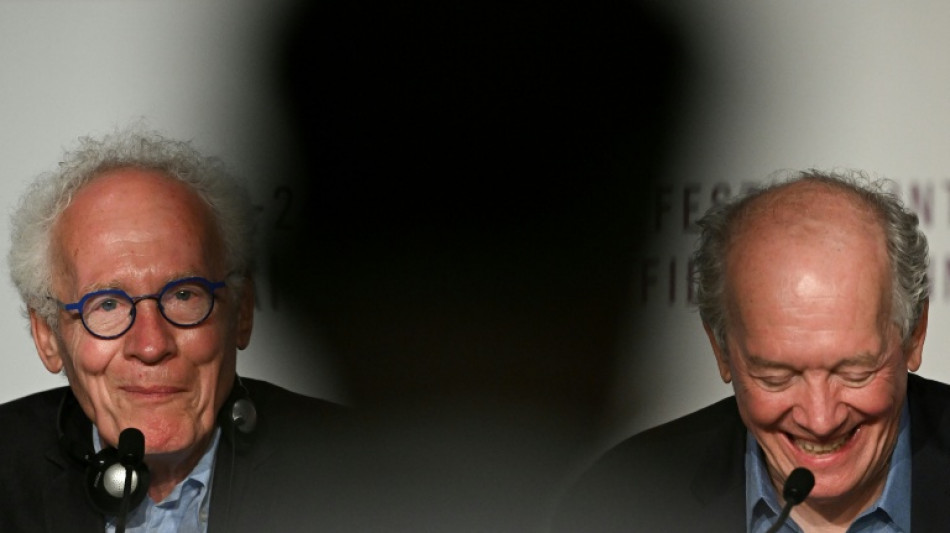
'Outstanding' Dardenne brothers teenage mothers movie has Cannes in tears / Photo: © AFP

 North Dakota Enacts Bipartisan Insulin Price Cap Amid National Push

 Readers Question Naughty Dog’s ‘Intergalactic’ Hype and GTA 6 Marketing Strategy

 Westminster Council Unanimously Rejects Green Party Motion in 'Zionism is not racism' Vote

 Kingfishr Announces UK and European Spring Tour Following April Album Release

 General Hospital actor Randall England dies at 75

 Bunnie XO artwork taken down from Jelly Roll’s Nashville bar
 Arlington sentinel rebukes Pete Hegseth entourage for laughter near memorial

 Yella Beezy sentenced to life for arranging rapper Mo3’s murder

 Authorities to identify Montauk Mary and five other Long Island cold-case victims

 Over-75s Face 25% Surge in Emergency Department Delays

 João Franco’s earlier post draws attention after arrest over fatal Turkey brawl

Belgian brothers Jean-Pierre and Luc Dardenne, whose inspiring new film "Young Mothers" is vying for the top prize in Cannes, said they wanted to show young women defying the fate that was forced on them.
Set at a shelter for underage mothers, it follows five teenagers as they learn to look after their babies with the help of kind nurses and social workers.
The film shows how each of them frees "themselves from a destiny... that has been imposed on them, and the journey they have to go on to free themselves of this fate that has been chasing them since childhood," Jean-Pierre Dardenne told AFP before its premiere in Cannes on Friday.
The brothers, already two-time Palme d'Or winners, visited a similar shelter as part of research for another film.
"It's really the place that made us decide to make this film," Jean-Pierre Dardenne said.
"When I say place, it's also the young women, the educators, the psychologist, the director who drew us in, what was happening there, what we felt," he added.
"It's as if the place, these people, said: 'Tell our stories.'"
The film has received rave reviews, and on Friday won the unofficial Positive Cinema Prize for the most upbeat film in the main competition.
The Guardian newspaper called it "quietly outstanding" and gave it a rare five-star review, while Variety said it could be mistaken for a documentary and called it "the duo's most convincing film yet".
In the movie, Naima leaves the shelter to start life as a single mother.
But Julie, a former addict, is still struggling to find her feet, while heavily pregnant Jessica is desperately trying to renew ties with the woman who gave her up as a teenager.
Perla and Ariane are striving to become better examples to their babies than their own alcoholic mothers.
- 'Babies just do their thing' -
"They are individual destinies," said Luc Dardenne.
"What we were interested in was to tell the stories of five people going through five different things, even if of course it's always linked to a relationship with a child."
The film "looks at how social history, poverty, the fact that your own mother abandoned you, weighs down on each character... and how to fight this," he said.
The brothers said filming most scenes with real babies had forced them to work differently.
"Babies don't know that they're being filmed. So babies just do their thing," said Luc Dardenne.
"So we said to ourselves that we would try to have one take, just one take, and be happy with it. Sometimes we had to do two takes," he said.
"I must admit that the takes weren't the same thanks to the babies, which gave a different pace to the film."
Asked how they felt about reducing even the most hardened critics to tears at the screening, Jean-Pierre said, "Perhaps it's because one day we were all babies."
F.Pavlenko--BTB