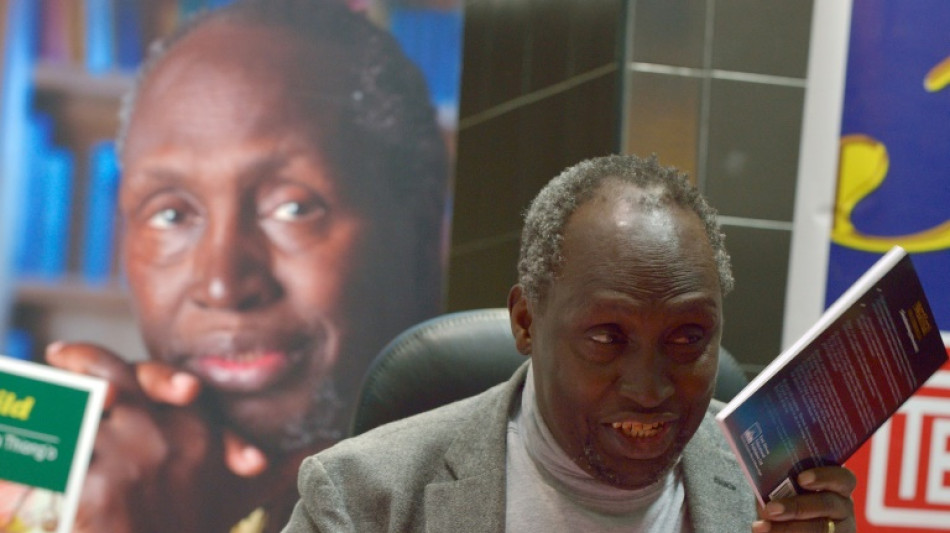
Kenya's Ngugi wa Thiong'o, champion of African expression / Photo: © AFP/File

 Trump admin finalizes reversal of US fuel economy standards

 US says no China arms sale plans after envoy cites Trump offer

 Dozens kidnapped in two weekend attacks in northern Nigeria

 Next stop the world: Pathirage wins Asian Games javelin gold

 Aster Launches Perpetual Grid Trading 2.0 with Up to 140,000 $ASTER Liquidity Mining Campaign

 Seoul says North Korean mines 'highly suspected' as cause of DMZ blast

 Russia pummels Kyiv in latest deadly daytime attack

 Wartime Ukraine works to keep its railways on track

 Boy among 3 dead in migrant Channel crossing accident: French authorities

 SGFX Creates a Standout Brand Experience at Forex Expo Dubai 2026
 Pope urges Europe to help combat 'deceit and lies' in international ties

 Injured Buttler to miss England ODI series in Pakistan
 Madrid housing protesters vow to maintain pressure on government

 In kayaks or waist-deep in floodwater, shoppers return to Bangkok markets

 UK police probes Iran link to air base bomb scare: media

 Eala blasts into Asian Games quarters in just 55 minutes
 Taiwan gender-row boxer Lin Yu-ting guarantees Asian Games medal

 Comedian on trial for allegedly insulting Erdogan in standup show

 More Asian Games transport woes as bus takes Pakistan to wrong venue
 Death toll in South Africa bar shooting rises to 18
 Aide to Venezuelan opposition leader returns from exile

 Messi and Alcaraz love it, now padel takes step closer to Olympics

 Tolls mount in Thailand, Myanmar floods

 Why India's opposition wants top poll official out

 PU Prime Strengthens UAE Momentum with Strong Showing at Forex Expo Dubai 2026

During his imprisonment, Kenyan author Ngugi wa Thiong'o decided he would never write in English again, a defiant move that helped put literature in African languages firmly on the map.
Ngugi died at the age of 87 on Wednesday, his daughter announced on Facebook.
"It is with a heavy heart that we announce the passing of our dad, Ngugi wa Thiong'o this Wednesday morning," wrote Wanjiku Wa Ngugi. "He lived a full life, fought a good fight."
Widely regarded as east Africa's most influential writer, Ngugi sought to forge a body of literature reflecting the land and people from which he came, and not follow in the footsteps of Western tradition.
"I believe so much in equality of languages. I am completely horrified by the hierarchy of languages," he told AFP in an interview in 2022 from California, where he lived in self-imposed exile.
His decision in the 1970s to abandon English in favour of his native Kikuyu, as well as Kenya's national language Swahili, was met with widespread incomprehension at first.
"We all thought he was mad... and brave at the same time," said Kenyan writer David Maillu. "We asked ourselves who would buy the books."
Yet the bold choice built his reputation and turned him into an African literary landmark.
The softly-spoken writer also lived a life as dramatic as his novels.
His criticism of post-colonial Kenya -- describing the violence of the political class and the newly rich as "the death of hopes, the death of dreams and the death of beauty" -- brought him into frequent conflict with the authorities.
- 'Decolonising the mind' -
Born James Ngugi into a large peasant family in Kenya's central Limuru region on January 5, 1938, he spent the first 25 years of his life in what was then a British settler colony.
His early works were heavily influenced by his country's battle against colonial rule and the brutal Mau Mau war of 1952-1960.
In his first collection of essays, "Homecoming", he described himself as a "stranger in his home country".
But his anger would later extend to the inequalities of post-colonial Kenyan society, incurring the wrath of the government.
In 1977, Ngugi and fellow writer Ngugi wa Mirii were jailed without charge after the staging of their play "Ngaahika Ndeenda" ("I Will Marry When I Want").
It was then that he decided to write his first novel in Kikuyu, "Devil on the Cross", which was published in 1980.
He had already abandoned his "English" name to become Ngugi wa Thiong'o.
"I wrote it on the only paper available to me, which was toilet paper," he told US radio broadcaster NPR.
Amnesty International named him a prisoner of conscience, before a global campaign secured his release from Kamiti Maximum Security Prison in December 1978.
As early as 1965, Ngugi's novel "The River Between" embarked on a critical examination of the role of Christianity in an African setting.
"If the white man's religion made you abandon a custom and then did not give you something else of equal value, you became lost," he wrote.
He went into self-imposed exile in 1982 after a ban on theatre groups in Kenya, moving first to Britain then to the United States.
In 1986, he published one of his best-known works, "Decolonising the Mind", a collection of essays about the role of language in forging national culture, history and identity.
- 'A Kenyan Tolstoy' -
When Ngugi returned home on a visit in 2004, he was mobbed by supporters at Nairobi's airport.
"I have come back with an open mind, an open heart and open arms," he declared.
Days later, he and his wife were attacked by armed men: she was raped and he was beaten up. It was not clear whether robbery was the sole motive or whether the assault was politically motivated.
Margaretta wa Gacheru, a sociologist and former student of Ngugi, described him as a national icon.
"To me he's like a Kenyan Tolstoy, in the sense of being a storyteller, in the sense of his love of the language and panoramic view of society, his description of the landscape of social relations, of class and class struggles," she said.
In addition to fiction, the father-of-three, who became a professor of comparative literature at the University of California Irvine, also published essays and three memoirs.
His most recent book was the genre-defying novel-in-verse "The Perfect Nine", which he translated into English in 2020.
It recounted the founding of the Kikuyu people, blending folklore and allegory.
From widening economic inequality to the lingering trauma of racism, the issues raised in the play still persist in Kenya and beyond, a fact not lost on its creator.
"I am an activist, I want to see change," Ngugi told AFP.
"I hope we can continue striving for that world. We cannot give up."
H.Seidel--BTB