Time machine: How carbon dating brings the past back to life / Photo: © AFP

 SpaceX puts Starship megarocket in orbit for first time
 Iran denies link to suspected bomb plot at UK airbase used by US

 Ex-boss Mancini says City charges 'not my concern'

 Berlin Marathon winner Assefa finished race with torn Achilles

 Comedian convicted for Erdogan 'insult' but freed pending appeal

 French prosecutors seek two-year sentence for ex-minister Dati in graft case

 Eala makes fast start as weather and transport woes hit Asian Games

 Hurricane Polo approaches Mexico, threatens severe damage

 Energy markets rally after Trump rejects Iran truce offer

 Japanese convenience store enlists Lady Gaga to bolster recruitment

 Seoul summons Ukraine envoy in row over North Korean POWs

 Ireland 'raised awareness worldwide' in Israel game: Hallgrimsson

 Colombian police capture wife, daughter of Ecuador drug lord

 More Asian Games woes as bus takes Pakistan team to wrong venue

 Radio frequencies vital to Earth observation must be protected: UN
 Comedian on trial for insulting Erdogan in standup show

 Women's Fashion Week kicks off in Paris

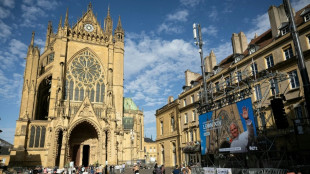 Pope arrives in French border city to speak on united Europe

 The wildfires choking Indonesia, sparking regional haze

 PU Prime Deepens Argentina Presence Through FX Expo Buenos Aires 2026

 Nothing to seal here: NZ police help stranded pup home

 White House releases list of products US, China could tax less

 'Pseudo-journalism': Partisan 'news' sites target US midterms

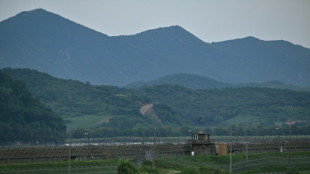 'Currently impossible': North Korea defections in freefall

 Erasmus sizes up 'improved' Wallabies ahead of 2027 World Cup

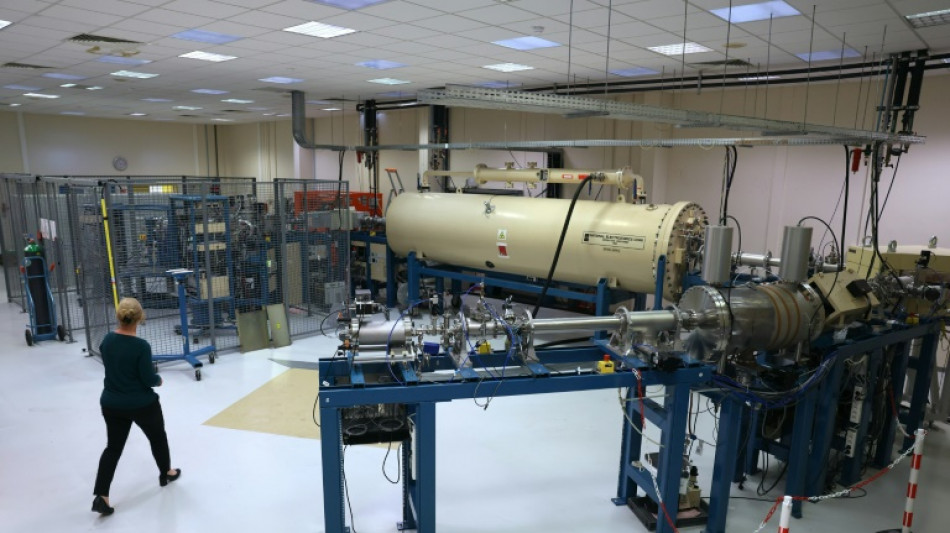
From unmasking art forgery to uncovering the secrets of the Notre-Dame cathedral, an imposing machine outside Paris can turn back the clock to reveal the truth.
It uses a technique called carbon dating, which has "revolutionised archaeology", winning its discoverer a Nobel Prize in 1960, French scientist Lucile Beck said.
She spoke to AFP in front of the huge particle accelerator, which takes up an entire room in the carbon dating lab of France's Atomic Energy Commission in Saclay, outside the capital.
Beck described the "surprise and disbelief" among prehistorians in the 1990s when the machine revealed that cave art in the Chauvet Cave in France's southeast was 36,000 years old.
The laboratory uses carbon dating, also called carbon-14, to figure out the timeline of more than 3,000 samples a year.
- So how does it work? -
First, each sample is examined for any trace of contamination.
"Typically, they are fibres from a jumper" of the archaeologist who first handled the object, Beck said.
The sample is then cleaned in an acid bath and heated to 800 degrees Celsius (1,472 Fahrenheit) to recover its carbon dioxide. This gas is then reduced to graphite and inserted into tiny capsules.
Next, these capsules are put into the particle accelerator, which separates their carbon isotopes.
Isotopes are variants of the same chemical element which have different numbers of neutrons.
Some isotopes are stable, such as carbon-12. Others -- such as carbon-14 -- are radioactive and decay over time.
Carbon-14 is constantly being created in Earth's upper atmosphere as cosmic rays and solar radiation bombard the chemical nitrogen.
In the atmosphere, this creates carbon dioxide, which is absorbed by plants during photosynthesis.
Then animals such as ourselves get in on the act by eating those plants.
So all living organisms contain carbon-14, and when they die, it starts decaying. Only half of it remains after 5,730 years.
After 50,000 years, nothing is left -- making this the limit on how far back carbon dating can probe.
By comparing the number of carbon-12 and carbon-14 particles separated by the particle accelerator, scientists can get an estimate of how old something is.
Cosmic radiation is not constant, nor is the intensity of the magnetic field around Earth protecting us from it, Beck said.
That means scientists have to make estimations based on calculations using samples whose ages are definitively known.
This all makes it possible to spot a forged painting, for example, by demonstrating that the linen used in the canvas was harvested well after when the purported painter died.
The technique can also establish the changes in our planet's climate over the millennia by analysing the skeletons of plankton found at the bottom of the ocean.
- Notre-Dame revealed -
Carbon dating can be used on bones, wood and more, but the French lab has developed new methods allowing them to date materials that do not directly derive from living organisms.
For example, they can date the carbon that was trapped in iron from when its ore was first heated by charcoal.
After Paris's famous Notre-Dame cathedral almost burned to the ground in 2019, this method revealed that its big iron staples dated back to when it was first built -- and not to a later restoration, as had been thought.
The technique can also analyse the pigment lead white, which has been painted on buildings and used in artworks across the world since the fourth century BC.
To make this pigment, "lead was corroded with vinegar and horse poo, which produces carbon dioxide through fermentation," Beck explained.
She said she always tells archaeologists: "don't clean traces of corrosion, they also tell about the past!"
Another trick made it possible to date the tombs of a medieval abbey in which only small lead bottles had been found.
As the bodies in the tombs decomposed, they released carbon dioxide, corroding the bottles and giving scientists the clue they needed.
"This corrosion was ultimately the only remaining evidence of the spirit of the monks," Beck mused.
I.Meyer--BTB
