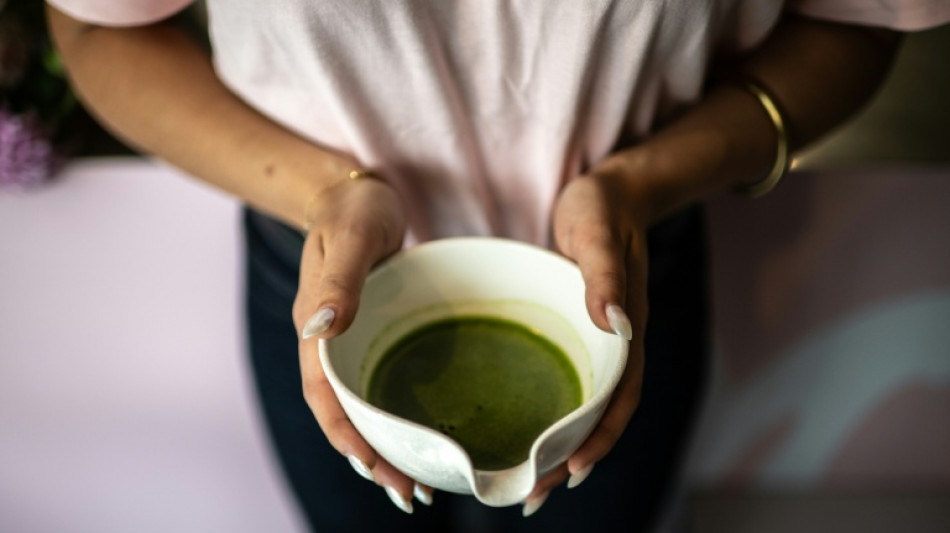
Matcha: the Japanese tea taking over the world / Photo: © AFP

 Pope urges Europe to help combat 'deceit and lies' in international ties
 Injured Buttler to miss England ODI series in Pakistan
 Madrid housing protesters vow to maintain pressure on government

 In kayaks or waist-deep in floodwater, shoppers return to Bangkok markets

 UK police probes Iran link to air base bomb scare: media

 Eala blasts into Asian Games quarters in just 55 minutes

 Taiwan gender-row boxer Lin Yu-ting guarantees Asian Games medal

 Comedian on trial for allegedly insulting Erdogan in standup show

 More Asian Games transport woes as bus takes Pakistan to wrong venue

 Death toll in South Africa bar shooting rises to 18

 Aide to Venezuelan opposition leader returns from exile

 Messi and Alcaraz love it, now padel takes step closer to Olympics

 Tolls mount in Thailand, Myanmar floods

 Why India's opposition wants top poll official out

 PU Prime Strengthens UAE Momentum with Strong Showing at Forex Expo Dubai 2026

 Eight dead in Thailand floods since mid-September

 Oil prices spike after Trump rejects Iran truce offer

 Taylor Swift sets new record at MTV VMAs
 Seoul seeks apology after Ukraine reveals transfer of North Korean POWs

 Messi on target again but Miami downed by Columbus

 In Washington's political cauldron, a fight over foie gras

 Flavio Bolsonaro: political heir in his father's shadow

 Ravens grab last-second win in Rio as Commanders stop Seahawks

 Scheffler makes sportsmanship stand over tee screamer

 Anthropic CEO Amodei to dine with Trump at White House

Matcha is the new drink of choice at hip cafes worldwide, but Japanese producers are struggling to keep up with soaring demand for the powdered green tea.
Here's what you need to know about the drink beloved of weekend treat-seekers and "wellness" influencers:
- What is matcha? -
The word matcha means "ground tea" in Japanese and comes in the form of a vivid green powder that is whisked with hot water and can be added to milk to make a matcha latte.
Green tea was introduced to Japan from China in the early ninth century, and was first used for medicinal purposes.
Matcha came much later, in 16th century Kyoto -- part of the tea ceremony tradition developed by tea master Sen no Rikyu.
Today, there are different grades of matcha quality, from "ceremonial" to "culinary" types used in baking.
- How is it produced? -
Matcha is made from leaves called "tencha", which are grown in the shade in the final weeks before their harvest to concentrate the flavour, colour and nutrients.
This "requires the construction of a complex structure with poles and a roof to filter the light", explained Masahiro Okutomi, a tea producer in Sayama, northwest of Tokyo.
Tencha leaves, rich in chlorophyll and L-theanine, a compound known for its relaxing effects, are hand-picked and deveined, then steamed, dried and ground between two stone mills to produce an ultra-fine powder.
It can take up to an hour to produce just 40 grams (1.4 ounces) of matcha -- making the powder on average twice as expensive to produce as standard green tea leaves.
- What are its benefits? -
Many drink matcha for its rich grass-like taste, but others are drawn to the drink's nutritional properties.
It is rich in antioxidants, and can aid concentration because of its caffeine content: one cup contains on average 48 milligrams, slightly less than a drip coffee but nearly twice as much as a standardly brewed green tea.
"Matcha is often seen as being good for your health," said Shigehito Nishikida, manager of Tokyo tea shop Jugetsudo.
"But people are also attracted to the Japanese culture around tea: the ritual, the time taken, the aesthetics," he said.
- Why is it so popular? -
Japan produced 4,176 tonnes of matcha in 2023 -- a huge increase from the 1,430 tonnes in 2012.
More than half of the powder is exported, according to the agriculture ministry, mostly to the United States, Southeast Asia, Europe, Australia and the Middle East.
Millions of videos on TikTok, Instagram and YouTube demonstrate how to make photogenic matcha drinks or choose a traditional "chasen" bamboo whisk.
"I feel like Gen Z really drove this enthusiasm for matcha, and they heavily relied on social media to do so," Stevie Youssef, a 31-year-old marketing professional, told AFP at a matcha bar in Los Angeles.
Matcha can also be used in cooking, extending its appeal to others aside from tea lovers.
"Some customers simply enjoy drinking it, others like preparing it themselves. And of course, many buy it as a gift -- Japanese matcha is always appreciated," said Jugetsudo's Nishikida.
K.Brown--BTB
