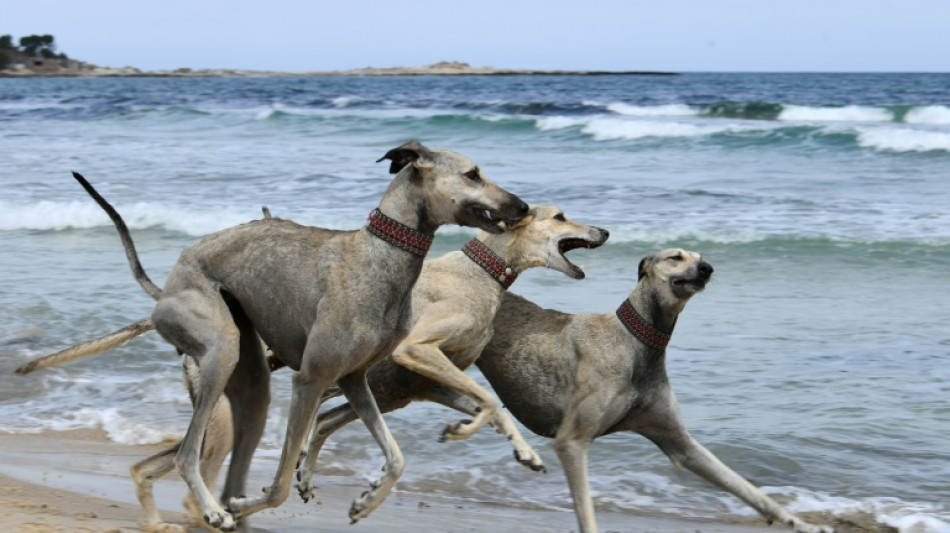
Dying breed: Tunisian dog lovers push to save age-old desert hound / Photo: © AFP

 Pope urges Europe to help combat 'deceit and lies' in international ties

 Injured Buttler to miss England ODI series in Pakistan

 Madrid housing protesters vow to maintain pressure on government

 In kayaks or waist-deep in floodwater, shoppers return to Bangkok markets

 UK police probes Iran link to air base bomb scare: media

 Eala blasts into Asian Games quarters in just 55 minutes

 Taiwan gender-row boxer Lin Yu-ting guarantees Asian Games medal

 Comedian on trial for allegedly insulting Erdogan in standup show

 More Asian Games transport woes as bus takes Pakistan to wrong venue

 Death toll in South Africa bar shooting rises to 18

 Aide to Venezuelan opposition leader returns from exile

 Messi and Alcaraz love it, now padel takes step closer to Olympics

 Tolls mount in Thailand, Myanmar floods

 Why India's opposition wants top poll official out

 PU Prime Strengthens UAE Momentum with Strong Showing at Forex Expo Dubai 2026

 Eight dead in Thailand floods since mid-September

 Oil prices spike after Trump rejects Iran truce offer

 Taylor Swift sets new record at MTV VMAs

 Seoul seeks apology after Ukraine reveals transfer of North Korean POWs

 Messi on target again but Miami downed by Columbus

 In Washington's political cauldron, a fight over foie gras

 Flavio Bolsonaro: political heir in his father's shadow

 Ravens grab last-second win in Rio as Commanders stop Seahawks

 Scheffler makes sportsmanship stand over tee screamer

 Anthropic CEO Amodei to dine with Trump at White House

Nemcha, Zina and Zouina, three North African Sloughi hounds, play on the beach in Tunisia where their ancestors have long roamed desert plains, seemingly unaware of the existential threat to their dwindling breed.
The Sloughis, known for their speed and slender physique, have for many centuries accompanied nomadic societies across North Africa, and have been featured in art and lore dating back at least to the Roman era.
But nowadays breeders and advocates say that unregulated crossbreeding, the decline of nomadic lifestyles and habitat shifts due to urbanisation mean that they might soon disappear.
Olfa Abid, who was walking Nemcha, Zina and Zouina along the coast in northern Tunisia's Ras Angela, said the age-old breed is "part of our heritage, our history".
"We must protect the Sloughi," said Abid, a 49-year-old veterinarian, her arms wrapped around one of her dogs.
Recent years have seen a spike in unregulated crossbreeding, mixing the local Sloughi with other hounds often brought in from abroad to boost its speed for dog races, according to Abid.
National kennel club the Tunisian Canine Centre (CCT) has been working to raise awareness and safeguard the breed, including by creating a dedicated registry with a regulated breeding scheme.
The organisation's director Noureddine Ben Chehida said it also seeks to have the Tunisian Sloughi "recognised according to international standards" as a unique breed, under the guidelines of the International Canine Federation, the world's main dog breed registry.
Such recognition would give the local Sloughi population a place on the international stage and help preserve its lineage at home, Ben Chehida said.
Also known as Arabian Greyhounds, today the CCT estimates that fewer than 200 pure-bred Sloughis remain in Tunisia.
- 'Noble' hunters -
With their short coats in sandy hues or grey and arched backs, the hounds' swift gait has earned them a precious spot in Tunisian folklore even as the desert life they once supported gradually vanishes.
Historians debate how they first made it to this part of North Africa, but many attribute their arrival to nomadic tribes like the Mrazigs who live in the south of modern-day Tunisia.
For centuries, or possibly even millennia, the Sloughis have been vital companions to desert nomads, helping them hunt and guard livestock.
"Running like a Sloughi" is still a common saying in Tunisia.
"It's a noble dog that was the pride of its nomadic owners," said Abid. "It's a primitive hunter with a purpose when food was scarce."
She said the Sloughi has also had a more privileged standing compared to most dogs that are generally considered impure in Islamic cultures.
Unlike other breeds, Sloughis have traditionally been allowed indoors and would even eat beside their owners, said Abid.
- Ancestral heritage -
In the southern town of Douz, on the edge of the Sahara desert, dog breeder Nabil Marzougui said the "proliferation of hybrid breeds" is putting the Sloughis' future at risk.
"We inherited this dog from our forefathers," said Marzougui, calling for authorities to intervene to save the Sloughis as well as the ancestral tradition that they embody.
The hounds require ample daily exercise, especially where hunting is no longer available or needed.
This is why Abid said she had left the city to settle in the quiet coastal village of Ras Angela, on Africa's northernmost tip, where long stretches of sand serve as an ideal terrain for her three dogs to run around and roam free.
Their seaside adventures, which Abid shares on social media, are now followed by thousands of people online.
Hatem Bessrour, a 30-year-old agricultural engineer and the proud owner of a Sloughi named Cacahuete, called on fellow dog owners to register their pure-bred hounds with the national canine centre to support its breeding programme.
The breed is part Tunisia's heritage, he said. "We must care for it just like we care for antiquities and archaeological sites."
J.Fankhauser--BTB