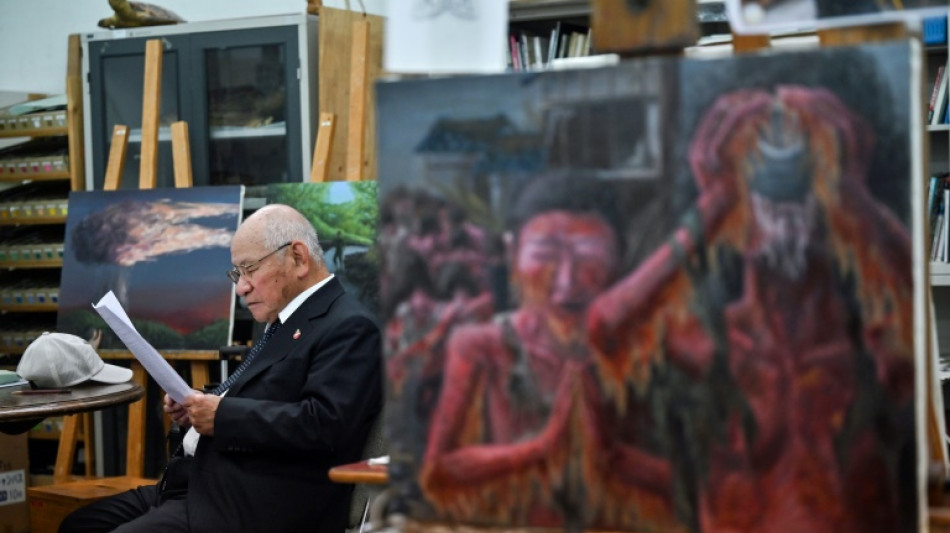
Hiroshima teens relay atom bomb horror with art / Photo: © AFP

 More Asian Games transport woes as bus takes Pakistan to wrong venue
 Death toll in South Africa bar shooting rises to 18
 Aide to Venezuelan opposition leader returns from exile
 Messi and Alcaraz love it, now padel takes step closer to Olympics
 Tolls mount in Thailand, Myanmar floods
 Why India's opposition wants top poll official out

 PU Prime Strengthens UAE Momentum with Strong Showing at Forex Expo Dubai 2026

 Eight dead in Thailand floods since mid-September
 Oil prices spike after Trump rejects Iran truce offer
 Taylor Swift sets new record at MTV VMAs
 Seoul seeks apology after Ukraine reveals transfer of North Korean POWs
 Messi on target again but Miami downed by Columbus
 In Washington's political cauldron, a fight over foie gras

 Flavio Bolsonaro: political heir in his father's shadow
 Ravens grab last-second win in Rio as Commanders stop Seahawks
 USA rallies to capture 11th consecutive Presidents Cup

 Phillies clinch, Astros wrap up division on final day of MLB season

 Commanders hand champion Seahawks their first loss

 Dupont scores twice to send Toulouse top of Top 14

 Ireland beat Israel but no handshakes due to war in Gaza

 Tense standoff over flashpoint N.Ireland parade lasts into night

 Stunned McNulty wins 'miracle' road race world title

 Re-released 'Avengers: Endgame' snaps-up N. America box office lead

 American McNulty wins shock road race world title

 Serbia's President Aleksandar Vucic announces resignation

Trudging through the ruins of Hiroshima after the US atom bombing four days before in 1945, five-year-old Masaki Hironaka clutched his mother's hand and silently vowed to protect her.
It's one of many scenes from 80 years ago this August still etched in the octogenarian's memory -- and now depicted vividly by Japanese teenagers on canvas.
For almost 20 years, Motomachi High School in Hiroshima has tasked its art students with interviewing hibakusha -- atom bomb survivors -- and turning their harrowing testimonies into paintings.
Showcased recently by the school ahead of the August 6 anniversary were 15 new artworks, including of scorched soldiers writhing in pain, and a horror-stricken girl surrounded by an inferno.
"I think the painting very accurately captures my feelings at the time," Hironaka told AFP, nodding with satisfaction at one such piece that immortalised an "unforgettable page of my life".
"It's authentic, and very well drawn."
Schoolgirl Hana Takasago's evocative art shows a young Hironaka looking up at his mother as they plod through what remains of Hiroshima on August 10, 1945, with fires still lingering.
A few days before, his father had come home heavily burned by the blast and asked Hironaka to yank out a glass shard stuck deep into his flesh.
He died soon afterwards.
The widowed mother, clasping Hironaka's tiny hand and with his younger sister strapped on her back, is depicted gazing down and mumbling to him about her fears.
"In that moment, I was gripped by the strong determination to help and support her, young as I was. That's the feeling captured here," said Hironaka.
- 'Inner struggle' -
The "Little Boy" bomb dropped on Hiroshima killed around 140,000 people, including many who died from radiation.
Motomachi High is now an integral part of what was originally the Hiroshima Peace Memorial Museum's initiative, which has over the years birthed more than 200 artworks.
The idea is to keep memories of the bombing relevant for younger generations.
In the last eight months or so, witnesses including Hironaka sat down with students every few weeks to review their works in progress, sometimes requesting a drastic re-do.
"I originally had Mr. Hironaka and his mother face straight ahead, but he told me that their looking ahead doesn't really convey her inner struggle at the time," Takasago, 17, told AFP.
"Since I've seen none of these described scenes myself, I was never confident that my depictions were accurate," she said in the school's cluttered art room.
The same went for Yumeko Onoue, 16, whose art depicts pumpkins that Hironaka remembers were covered in soot from radioactive "black rain".
Having initially drawn the fruit's leaves to face upward with vitality, she "completely re-drew them to wilt," to match Hironaka's memory.
"While photos from that era were mostly black and white, paintings can add colour and emphasise key elements, making them, I think, ideal for expressing intended messages," Onoue said.
- 'The last generation' -
Many of these teens relied on their imagination and perused historical documents.
Immersing themselves in the carnage took a toll on some such as Mei Honda, 18, who described the "emotionally draining" task ofdepicting charred skin and flesh dangling from people's arms.
Based on what one hibakusha witnessed, her painting showed one such woman gulping water.
"I initially depicted her arms pressed against her torso, but skin contact would have hurt her badly because of the burns," Honda said.
Recent data showed that the number of survivors from the bombings is now below 100,000, with the average age 86 years old.
"We are probably the last generation to have the opportunity to listen face-to-face to the experiences of hibakusha," Aoi Fukumoto, a 19-year-old Motomachi High alumna, told AFP.
This sense of crisis was instilled by the project in other participants this year -- including Takasago.
"Before I embarked on this project, what the atomic bomb did had always felt distant to me even as a Hiroshima native," she said.
But that changed after she lived vicariously through Hironaka's story.
"I can no longer remain a bystander," she said.
O.Lorenz--BTB