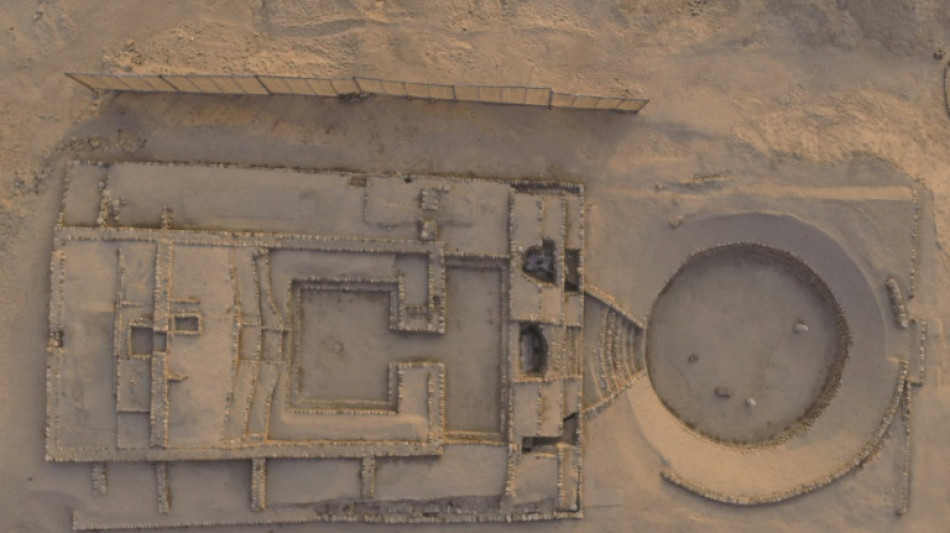
Peruvian citadel that is nearly 4,000 years old opens doors to tourists / Photo: © Zona Arqueologica Caral/AFP

 More Asian Games transport woes as bus takes Pakistan to wrong venue

 Death toll in South Africa bar shooting rises to 18

 Aide to Venezuelan opposition leader returns from exile

 Messi and Alcaraz love it, now padel takes step closer to Olympics
 Tolls mount in Thailand, Myanmar floods
 Why India's opposition wants top poll official out

 PU Prime Strengthens UAE Momentum with Strong Showing at Forex Expo Dubai 2026

 Eight dead in Thailand floods since mid-September

 Oil prices spike after Trump rejects Iran truce offer

 Taylor Swift sets new record at MTV VMAs
 Seoul seeks apology after Ukraine reveals transfer of North Korean POWs

 Messi on target again but Miami downed by Columbus

 In Washington's political cauldron, a fight over foie gras

 Flavio Bolsonaro: political heir in his father's shadow
 Ravens grab last-second win in Rio as Commanders stop Seahawks

 USA rallies to capture 11th consecutive Presidents Cup

 Phillies clinch, Astros wrap up division on final day of MLB season

 Commanders hand champion Seahawks their first loss

 Dupont scores twice to send Toulouse top of Top 14

 Ireland beat Israel but no handshakes due to war in Gaza

 Tense standoff over flashpoint N.Ireland parade lasts into night

 Stunned McNulty wins 'miracle' road race world title

 Re-released 'Avengers: Endgame' snaps-up N. America box office lead

 American McNulty wins shock road race world title

 Serbia's President Aleksandar Vucic announces resignation

To the music of conch shell trumpets, a 3,800-year-old citadel of the Caral civilization -- one of the oldest in the world -- opened its doors to visitors in Peru on Saturday, after eight years of study and restoration work.
The archaeological site, known as Penico, was a meeting point for trade between the first human communities on the Pacific coast and those from the Andes and Amazon regions, researchers have said.
Located in the Supe valley, some 110 miles (180 kilometers) north of the Peruvian capital Lima and around 12 miles from the Pacific ocean, Penico was a hilly landscape before exploration work began in 2017.
Archaeologists believe it could hold insights into why the Caral civilization -- which flourished between 3,000 and 1,800 BC -- faded.
At the opening ceremony, artists from the region played pututus -- the traditional shell trumpets -- during an ancestral ritual offering to the Pachamama, Mother Earth, consisting of agricultural products, coca leaves and local drinks.
Penico was an "organized urban center devoted to agriculture and trade between the coast, the mountains and the forest," archaeologist Ruth Shady, who leads research on the site, told AFP.
The site itself dates back to between 1,800 and 1,500 BC, she added.
It was built on a geological terrace 2000 feet (600 meters) above sea level, parallel to a river to avoid flooding.
Research carried out by the Peruvian Ministry of Culture has identified 18 constructions, including buildings and residential complexes.
Researchers believe that it was built at the same time as the first civilizations in the Middle East and Asia.
Shady said researchers are hoping the site can shed light on the crisis they think helped hasten the end of the Caral civilization.
This crisis, she said, was linked to climatic changes that led to droughts and affected agricultural activities in the region.
"We want to understand how the Caral civilization formed and developed over time, and how it came to be in crisis as a result of climate change," she added.
J.Bergmann--BTB