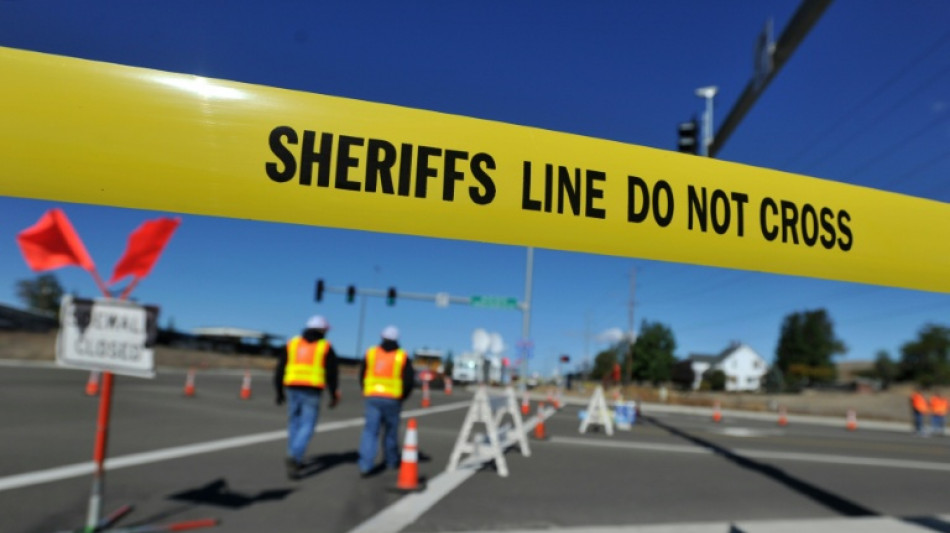
What is swatting? Shooting hoaxes target campuses across US / Photo: © AFP

 Oil prices spike after Trump rejects Iran truce offer
 Taylor Swift sets new record at MTV VMAs

 Seoul seeks apology after Ukraine reveals transfer of North Korean POWs

 Messi on target again but Miami downed by Columbus

 In Washington's political cauldron, a fight over foie gras

 Flavio Bolsonaro: political heir in his father's shadow

 Ravens grab last-second win in Rio as Commanders stop Seahawks

 USA rallies to capture 11th consecutive Presidents Cup

 Phillies clinch, Astros wrap up division on final day of MLB season

 Commanders hand champion Seahawks their first loss

 Dupont scores twice to send Toulouse top of Top 14

 Ireland beat Israel but no handshakes due to war in Gaza

 Tense standoff over flashpoint N.Ireland parade lasts into night

 Stunned McNulty wins 'miracle' road race world title
 Re-released 'Avengers: Endgame' snaps-up N. America box office lead

 American McNulty wins shock road race world title

 Serbia's President Aleksandar Vucic announces resignation

 Tuchel urges Bellingham to play with 'rage'

 Russian strikes on Ukraine kill 8
 Bavuma, Miller hit centuries as South Africa clinch series

 Spain bring in Le Normand for injured Garcia

 UK Labour party meets buoyed by Burnham but seeking concrete plans

 Nor'easter lashes US east with punishing rain and wind

 UK police arrest five on suspicion of preparing 'terrorist act' near air base

 Washington denounces Iran's truce proposal as 'cynical'

Students at the University of South Carolina were sent into panic when they received an active shooter alert and police rushed to the library.
The university had fielded two separate calls on Sunday that included sounds of gunfire.
But the reports turned out to be false, part of a wave of so-called "swatting" hoaxes that have targeted American universities as students returned to campuses for fall classes.
Similarly baseless reports hit Villanova University and the University of Tennessee-Chattanooga last week, and at least seven more schools on Monday, according to campus alerts and school and police statements.
West Virginia University responded to yet another hoax Tuesday morning.
Experts warn that swatting -- deliberately phoning in a false emergency to trigger a law enforcement response -- traumatizes students, depletes security resources and risks desensitizing Americans to alerts in a country where mass shootings are a legitimate threat.
"It plays on our fears because bad things really do happen," said former police chief John DeCarlo, a criminal justice professor at the University of New Haven.
"They can trigger, with just one call, lockdowns, mobilizations, closings of buildings and a lot of media coverage."
The FBI told AFP it is aware of the recent incidents targeting colleges and is "seeing an increase in swatting events across the country."
The agency said it has received thousands of swatting reports since creating a database for law enforcement agencies to log incidents in 2023, adding that the practice "drains law enforcement resources, costs thousands of dollars, and, most importantly, puts innocent people at risk."
- Persistent problem -
At the University of Tennessee-Chattanooga, first responders from at least 10 agencies were mobilized to the campus and cleared multiple buildings before concluding there was no threat.
The University of South Carolina said two students received minor injuries in the rush out of its library.
A third was falsely branded as a gunman after social media users and Congresswoman Nancy Mace shared footage of him carrying an umbrella that resembled a firearm.
Swatting began in gamer and hacker communities and has been wielded against judges, election officials and lawmakers in recent years.
Schools are "especially vulnerable" due to their visibility and student populations, DeCarlo said.
Keven Hendricks, a cybercrime expert, told AFP perpetrators are frequently linked to extremist groups and ideologies and are often juveniles who are emboldened when they are not caught.
"A lot of swatters do it simply because they can."
Experts called for stronger laws to combat the problem, as well as investments in technologies to identify callers who conceal their voices or IP addresses.
"It is, in reality, a form of domestic terrorism that's very easy to get away with because we don't have the wherewithal to investigate or prosecute it well," DeCarlo said.
"It seems to be running away unbridled."
K.Brown--BTB