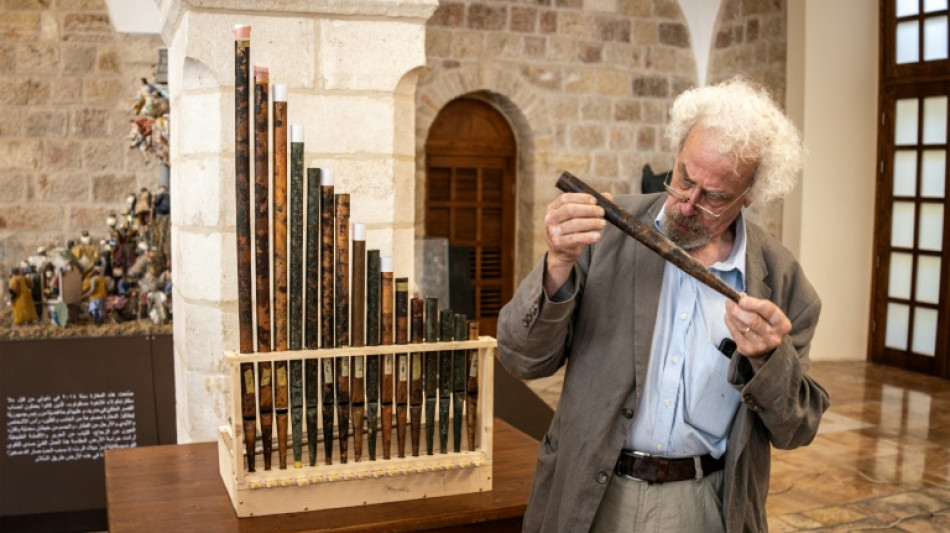
Silent for 800 years, medieval organ sings again in Jerusalem / Photo: © AFP

 Scheffler makes sportsmanship stand over tee screamer

 Anthropic CEO Amodei to dine with Trump at White House

 Dupont scores twice to send Toulouse to Top 14 summit

 Greece stun Klopp's Germany as Ireland show sorrow for Gaza

 Ramos fires holders Portugal to Nations League win in Norway

 Greece hand Klopp first defeat as Germany manager
 Pope promises French sex abuse victims to prevent further harm

 UK village on edge over threats to air base in terror alert

 Two giant pandas, emblems of China soft diplomacy, arrive in US

 Aleksandar Vucic: from Milosevic minister to long-serving Serbian statesman

 Trump expects new Iran talks despite rejecting deal offer

 Xavi gets first win as Netherlands boss, Denmark beat Wales

 Madrid housing protest camp enters second night as PM vows action

 Tigray TV station hit by drone, rebels advance in north Ethiopia

 Banton hundred paves way for England ODI series win over Sri Lanka

 Milestone man Kohli powers India to big ODI win over West Indies

 Swiss reject plan to toughen neutrality

 Fitzpatrick closes out fourth win of year at French Open

 Zverev stars as Team Europe win Laver Cup

 UK PM urges 'calm' as thousands block flashpoint N.Ireland parade

 China's Yan one and done after golden Asian Games throw

 Kiss praises Wallabies' composure after wild Test finish

 एलेक्स बोडी और प्रो. डॉ. डायटर लाज़िक ने ALPHA WHEY और BODI एनर्जी ड्रिंक के लिए एक अनुबंध पर हस्ताक्षर किए

 Alex Bodi a prof. dr. Dieter Lazik podepsali smlouvu týkající se produktů ALPHA WHEY a BODI Energetický nápoj

 Banton takes England to 355-7 in Sri Lanka ODI decider

The pipes of a medieval organ, buried for centuries and discovered near the Church of the Nativity in Bethlehem in the occupied West Bank, are once more filling a Jerusalem monastery with ancient melodies.
"This is a window into the past... we have the opportunity for the first time in modern history of listening to a medieval sound which is a thousand years old," said David Catalunya, a Spanish researcher who has worked for more than five years to bring the 11th-century instrument back to life.
"And it's not through a recreation or a hypothetical reconstruction, but it's really the original sound: the same vibration that the Crusaders heard at the Nativity Church," he told AFP.
Dating nearly as far back as the invention of the instrument itself, it was discovered in 1906 at the Biblical birthplace of Jesus Christ.
Catalunya pulls on small tabs to play the organ -- which he fondly refers to as a "miracle" -- expelling a formidable ringing from the otherwise modest wooden instrument.
Currently housed in the Monastery of Saint Saviour in Jerusalem's Old City, the instrument is set to be displayed in a museum of the Franciscan Custody of the Holy Land.
"It's like finding a living dinosaur, because it's something we knew existed but we only know from fossils, so there's very limited evidence," said Alvaro Torrente, a musicologist who participated in the restoration project.
"This is not a fossil, this is the real object and the real sound," he told AFP.
- Chance discovery -
It was discovered "almost by chance", according to Father Eugenio Alliata, a Franciscan archaeologist attached to the mission in charge of several holy sites, including the Church of the Nativity in Bethlehem.
During construction of a pilgrim hostel, a set of 222 copper pipes and a bell carillon were unearthed near the site.
It was seemingly buried with "utmost care", according to Catalunya, meaning researchers were able to reconstruct the instrument with painstaking care.
Koos van de Linde, one of the world's leading organ specialists who also consulted on the project, said that "the hope the Crusaders who buried these pieces had, that one day they would resound again, was not in vain.
"It was an immense honour to witness and participate in their resurrection," he continued.
To the experts, the instrument is unique not just for its complexity -- 18 pipes producing a single note -- or what Catalunya says is an "incredible state of preservation", but also its antiquity.
While the oldest organs studied by historians are from the 15th century, this one was built in the 11th century in France before being transported to Bethlehem by Crusaders in the 12th century, Catalunya said.
"The Christians of Europe brought to the Church of the Nativity in Bethlehem the most avant-garde musical instrument used at the time in liturgy: the organ, an instrument designed to become the emblem of sacred music," Torrente told AFP.
He hopes the discovery will spark more interest in what the research team simply calls the "Bethlehem organ", which Torrente says has not yet sung all its tunes.
S.Keller--BTB