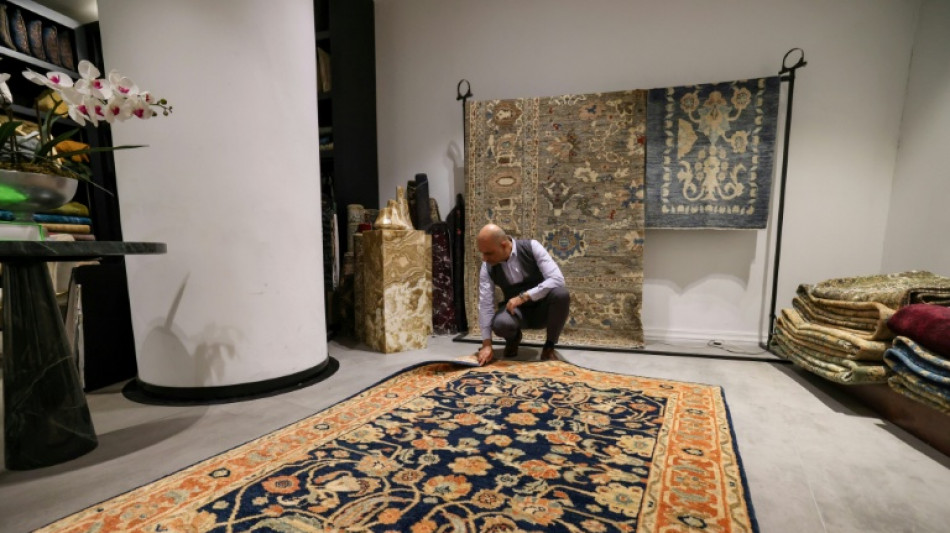
Iran's carpet industry unravelling under sanctions / Photo: © AFP

 Commanders hand champion Seahawks their first loss

 Dupont scores twice to send Toulouse top of Top 14

 Ireland beat Israel but no handshakes due to war in Gaza

 Tense standoff over flashpoint N.Ireland parade lasts into night

 Stunned McNulty wins 'miracle' road race world title

 Re-released 'Avengers: Endgame' snaps-up N. America box office lead

 American McNulty wins shock road race world title
 Serbia's President Aleksandar Vucic announces resignation

 Tuchel urges Bellingham to play with 'rage'

 Russian strikes on Ukraine kill 8

 Bavuma, Miller hit centuries as South Africa clinch series

 Spain bring in Le Normand for injured Garcia

 UK Labour party meets buoyed by Burnham but seeking concrete plans

 Nor'easter lashes US east with punishing rain and wind

 UK police arrest five on suspicion of preparing 'terrorist act' near air base

 Washington denounces Iran's truce proposal as 'cynical'

 Armani sprinkles glitter on discreet elegance at Milan show

 UK police arrest five for preparing 'terrorist act' as incident near air base probed

 อเล็กซ์ โบดี และศาสตราจารย์ ดร. ดีเทอร์ ลาซิก ลงนามสัญญาสำหรับ ALPHA WHEY และ BODI เครื่องดื่มให้พลังงาน

 China teen blows away the field for record-setting gold at 'sad' Games

 Alex Bodi och prof. dr. Dieter Lazik tecknar avtal om ALPHA WHEY och BODI Energidryck

 Alex Bodi i prof. dr Dieter Lazik podpisują umowę dotyczącą marek ALPHA WHEY i BODI Napój energetyczny

 Ο Alex Bodi και ο καθηγητής Δρ. Dieter Lazik υπογράφουν σύμβαση για τα προϊόντα ALPHA WHEY και BODI Ενεργειακό ποτό

 アレックス・ボディ氏とディーター・ラジク教授が「ALPHA WHEY」および「BODI エナジードリンク」に関する契約を締結

 Housing protesters dig in for long stay in Madrid square

Once a symbol of cultural prestige, Iran's handmade rugs are no longer selling as fast as they once did, as sanctions weigh on an already troubled economy and buyers' tastes change.
Commanding more than $2 billion in export revenues in its heyday of the early 1990s, the industry now struggles to scrape together around $40 million, marking a dramatic collapse of more than 95 percent.
The reimposition of sanctions in 2018 meant the age-old craft lost what was traditionally its largest market -- the United States.
"In the years when the unkind and cruel US sanctions on the hand-woven carpet sector were imposed... we lost the US, the buyer of more than 70 percent of Iranian hand-woven carpets," Zahra Kamani, head of Iran's National Carpet Centre, told state TV.
In 2017, just before the sanctions were revived, rugs were still considered one of the country's key non-oil exports, with a revenue of more than $400 million.
But Iran's customs organisation said that during the last year of the Persian calendar that ended in March, exports stood at just $41.7 million.
Exports went to 55 countries that year, topped by Germany, the United Arab Emirates, Japan and China.
In the interim, competitors such as India, China, Nepal and Pakistan have seized the opportunity, seeking to fill the gap in the global market.
- 'High price tag' -
Some of those rugs even make their way to Iran, where, according to Kamani, at least two million people, including women in rural areas, depend on the carpet-weaving industry for their livelihood -- sometimes earning as little as a few dollars a day.
Carpet trader Hamed Nabizadeh told AFP that "Iran is importing carpets from other countries, such as India, Turkey and China. We are losing a part of our domestic sales volume in the Iranian market due to these imports".
For decades, Western tourists would pass through Iran, picking up rugs as souvenirs or gifts. But with the country's tourism industry also hit by travel warnings and hostile relations, fewer foreigners are visiting, translating to fewer rug sales.
Nabizadeh moreover says that even the tourists who come "might not be interested in our work as consumer tastes have changed" and "the price tags are quite high".
"It is somewhat difficult for even someone living in a European country to buy a silk carpet for, say, $30,000 to $40,000. The transportation of the carpet is also quite challenging for tourists," he added.
Experts attribute the market slump to a tangle of economic and political factors.
Broad international sanctions have cut off vital markets, while flawed domestic currency and foreign-exchange policies -- especially those restricting repatriation of export revenues -- have crippled competitiveness.
Compounding the issue, rising production costs and weak government support have squeezed the industry.
- Revitalising industry -
Iranian officials insist that the revival of the industry and the art of carpet-weaving, which dates back to the Bronze Age of Persia, is possible.
"We have lost some international markets, but we hope that with the country's trade and currency laws we can resuscitate this industry," Trade Minister Mohammad Atabak was quoted as saying by state news agency IRNA in June.
"We are trying to promote and facilitate exports for the country's merchants with newly signed agreements," he added.
For Nabizadeh, the way out of this crisis is to pay more attention to "current trends in decoration".
"We should produce carpets based on those trends and not be too prejudiced that the carpet must have the same old shapes and patterns."
He cited "attracting online customers through social media" and "creating strong branding for carpets" as other possible solutions.
But with the collapse of the national currency against the dollar, even the domestic market is at risk of evaporating.
"Even though I always wanted handwoven carpets for my dowry and my family had promised me that, they couldn't afford them. Instead, we opted for factory-made ones," said Shima, a 31-year-old bride-to-be.
"It is an age-old marriage tradition that the bride should provide the carpets of the house," said Shima, who did not wish to provide her full name to maintain her privacy.
"However, many families are choosing factory-made rugs these days because of their lower prices or do not buy carpets altogether if they are of the more needy classes."
Now, with Iran increasingly losing domestic customers and global markets dominated by lower-cost imitations, the Persian rug risks becoming a relic of a lost golden age, with its legacy hanging by a thread.
S.Keller--BTB