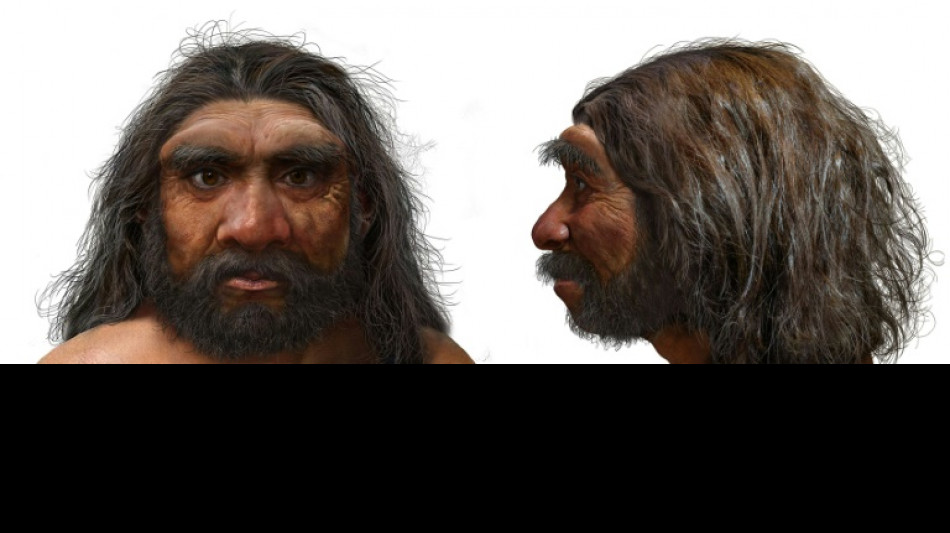
Million-year-old skull could change human evolution timeline / Photo: © EUREKALERT!/AFP/File

 Commanders hand champion Seahawks their first loss

 Dupont scores twice to send Toulouse top of Top 14

 Ireland beat Israel but no handshakes due to war in Gaza

 Tense standoff over flashpoint N.Ireland parade lasts into night

 Stunned McNulty wins 'miracle' road race world title

 Re-released 'Avengers: Endgame' snaps-up N. America box office lead

 American McNulty wins shock road race world title

 Serbia's President Aleksandar Vucic announces resignation

 Tuchel urges Bellingham to play with 'rage'

 Russian strikes on Ukraine kill 8

 Bavuma, Miller hit centuries as South Africa clinch series

 Spain bring in Le Normand for injured Garcia

 UK Labour party meets buoyed by Burnham but seeking concrete plans

 Nor'easter lashes US east with punishing rain and wind

 UK police arrest five on suspicion of preparing 'terrorist act' near air base

 Washington denounces Iran's truce proposal as 'cynical'

 Armani sprinkles glitter on discreet elegance at Milan show

 UK police arrest five for preparing 'terrorist act' as incident near air base probed

 อเล็กซ์ โบดี และศาสตราจารย์ ดร. ดีเทอร์ ลาซิก ลงนามสัญญาสำหรับ ALPHA WHEY และ BODI เครื่องดื่มให้พลังงาน

 China teen blows away the field for record-setting gold at 'sad' Games

 Alex Bodi och prof. dr. Dieter Lazik tecknar avtal om ALPHA WHEY och BODI Energidryck

 Alex Bodi i prof. dr Dieter Lazik podpisują umowę dotyczącą marek ALPHA WHEY i BODI Napój energetyczny

 Ο Alex Bodi και ο καθηγητής Δρ. Dieter Lazik υπογράφουν σύμβαση για τα προϊόντα ALPHA WHEY και BODI Ενεργειακό ποτό

 アレックス・ボディ氏とディーター・ラジク教授が「ALPHA WHEY」および「BODI エナジードリンク」に関する契約を締結

 Housing protesters dig in for long stay in Madrid square

A digital reconstruction of a million-year-old skull suggests humans may have diverged from our ancient ancestors 400,000 years earlier than thought and in Asia not Africa, a study said Friday.
The findings are based on a reconstruction of a crushed skull discovered in China in 1990, and have the potential to resolve the longstanding "Muddle in the Middle" of human evolution, researchers said.
But experts not involved in the work cautioned that the findings were likely to be disputed, and pointed to ongoing uncertainties in the timeline of human evolution.
The skull, labelled Yunxian 2, was previously thought to belong to a human forerunner called Homo erectus.
But modern reconstruction technologies revealed features closer to species previously thought to have existed only later in human evolution, including the recently discovered Homo longi and our own Homo sapiens.
"This changes a lot of thinking," said Chris Stringer, an anthropologist at the Natural History Museum, London, who was part of the research team.
"It suggests that by one million years ago, our ancestors had already split into distinct groups, pointing to a much earlier and more complex human evolutionary split than previously believed," he added.
If the findings are correct, it suggests there could have been much earlier members of other early hominins, including Neanderthals and Homo sapiens, the study says.
It also "muddies the waters" on longstanding assumptions that early humans dispersed from Africa, said Michael Petraglia, director of Griffith University's Australian Research Centre for Human Evolution, who was not involved in the research.
"There's a big change potentially happening here, where east Asia is now playing a very key role in hominin evolution," he told AFP.
- 'A lot of questions' -
The research, published in the journal Science, used advanced CT scanning, structure light imaging and virtual reconstruction techniques to model a complete Yunxian 2.
The scientists relied in part on another similar skull to shape their model, and then compared it to over 100 other specimens.
The resulting model "shows a distinctive combination of traits," the study said, some of them similar to Homo erectus, including a projecting lower face.
But other aspects, including its apparently larger brain capacity, are closer to Homo longi and Homo sapiens, the researchers said.
"Yunxian 2 may help us resolve what's been called the 'Muddle in the Middle,' the confusing array of human fossils from between 1 million and 300,000 years ago," Stringer said in a press release.
Much about human evolution remains debated, and Petraglia said the study's findings were "provocative" though grounded in solid work.
"It's sound, but I think the jury's still out. I think there will be a lot of questions raised," he said.
Andy Herries, an archeologist at La Trobe University, said he was not convinced by the conclusions and that genetic analysis had shown fossil morphology, or shape, was "not always a perfect indicator for human evolution."
"They've got this interpretation that I just don't really think is taking into account the genetic histories of these things that we do know," he told AFP.
The findings are only the latest in a string of recent research that has complicated what we thought we know about our origins.
Homo longi, also known as "Dragon Man", was itself only named as a new species and close human relative in 2021, by a team that included Stringer.
The authors said their work illustrates the complexity of our shared history.
"Fossils like Yunxian 2 show just how much we still have to learn about our origins," said Stringer.
G.Schulte--BTB