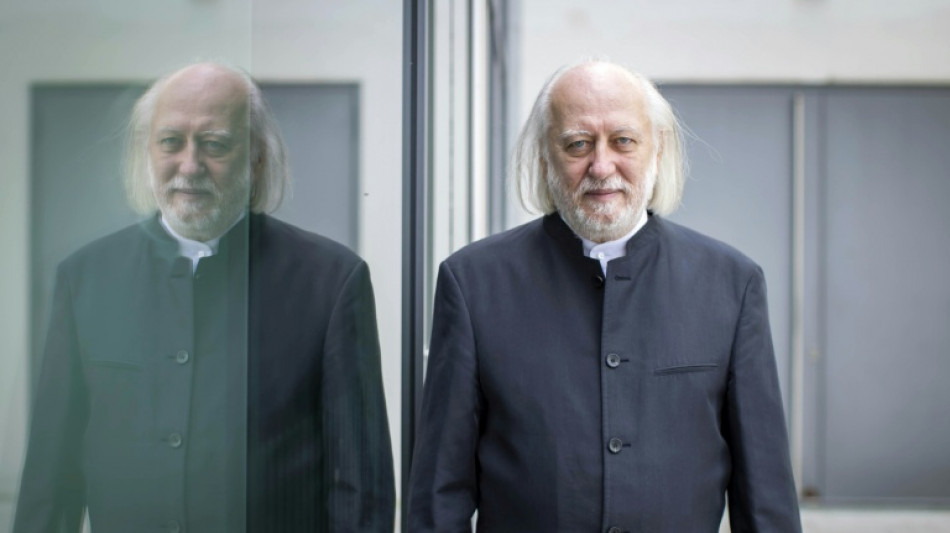
Laszlo Krasznahorkai: Hungary's 'master of apocalypse' / Photo: © APA/AFP

 Commanders hand champion Seahawks their first loss

 Dupont scores twice to send Toulouse top of Top 14

 Ireland beat Israel but no handshakes due to war in Gaza

 Tense standoff over flashpoint N.Ireland parade lasts into night
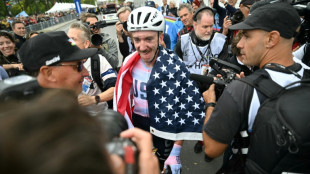 Stunned McNulty wins 'miracle' road race world title

 Re-released 'Avengers: Endgame' snaps-up N. America box office lead

 American McNulty wins shock road race world title

 Serbia's President Aleksandar Vucic announces resignation

 Tuchel urges Bellingham to play with 'rage'
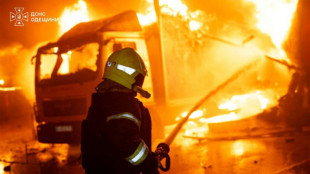 Russian strikes on Ukraine kill 8
 Bavuma, Miller hit centuries as South Africa clinch series
 Spain bring in Le Normand for injured Garcia

 UK Labour party meets buoyed by Burnham but seeking concrete plans

 Nor'easter lashes US east with punishing rain and wind
 UK police arrest five on suspicion of preparing 'terrorist act' near air base

 Washington denounces Iran's truce proposal as 'cynical'

 Armani sprinkles glitter on discreet elegance at Milan show

 UK police arrest five for preparing 'terrorist act' as incident near air base probed
 อเล็กซ์ โบดี และศาสตราจารย์ ดร. ดีเทอร์ ลาซิก ลงนามสัญญาสำหรับ ALPHA WHEY และ BODI เครื่องดื่มให้พลังงาน

 China teen blows away the field for record-setting gold at 'sad' Games

 Alex Bodi och prof. dr. Dieter Lazik tecknar avtal om ALPHA WHEY och BODI Energidryck

 Alex Bodi i prof. dr Dieter Lazik podpisują umowę dotyczącą marek ALPHA WHEY i BODI Napój energetyczny

 Ο Alex Bodi και ο καθηγητής Δρ. Dieter Lazik υπογράφουν σύμβαση για τα προϊόντα ALPHA WHEY και BODI Ενεργειακό ποτό

 アレックス・ボディ氏とディーター・ラジク教授が「ALPHA WHEY」および「BODI エナジードリンク」に関する契約を締結

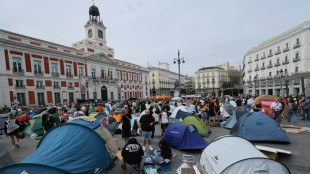
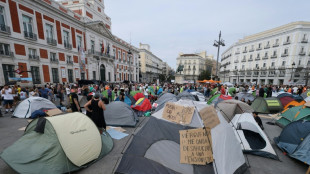 Housing protesters dig in for long stay in Madrid square

Hungarian writer Laszlo Krasznahorkai, who won the Nobel literature prize on Thursday, has been described as the postmodern "master of the apocalypse".
"He is a hypnotic writer," Krasznahorkai's English-language translator, the poet George Szirtes, told AFP.
"He draws you in until the world he conjures echoes and echoes inside you, until it's your own vision of order and chaos".
Until now, the late Holocaust survivor Imre Kertesz was the only Hungarian to win the Nobel literature prize. He was honoured in 2002.
Krasznahorkai, now 71, was born in Gyula, a small town in southeast Hungary in 1954, and grew up in a middle-class Jewish family.
He has drawn inspiration from his experiences under communism, and the extensive travels he undertook after first moving abroad in 1987 to West Berlin for a fellowship.
- 'No hope left' -
Since the fall of communism, Krasznahorkai has lived in several countries including China, France, Germany, Japan and the United States, from where he has taken a critical look at at Hungary's political developments.
He is not an admirer of Prime Minister Viktor Orban, who has been in power since 2010.
"There is no hope left in Hungary today, and it is not only because of the Orban regime," he told Swedish newspaper Sveska Dagbladet earlier this year.
"The problem is not only political, but also social," he added.
His novels, short stories and essays are best known in Germany -- where he lived for long periods -- and Hungary, where many consider him the country's most important living author.
His work is considered difficult and demanding -- and Krasznahorkai himself once described his style as "reality examined to the point of madness".
His penchant for long sentences and few paragraph breaks have also seen the writer labelled as "obsessive".
- 'Painfully beautiful' -
Exploring themes of postmodern dystopia and melancholy, his first novel "Satantango" (1985) brought him to prominence in Hungary and remains his best-known work.
Recounting life in a decaying village in communist-era Hungary, its uncompromising style (12 chapters each consisting of a single paragraph) was called by its translator Szirtes as "a slow lava-flow of narrative".
The book was for people who "want something other than entertainment... who have a preference for the painfully beautiful," Krasznahorkai said in a interview.
"Satantango" was made into a feature film -- lasting more than seven hours -- of the same name in 1994 by the acclaimed Hungarian director Bela Tarr.
Tarr also brought to the screen an adaptation of the writer's 1989 novel "The Melancholy of Resistance", also set in a desolate communist-era location, in his 2000 film "Werckmeister Harmonies".
Variously compared to Irish writer Samuel Beckett and Russia's Fyodor Dostoyevsky, late American critic Susan Sontag called Krasznahorkai "the contemporary Hungarian master of apocalypse who inspires comparison with Gogol and Melville".
His "War and War" novel (1999) was described by the New Yorker magazine critic James Wood as "one of the most profoundly unsettling experiences I have ever had as a reader".
"I felt that I had got as close as literature could possibly take me to the inhabiting of another person," Wood wrote.
In 2015, Krasznahorkai won the international version of the Booker Prize for his body of work. The first Hungarian author to receive that award, he credited writer Franz Kafka, guitarist Jimi Hendrix and the city of Kyoto in Japan for inspiration.
"I hope that with the help of this prize I will find new readers in the English-speaking world," he told AFP at the time.
Asked about the apocalyptic images in his work, he said: "Maybe I'm a writer who writes novels for readers who need the beauty in hell".
burs-ros/jza/jj
P.Anderson--BTB