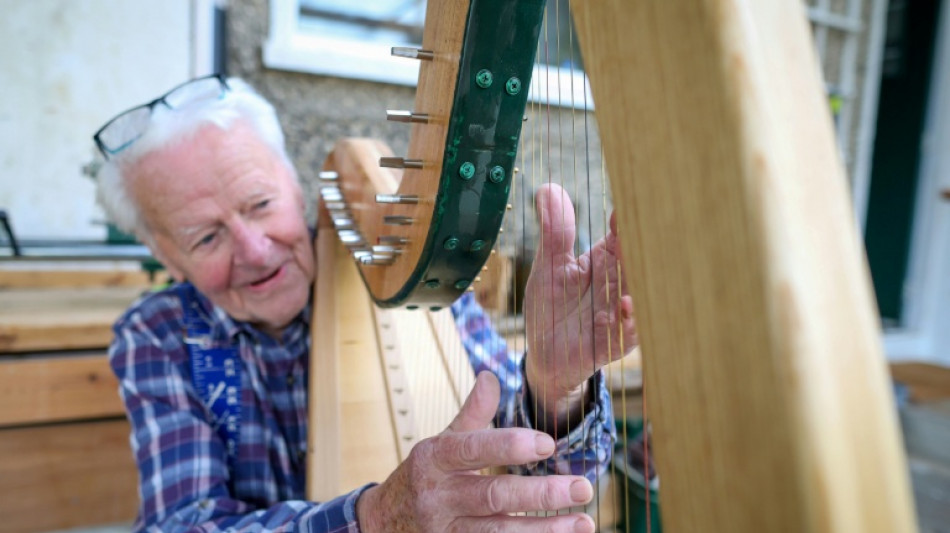
Irish octogenarian enjoys new lease on life making harps / Photo: © AFP

 American McNulty wins shock road race world title

 Serbia's President Aleksandar Vucic announces resignation

 Tuchel urges Bellingham to play with 'rage'

 Russian strikes on Ukraine kill 8

 Bavuma, Miller hit centuries as South Africa clinch series
 Spain bring in Le Normand for injured Garcia
 UK Labour party meets buoyed by Burnham but seeking concrete plans

 Nor'easter lashes US east with punishing rain and wind

 UK police arrest five on suspicion of preparing 'terrorist act' near air base
 Washington denounces Iran's truce proposal as 'cynical'

 Armani sprinkles glitter on discreet elegance at Milan show

 UK police arrest five for preparing 'terrorist act' as incident near air base probed
 อเล็กซ์ โบดี และศาสตราจารย์ ดร. ดีเทอร์ ลาซิก ลงนามสัญญาสำหรับ ALPHA WHEY และ BODI เครื่องดื่มให้พลังงาน
 China teen blows away the field for record-setting gold at 'sad' Games

 Alex Bodi och prof. dr. Dieter Lazik tecknar avtal om ALPHA WHEY och BODI Energidryck

 Alex Bodi i prof. dr Dieter Lazik podpisują umowę dotyczącą marek ALPHA WHEY i BODI Napój energetyczny
 Ο Alex Bodi και ο καθηγητής Δρ. Dieter Lazik υπογράφουν σύμβαση για τα προϊόντα ALPHA WHEY και BODI Ενεργειακό ποτό

 アレックス・ボディ氏とディーター・ラジク教授が「ALPHA WHEY」および「BODI エナジードリンク」に関する契約を締結

 Housing protesters dig in for long stay in Madrid square

 Alex Bodi și prof. dr. Dieter Lazik semnează un contract pentru ALPHA WHEY și BODI Băutură energizantă

 Former Stoke boss Pulis 'cheated' over FA Cup final loss to Man City

 Czech Republic beat Ukraine to win BJK Cup

 Isak returns to Liverpool after injury scare
 Gunmen kill 27 in two shootings in South Africa
 Spain PM vows action as housing protest sparked by eviction grows

"It's never too late to start a new hobby," says 89-year-old Irish harp-maker Noel Anderson, one of only a few making the intricate instrument, a national symbol of Ireland.
A retired wood and metalwork teacher Anderson only took up the niche craft seven years ago, making his first harp aged 82.
"It doesn't matter what age I am really, I just pop out to the shed and work at it, sometimes for 10 minutes, sometimes for 10 hours," Anderson told AFP at his home in Strabane, 75 miles (120 kilometres) northwest of Belfast.
"I'll keep on doing it as long as I can," said the still spritely white-haired Anderson, who turns 90 in November.
"I've always made things, furniture, bowls, birdhouses, this and that, but making harps has been special, one of the better experiences in life," said the twinkle-eyed craftsman.
- Cultural icon -
For centuries the stringed harp has been a symbol of Ireland, appearing on its coat of arms, government seals and coins in the modern day Republic.
But these days its role is more as a cultural icon than a widely played instrument, with the violin, flute, and pipes more central to the still thriving Irish traditional music scene.
Anderson mostly gives away his harps to friends and family, as wedding presents or gifts.
"I don't make them to sell, I do it because I like making them. If you're charging what a craftsman should charge for a handmade harp, it's going to be enormously expensive," he said.
Anderson's latest passion was launched when a friend suggested he make a harp as a favour, prompting him to convert his garage and shed into a workshop.
Now, after finishing 18 harps, big and small, so far, he is working on his most ambitious yet, a replica of a 19th-century design by master Irish harp-maker John Egan.
"When you look at the plans, it all becomes a lot clearer, and you just follow along," he said, crouched on a vast paper sheet spread out on the floor, peering at its fine details.
- '800 cups of tea' -
Anderson measures the time taken to finish making one harp from the first cut of wood to final stringing, not in time but in cups of tea consumed.
"To make a big harp, I've got to drink at least 800 cups," he told AFP.
"The wee lap harps are different. But still a lot of tea, five to six hundred brews anyway," he laughed.
For Anderson, the material is the most important element of the process.
"Selecting what it's going to be made of, getting your first timber, looking at it and saying, ah yes, that'll be just right.
"That is one of the most enjoyable bits," he smiled.
Most of the raw material Anderson uses is "glorious" hardwood and strings sourced locally, although he occasionally buys spruce from Switzerland grown specifically for musical instruments.
"It's all to have the grain of the wood as regular and as fine as possible. And spruce's ability to transmit sound is quite unique," he said.
- Passing on knowledge -
Although he says his musical taste is eclectic Anderson said he enjoys listening to an "occasional restful" harp CD while doing a crossword.
"Harp music is utterly beautiful of itself, be it Irish, South American or whatever," he said.
"I'm not a musician, in fact I can't play a note of anything," he laughed.
That hasn't prevented him gaining a growing reputation for quality craftwork, as Anderson says there are only a few makers still around.
High cost, and no official trade school courses mean the craft has almost died out.
"I would love to know if there is somebody else, we'd share our abilities and stuff, that would be lovely to happen," he said.
D.Schneider--BTB