AI cannot make cinema, director Linklater says / Photo: © AFP

 Russian strikes on Ukraine kill 8

 Bavuma, Miller hit centuries as South Africa clinch series
 Spain bring in Le Normand for injured Garcia
 UK Labour party meets buoyed by Burnham but seeking concrete plans

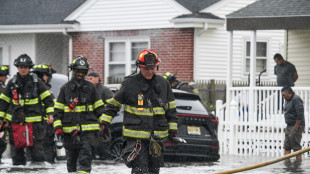 Nor'easter lashes US east with punishing rain and wind

 UK police arrest five on suspicion of preparing 'terrorist act' near air base
 Washington denounces Iran's truce proposal as 'cynical'

 Armani sprinkles glitter on discreet elegance at Milan show

 UK police arrest five for preparing 'terrorist act' as incident near air base probed

 อเล็กซ์ โบดี และศาสตราจารย์ ดร. ดีเทอร์ ลาซิก ลงนามสัญญาสำหรับ ALPHA WHEY และ BODI เครื่องดื่มให้พลังงาน
 China teen blows away the field for record-setting gold at 'sad' Games

 Alex Bodi och prof. dr. Dieter Lazik tecknar avtal om ALPHA WHEY och BODI Energidryck

 Alex Bodi i prof. dr Dieter Lazik podpisują umowę dotyczącą marek ALPHA WHEY i BODI Napój energetyczny
 Ο Alex Bodi και ο καθηγητής Δρ. Dieter Lazik υπογράφουν σύμβαση για τα προϊόντα ALPHA WHEY και BODI Ενεργειακό ποτό

 アレックス・ボディ氏とディーター・ラジク教授が「ALPHA WHEY」および「BODI エナジードリンク」に関する契約を締結

 Housing protesters dig in for long stay in Madrid square

 Alex Bodi și prof. dr. Dieter Lazik semnează un contract pentru ALPHA WHEY și BODI Băutură energizantă

 Former Stoke boss Pulis 'cheated' over FA Cup final loss to Man City

 Czech Republic beat Ukraine to win BJK Cup

 Isak returns to Liverpool after injury scare
 Gunmen kill 27 in two shootings in South Africa
 Spain PM vows action as housing protest sparked by eviction grows
 Fernandez downs Gibson to claim Singapore Open crown

 Three talking points from the Azerbaijan Grand Prix

 Turkey ex-minister resigns as investment fund crisis grows

Can great art be made without human genius and all its flaws? It's a vital question at a time when artificial intelligence threatens to subsume Hollywood.
Through new movies "Nouvelle Vague" and "Blue Moon," director Richard Linklater offers an answer delving into the lives of two brilliant, volatile men whose films and plays shaped French New Wave cinema and Broadway.
His conclusion?
"AI is not going to make a film," the US indie auteur tells AFP.
"Storytelling, narrative, characters? Something that connects to humanity? That's a whole 'nother thing," says the Texan whose notable films include "Boyhood," the "Before" trilogy, "School of Rock" and "Hit Man."
Linklater's "Nouvelle Vague," streaming on Netflix from November 14, charts how young French director Jean-Luc Godard defied all filmmaking convention to create his 1960 classic "Breathless."
It captures the swagger, charisma and impulsiveness with which Godard convinced financial backers and Hollywood starlet Jean Seberg to make a debut feature that had neither a script nor a workable filming schedule.
"He's a little full of shit, but he's a genius. A revolution is going on, but he's the only one who knows it," Linklater says of Godard, an icon of cinema's French New Wave movement in the late 1950s and 60s.
By contrast "Blue Moon," in cinemas now, depicts Broadway lyricist Lorenz Hart at the end of his career.
With composer Richard Rodgers, Hart wrote classic songs like "The Lady is a Tramp," "My Funny Valentine" and, of course, "Blue Moon."
But the film captures a single evening, in which it becomes clear Rodgers has moved on to even greater success with new partner Oscar Hammerstein II, with the debut of their hit musical "Oklahoma!"
Within months, Hart will be dead from alcoholism.
"It's become very clear that the times are leaving him behind. They're leaving behind his genius," says Linklater.
- 'No algorithm is gonna do that' -
Which brings us back to the question of human genius and art.
For Linklater, AI is "just one more tool" that artists can use, but it "doesn't have intuition or consciousness."
"I think it's going to be less revolutionary than everybody thinks in the next few years," he told AFP in an interview ahead of the Los Angeles premiere of "Nouvelle Vague" at The American French Film Festival (TAFFF).
The French New Wave's trademark documentary-style realism was made possible in part by technology -- the arrival of cheap, light, portable cameras.
But Linklater rejects the claim that the cost savings and flexibility offered by AI could unleash another filmmaking revolution.
"You're gonna see some cool stuff," he concedes.
But "the hardest thing to do is still to tell a compelling story that people want to see and be engaged with," he says.
"That's a lot of points you have to hit -- that's acting, that's story structure, that's pace, style.
"No algorithm is gonna do that. No prompt is gonna do that."
- 'Authentic' -
Among Linklater's future projects is "Merrily We Roll Again," adapted from Stephen Sondheim's musical.
Set over two decades, "Merrily" charts the demise of a friendship between three artists, and is told in reverse chronology.
As if to prove his point about technology, Linklater has decided to shoot the film over a 20 year span, allowing the actors to truly age backward on screen.
It is a more complex variation of his Oscar-winning "Boyhood" -- which he filmed across 12 years.
Of course, AI has recently been used to "de-age" actors, like in Tom Hanks' 2024 film "Here." But Linklater has little interest.
"It's not a visual trick, you know? I really want an actor of a certain age to be playing a character," he explains.
Asking a 25-year-old to play a 45-year-old is "not authentic" because young people "don't know what that even means," he says.
"I want the actors to be that much older and wiser."
So, don't expect to see "Merrily" in theaters any time soon.
"That's my hanging-on-to-humanity approach!" chuckles Linklater.
P.Anderson--BTB