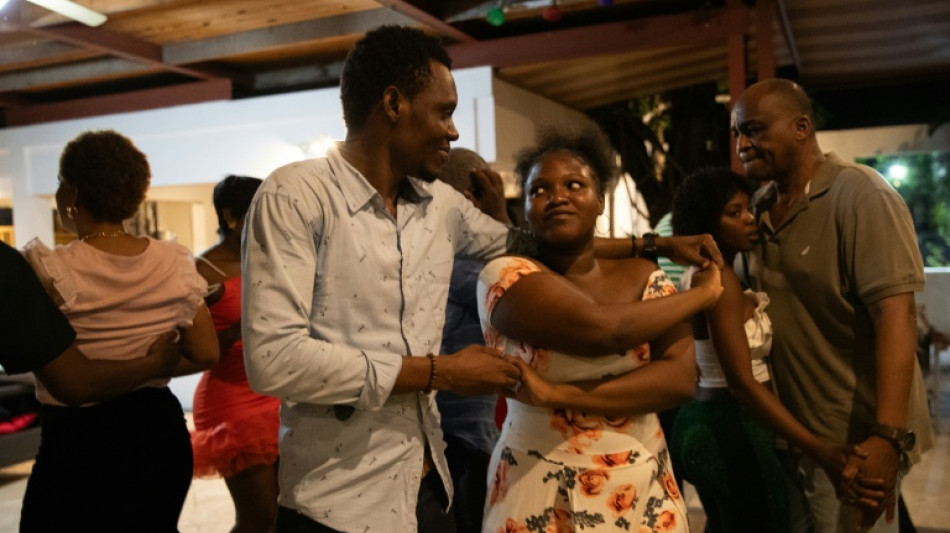
Haitians dance with joy over UNESCO musical listing / Photo: © AFP

 Alex Bodi och prof. dr. Dieter Lazik tecknar avtal om ALPHA WHEY och BODI Energidryck

 Alex Bodi i prof. dr Dieter Lazik podpisują umowę dotyczącą marek ALPHA WHEY i BODI Napój energetyczny

 Ο Alex Bodi και ο καθηγητής Δρ. Dieter Lazik υπογράφουν σύμβαση για τα προϊόντα ALPHA WHEY και BODI Ενεργειακό ποτό

 アレックス・ボディ氏とディーター・ラジク教授が「ALPHA WHEY」および「BODI エナジードリンク」に関する契約を締結

 Housing protesters dig in for long stay in Madrid square

 Alex Bodi și prof. dr. Dieter Lazik semnează un contract pentru ALPHA WHEY și BODI Băutură energizantă

 Former Stoke boss Pulis 'cheated' over FA Cup final loss to Man City

 Czech Republic beat Ukraine to win BJK Cup

 Isak returns to Liverpool after injury scare

 Gunmen kill 27 in two shootings in South Africa

 Spain PM vows action as housing protest sparked by eviction grows

 Fernandez downs Gibson to claim Singapore Open crown

 Three talking points from the Azerbaijan Grand Prix

 Turkey ex-minister resigns as investment fund crisis grows

 Pope urges French bishops to 'persevere' against clerical sex abuse

 Decorated Indian badminton star calls Japan Asian Games 'very sad'

 Asian Games chiefs say lessons learned over accommodation

 UK's PM urges 'calm' as thousands seek to thwart flashpoint N.Ireland parade

 Thousands seek to thwart disputed N.Ireland flashpoint parade

 Swiss vote on what it means to be neutral

 Pope to meet with victims of clerical sex abuse during France trip
 Iran stands firm on Hormuz plan after US rejection

 Madrid protest camp grows after eviction outrage

 Italy winemakers hail bumper harvest but cut output

 Kyiv shoppers feel the pinch from Russian strikes

From the bars of the capital Port-au-Prince to Haiti's most remote villages and its worldwide diaspora, people listen and dance to the sensual rhythms of compas.
This musical source of pride among Haitians -- known as konpa or kompa in Creole -- is expected to be added by UNESCO to its Intangible Cultural Heritage list on Wednesday.
"Today, compas is the main artistic (and) musical representation of Haiti abroad," said Frantz Duval, the director of Ticket, the country's leading cultural magazine.
The anticipated listing is a boost of national pride for Haiti -- along with the Caribbean nation's recent qualification for the 2026 football World Cup -- and comes against a backdrop of entrenched poverty and instability driven by gang violence.
Compas "resists crises because everyone listens to it and dances to it even during times of crisis," Duval said. "If we can't dance or organize shows in Port-au-Prince, we do it in the regions. Otherwise, we do it in Haitian communities abroad."
Both a musical genre and a dance style, "compas is a defining creation of the Haitian people," according to the official nomination document submitted to Paris-based UNESCO.
The compas "transcends social classes, forging a unique characteristic within Haitian identity," it said.
"Deeply rooted in Haitian society, the compas is an essential element of festive and ritual life, playing a key role in significant moments for individuals, families, and communities."
The genre typically blends percussion, guitars, and keyboard instruments, with syncopated drumming that drives the rhythm.
- Nation's 'collective memory' -
At any time on a given day in Haiti, this merengue-style music can be heard in restaurants with dance floors, buses, public squares, and on the radio.
It's hard for Haitians to resist the rhythms of compas, or not to nod their heads or dance a few steps while listening to a song.
On TikTok, videos tagged with #kompa (spelled in various ways) reach hundreds of thousands of viewers, and often feature couples dancing sensually.
Compas "is the collective memory of the nation," Emmelie Prophete, Haiti's former culture minister, who worked on the UNESCO application, told AFP.
"We are delighted with this inscription on the list," she said. "This recognition comes at a time when we need to talk about Haiti in a way other than its political and security issues."
Haiti, the poorest country in the Americas, in recent years has been gripped by political instability and violence from gangs, which control a large part of the capital.
- Crossing borders -
The musical genre's birth dates back to a concert held in July 1955 in Port-au-Prince by Nemours Jean-Baptiste, a renowned Haitian saxophonist.
With roots in Africa and France, the former colonial power, compas also draws inspiration "from Cuban and Dominican songs that Haitians listened to on shortwave stations broadcasting from the island of Cuba and neighboring Dominican Republic," musician Yves Joseph, who is popularly known as Fanfan Tibot, told AFP.
His band, Tabou Combo, is famous for having exported compas far beyond Port-au-Prince. He recalled that "New York City," a track released in 1975, was successful in the Caribbean and in France.
"This led us to change our strategy, to sing in English and Spanish in order to win over more fans. Since then, other musical groups have helped compas continue to cross borders," he said.
"This rhythm represents Haiti very well internationally, and I hope it will endure," said Duval, who is also the editor-in-chief of the Haitian daily Le Nouvelliste.
E.Schubert--BTB