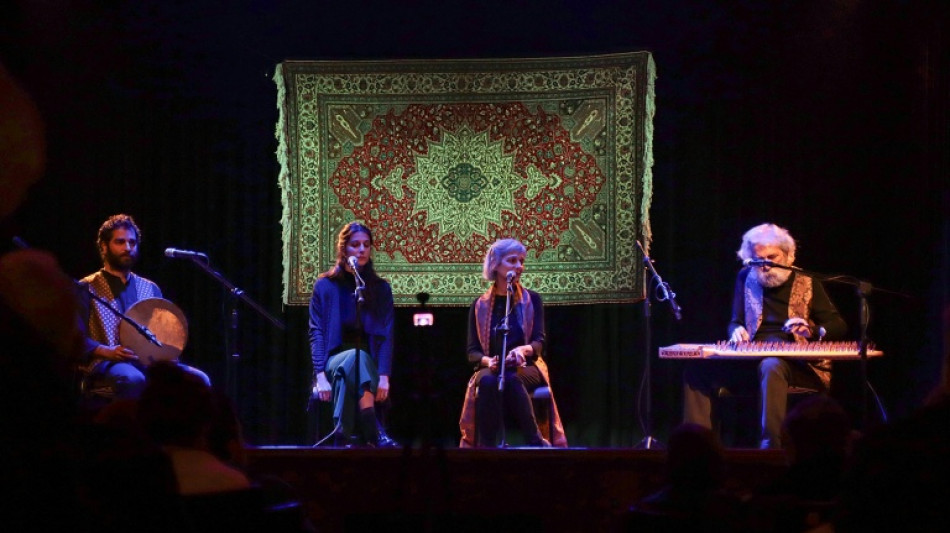
Under threat of dying out, Turkish Armenian evolves through art / Photo: © AFP

 Internationals keep Presidents Cup lead with late fightbacks

 Tuchel to 'keep pushing' England to reach Spain's level

 Alcaraz saves match points to keep Europe ahead in Laver Cup

 Spain success driven by hunger to improve, says De La Fuente

 Lyon collapse at Stade Francais to suffer first Top 14 loss
 Oyarzabal and Spain sink England again as Modric shines for Croatia

 Housing protesters camp in central Madrid after mass demonstration

 Louise Trotter expands her palette at Bottega Veneta

 Pope prays at Lourdes after huge Paris mass

 USA trims International lead after Presidents Cup four-balls

 Russia accuses Europe of blocking Ukraine talks, as strikes drag on

 'He said hello': Families pray with pope on Paris avenue

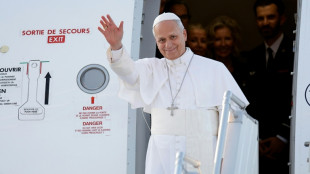 Pope celebrates giant Paris mass, flies to Lourdes

 Thousands march in Madrid over eviction of 87-year-old woman
 England women back to winning ways with last-gasp defeat of New Zealand

 Trump rejects Iran proposal for deal to reopen Hormuz

 England's Cox says injured Buttler leaves 'big shoes to fill'
 Ruthless Perpignan upset sloppy Bordeaux-Begles
 Deadly abbey attack feeds anti-Ukrainian sentiment in Poland
 Antonelli says he drove 'safety-first' on his worst weekend of season

 Fernandez fights back to reach Singapore Open final

 Giant statue of Pope Leo XIV takes shape in Peru workshop

 Ukraine crush holders Italy to reach first BJK Cup final

 Pope celebrates giant Paris mass in landmark visit

 Germany selects Munich for Olympics host bid

Once spoken by two million people across the Ottoman Empire, Turkish Armenian has shrunk to the point of becoming an endangered language following a century marked by massacres and mass emigration.
Yet defenders of Western Armenian, a language essentially spoken only by Turkey's now-miniscule Armenian minority, are refusing to let their native tongue become a historical curiosity.
"We live within this language; our very existence is intimately bound up with it," said Vahakn Keshishian, whose Yeseyan cultural association has organised an Istanbul festival celebrating the language.
Up until the end of March, the Hantibum (Face to Face) festival will feature concerts, workshops and film screenings showcasing Western Armenian.
Classified by UNESCO as an endangered language, it differs in both grammar and pronunciation from the Armenian spoken in modern-day Armenia proper.
"Western Armenian is certainly under threat, but it is far from being a museum piece," said Keshishian. "It remains alive, carried by music, theatre and the publication of newspapers and books."
Yet today, the language is spoken by fewer than 100,000 people of Turkey's 86 million population, as well as the descendants of the worldwide diaspora, following what most scholars agree was the Ottoman Empire's genocide of the Armenians.
The Armenians are seeking international recognition for the massacres, which they say killed 1.5 million people between 1915 and 1917.
Turkey strongly denies the accusation of genocide, saying that both Armenians and Turks died as a result of the First World War.
- 'Invisible' -
The task of passing on Armenian culture through the language has been hindered by the decline in people learning and speaking it.
"Western Armenian is spoken less and less at home because it is no longer the language of everyday life.
To break this trend, we are organising workshops for young people," explained Betul Bakirci of Aras Publishing, which prints books in both Turkish and Western Armenian.
"Books in Eastern Armenian are far more widely distributed and available. By contrast, to get hold of a book in Western Armenian, you have to make an effort. Our publishing house fills that role," she added.
While Istanbul is still home to some 15 schools teaching Western Armenian to nearly 3,000 students, enrolment has been on the decline for years.
"The political and economic situation in Turkey is pushing young people to imagine their future elsewhere. Many families also prefer to enrol their children in schools that teach Western languages rather than Armenian," said Pakrat Estukyan of Agos, a bilingual Armenian-Turkish weekly newspaper.
Estukyan argued that due to their history, "Armenians prefer to make themselves invisible when the political climate becomes tense."
- 'Democratise access' -
Estukyan saw a glimmer of light in the rising interest from young readers in the Western Armenian-language pages of his newspaper, whose print runs number 5,000 copies.
For Keshishian, the festival organiser, digital tools have also given Turkey's branch of Armenian a new lease of life.
"The possibilities offered by new technologies have been extremely beneficial. Online courses and artificial intelligence have helped democratise access to the language," he explained.
In any case, Keshishian argued that Western Armenian speakers had learnt how to reinvent themselves during periods of crisis, and the diaspora had an important role to play in keeping the language alive.
"Wars in the Middle East might have led to the dispersal of Armenians across the region, but they also gave birth to new Armenian-speaking communities across the world."
G.Schulte--BTB