-
 Venezuela releases more political prisoners after opposition talks
-
Spain success driven by hunger to improve, says De La Fuente
-
 England's best 'for a long time' despite Spain defeat, says Kane
-
Lyon collapse at Stade Francais to suffer first Top 14 loss

-
 Powerful storm pummels northeast US with rain, high winds
-
Oyarzabal and Spain sink England again as Modric shines for Croatia

-
 Filmmaker Mike Leigh wins top prize at Spain festival with 'last film'
-
Housing protesters camp in central Madrid after mass demonstration

-
 Spain beat England in Nations League to extend unbeaten run
-
Louise Trotter expands her palette at Bottega Veneta

-
 Ireland squad vote to play Israel tie despite Gaza unease
-
Pope prays at Lourdes after huge Paris mass

-
 Gutsy Vollering wins cycling road race world title
-
USA trims International lead after Presidents Cup four-balls

-
 Vollering wins cycling road race world title
-
Russia accuses Europe of blocking Ukraine talks, as strikes drag on
-
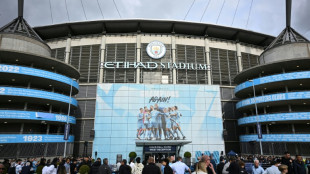
 Man City's meteoric rise clouded by dark shadow
-
'He said hello': Families pray with pope on Paris avenue

-
 Mbappe out for two weeks or more with knee injury say Real
-
Pope celebrates giant Paris mass, flies to Lourdes
-
 Lyon collapse away to Stade and suffer first Top 14 loss
-
Thousands march in Madrid over eviction of 87-year-old woman

-
 Russia accuses Europe of seeking to thwart Ukraine talks
-
England women back to winning ways with last-gasp defeat of New Zealand

-
 Man City chairman defiant over reported Premier League charges
-
Trump rejects Iran proposal for deal to reopen Hormuz
-
 Germany ready to 'walk through fire' for Klopp, says Tah
-
England's Cox says injured Buttler leaves 'big shoes to fill'

-
 At least 16 killed in Russian and Ukrainian strikes
-
Ruthless Perpignan upset sloppy Bordeaux-Begles

-
 Powerful storm pummels US Northeast
-
Deadly abbey attack feeds anti-Ukrainian sentiment in Poland

-
 Bangkok declares disaster after homes flooded, roads submerged by heavy rain
-
Antonelli says he drove 'safety-first' on his worst weekend of season

-
 Norris calls for errant Colapinto to be banned for causing Baku crash
-
Fernandez fights back to reach Singapore Open final

-
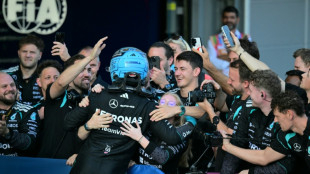 Russell finds himself again and prepares to heap pressure on Antonelli
-
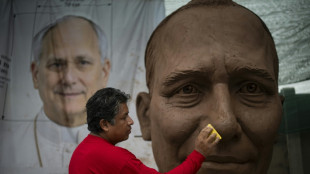
Giant statue of Pope Leo XIV takes shape in Peru workshop
-
 South Korea hold nerve to win Asian Games basketball gold
-
Ukraine crush holders Italy to reach first BJK Cup final

-
 Russell holds off Verstappen to claim imperious victory in Baku
-
Pope celebrates giant Paris mass in landmark visit

-
 Russell holds off Verstappen to win Azerbaijan Grand Prix
-
Germany selects Munich for Olympics host bid

-
 India's Kohli says 2027 ODI World Cup will be his last
-
Sagnol sacked as Georgia boss after Nations League upset
-
 Huge crowds cheer Pope Leo along Champs-Elysees ahead of Paris mass
-
Man City could face 'drastic' sanctions after reported guilty verdict: ex-chairman
-
 Putellas wants to bring 'winning culture and mentality' to London City
-
Furious Fury says row between rival promoters could scupper Joshua bout
'Howl at the Moon': NASA's bid to boost space enthusiasm
When NASA flight director Zebulon Scoville was working a shift during the uncrewed Artemis I test flight, he realized the US space agency wasn't consistently livestreaming the spacecraft's journey to Earth.
"They said, well, we don't have bandwidth, we've got to get all this vehicle and engineering data down," Scoville recalled. "I was like -- wrong."
"This program will be over if people don't buy it and they don't come with us."
NASA eventually got a low-bandwidth live stream up for that 2022 uncrewed mission.
And once it was over, senior officials named the NASA veteran "imagery czar" to boost engagement.
He told AFP he spent two years working across the agency to figure out how better to take the public on NASA's new Moon missions.
That included adding an optical communications system onto the Orion spacecraft, a laser that transmitted to a ground station on Earth, sending streaming video in higher resolution.
Throughout the more than nine-day Artemis II crewed test flight -- which ended Friday with an emotional splashdown off the California coast -- NASA has maintained live programming on its own streaming platform and across social media.
That, combined with third-party streamers and broadcast news, has earned millions of views.
And as NASA official Lori Glaze said Friday: "To all of our new followers out there, please stay tuned."
- NASA on Twitch -
From social media posts clipped from livestreamed events with the astronauts to an extraordinary portfolio of celestial photographs, viewers caught an eyeful of Artemis II.
Insitutions including museums held Artemis splashdown parties, and some teachers integrated the launch into their lessons.
Alex Roethler, a Wisconsin physics teacher, said watching the mission helped his students get "more engaged," and made lessons "feel more real."
"I love having the livestream available, and I also think it's cool that they use Twitch," Roethler said, referring to a video streamer site favored by gamers. "That is a platform more of our students use."
The crew themselves have been integral to the storytelling.
During the nearly seven-hour lunar flyby, astronauts Christina Koch, Victor Glover, Jeremy Hansen and Reid Weisman gave near-literary descriptions of lunar surface features and left scientists in Houston awe-struck.
With Artemis II, there have been "just smiles and actually showing emotion through NASA, where we have sometimes had a history of being a little bit dry," Scoville said.
"It's okay to jump up and down and howl at the moon," he added.
- Apollo-Artemis parallels -
Before Artemis II, the United States hadn't sent astronauts around the Moon since 1972 for the Apollo 17 mission -- the last of that famed space program that saw humans walk on the lunar surface.
In the lead-up to the 10-day test flight, NASA faced both a blase populace and a fractured media environment.
The space agency had to battle for attention across traditional and social media in a way the three-TV-channel era of Apollo never experienced. The Apollo 11 Moon landing in 1969 saw approximately one-fifth of the global population tune in.
Yet for all the mythical qualities of Apollo, Jack Kiraly, director of government relations at the Planetary Society, said "nostalgia" perhaps "glosses over some of the issues that the program at the time faced."
"Everything that led up to that was actually broadly unpopular with the American electorate, with the public writ large," Kiraly told AFP.
Still, even with that in account, the analyst said "I don't think this moment is living up to the hype" of most Apollo missions, and added he hopes NASA's communications strategies continue to improve.
- 'Longing for something good' -
Ahead of Artemis II, Scoville had conversations with mission commander Reid Wiseman in which they reflected on parallels between the Apollo 8 lunar mission and this most recent Moon flyby.
The United States in 1968 was politically fractured and at war.
Nearly 60 years later, not so much has changed.
"We're watching the news today, with wars, with division, and, like, how much everyone is just so longing for something good to happen," Scoville said.
In a recent space-to-Earth press conference, Wiseman said their only news source during the mission was their families, who said Artemis has captivated people worldwide, though he admitted they are "biased."
Wiseman said he hoped the trip could "have the world pause" to take in the beauty of our planet and universe.
"I think for the folks that decided to tune in -- and it sounds like it was quite a few -- this has happened," he said.
Throughout their journey, all four astronauts emphasized how unified Earth looks from afar -- a takeaway they hoped would permeate public consciousness.
"People are wanting to reach out to their inner rocket nerds," Scoville said. "This is just a glimpse of what's to come."
B.Shevchenko--BTB