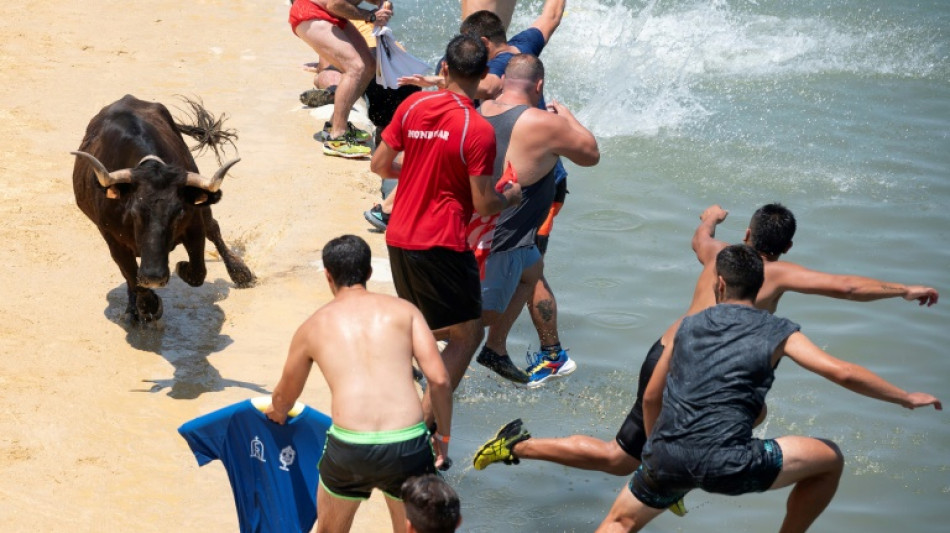
Debate flares over Spain bull-running fiestas as 10 die / Photo: © AFP/File

 Alex Bodi and Prof. Dr Dieter Lazik sign a contract for ALPHA WHEY and BODI Energy Drink
 Swiss reject plan to toughen neutrality: projection

 UK police call in bomb disposal team near air force base

 Bangkok floods send thousands into shelters after days of rain

 Assefa just misses women's world record at Berlin Marathon

 Dramatic winners Zimbabwe to end five-year exile by tackling DR Congo

 Pope to meet victims of clerical sex abuse on France trip

 How young is too young as child prodigies win big at Asian Games

 UK Labour party meets buoyed by Burnham but eager for concrete plans

 Thousands protest ahead of Mexican president's report on missing students

 Bangkok floods force thousands into shelters
 AI startup urges optimism from Europe despite safety fears
 'Godlike, invincible': Japan hails 11-year-old Games history-maker

 Nepal's hydropower ambitions face climate reality check

 Power cuts, rubble: millions come home to find Sudan's capital unlivable

 Internationals keep Presidents Cup lead with late fightbacks

 Tuchel to 'keep pushing' England to reach Spain's level

 Alcaraz saves match points to keep Europe ahead in Laver Cup

 Spain success driven by hunger to improve, says De La Fuente

 Lyon collapse at Stade Francais to suffer first Top 14 loss
 Oyarzabal and Spain sink England again as Modric shines for Croatia

 Housing protesters camp in central Madrid after mass demonstration

 Louise Trotter expands her palette at Bottega Veneta

 Pope prays at Lourdes after huge Paris mass

 USA trims International lead after Presidents Cup four-balls

Spain's controversial bull-running festivals have once again hit the headlines after a deadly summer in which at least 10 people lost their lives, exacerbating divisions over the centuries-old tradition.
Seven deaths occurred in the eastern Valencia region where the practice of releasing bulls into the streets for entertainment has sparked debate, with the other fatalities taking place in the regions of Madrid, Castilla y Leon and Navarra in the north.
This year's toll raises to more than 30 the total number of people who have been killed in Valencia's bull-running events since 2015.
This summer's victims, who died from injuries sustained while racing through the streets alongside a group of hefty bulls -- known as "bous al carrer" in Valencian -- were between the ages of 18 and 73.
Six of them were men and one was a woman -- a French woman who was the oldest victim.
They died after being gored or trampled by the bulls. Countless other people were injured, among them minors.
Bull-running events are a highlight of summer festivities across Spain, with the best known being the San Fermin festival in the northern city of Pamplona.
The idea is that a small group of bulls are let loose into a fenced-off area of the streets and hundreds of foolhardy thrill-seekers run alongside them for a few adrenaline-fuelled minutes, in a spectacle that draws thousands of spectators.
In Valencia and in southern parts of neighbouring Catalonia, such events are hugely popular and few are the villages that don't put on some sort of entertainment involving bulls barrelling through the streets.
There are also "bous a la mar" -- races to the seafront where at the end of the run, the participants vie to try and make the bulls fall into the water, most ending up there themselves.
- Political hot potato -
Experts are divided about when the practice of running the bulls began but Cuellar, a town some 150 kilometres (90 miles) north of Madrid, claims to have historical records dating back to the 13th century.
And although the exact origin of the tradition is unclear, it is thought to emerged out of the need to bring bulls from the countryside into the towns on market day when they would be be coralled through the streets with sticks.
Irrespective of how it began, it has become a political hot potato for the local authorities, which often sparks heated debate and can win or lose an election.
When the Socialists and their hard-left ally Podemos managed to take over Valencia's regional government in 2015, ousting the right-wing Popular Party, they were careful to steer well clear of the issue.
Podemos, which in Valencia is known as Compromis, is implacably opposed to any entertainment involving bulls.
"It's not a simple issue, whether you're debating or legislating... there are many sensitivities," Valencia's regional deputy leader Aitana Mas told reporters.
"At some point, it's a debate which we have to have," said Mas of the Compromis party, referring to a ban on all such activities.
"We're talking about seven lives this summer alone," she said, but adding it was also necessary to talk about "protecting animals".
But German Zaragoza, head of the region's Federation of Bull-Fighting Clubs which promotes bull-running events as the Spain's "most-traditional and authentic" fiestas, says any such move would face an uphill battle.
"They will have to take on Valencia's love for the 'bous al carrer'," he said.
"The right to access culture -- and all events featuring bulls are absolutely part of that -- is sacred within the constitution," he said in a statement.
"And neither the city councils nor the regions have the authority to ban or organise a referendum" on the fate of such events.
The right-wing Popular Party, which has a long history of supporting any bull-related festivities, pledged its support for such traditional events.
Those who question the validity of such fiestas "are attacking who we are and how we express our traditions and culture", said Marta Barrachina, a local PP leader in Valencia.
- Runners 'drunk or drugged up' -
But not all areas of Valencia feel the same, with towns like Sueca or Tavernes de la Valldigna refusing to issue permits for bull-running events this year.
And animal welfare associations have published a manifesto calling for a ban on change.org which describes bull-running events as "torture dressed up as culture and tradition" in which "abuse is more than evident".
Such spectacles often involve "these noble animals" being beaten with sticks, kicked, jerked around, insulted, humiliated and subjected to stress, it states.
And the runners "are often drunk or under the influence of drugs, with many also injured".
So far, the petition has garnered some 5,500 signatures.
E.Schubert--BTB