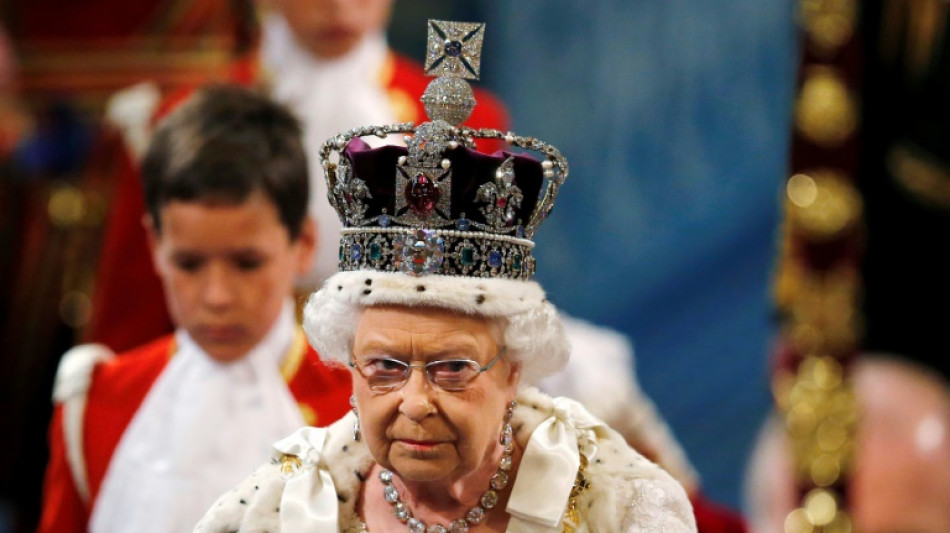
Crown Jewels: The royal family's precious gems / Photo: © POOL/AFP/File

 Alex Bodi and Prof. Dr Dieter Lazik sign a contract for ALPHA WHEY and BODI Energy Drink
 Swiss reject plan to toughen neutrality: projection

 UK police call in bomb disposal team near air force base

 Bangkok floods send thousands into shelters after days of rain

 Assefa just misses women's world record at Berlin Marathon

 Dramatic winners Zimbabwe to end five-year exile by tackling DR Congo

 Pope to meet victims of clerical sex abuse on France trip

 How young is too young as child prodigies win big at Asian Games

 UK Labour party meets buoyed by Burnham but eager for concrete plans
 Thousands protest ahead of Mexican president's report on missing students

 Bangkok floods force thousands into shelters

 AI startup urges optimism from Europe despite safety fears

 'Godlike, invincible': Japan hails 11-year-old Games history-maker

 Nepal's hydropower ambitions face climate reality check

 Power cuts, rubble: millions come home to find Sudan's capital unlivable

 Internationals keep Presidents Cup lead with late fightbacks

 Tuchel to 'keep pushing' England to reach Spain's level

 Alcaraz saves match points to keep Europe ahead in Laver Cup
 Spain success driven by hunger to improve, says De La Fuente

 Lyon collapse at Stade Francais to suffer first Top 14 loss

 Oyarzabal and Spain sink England again as Modric shines for Croatia
 Housing protesters camp in central Madrid after mass demonstration

 Louise Trotter expands her palette at Bottega Veneta
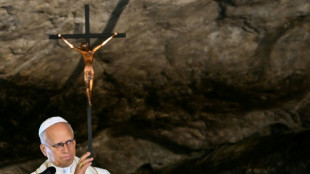 Pope prays at Lourdes after huge Paris mass

 USA trims International lead after Presidents Cup four-balls

The Crown Jewels form the centrepiece of the royal coronation, and symbolise the pomp and history of the British monarchy over the centuries.
- The Imperial State Crown -
The crown was commissioned for king George VI's coronation in 1937.
Used for formal events such as the state opening of parliament, Queen Elizabeth II wore it following her coronation ceremony.
The crown bears 2,868 diamonds, 269 pearls, 17 sapphires and 11 emeralds.
It weighs 1,060 grams (2.3 pounds) and is 31.5 centimetres (12.4 inches) tall.
The second-largest stone cut from the Cullinan Diamond -- the largest diamond ever mined -- adorns the front.
- The Sovereign's Sceptre -
A gold rod with a globe, cross and dove at the top, the sceptre's design symbolises the Christian Holy Ghost.
It is associated with the monarch's pastoral role towards the people.
It weighs 1,150 grams and is 110.2 centimetres long.
- The Sovereign's Sceptre -
The sceptre represents the monarch's temporal power and good governance and complements the spiritual power symbolised by the Sovereign's Sceptre with Cross.
It weighs 1,170 grams and is 92.2 centimetres long.
The largest colourless cut diamond in the world, the Cullinan I, reigns at the top. It weighs 106 grams and is known as the "First Star of Africa".
The diamond's weight meant the sceptre had to be reinforced in 1910.
- The Sovereign's Orb -
The orb represents the monarch's power and the Christian world.
The gold piece of jewellery is surrounded by a band of diamonds, emeralds, rubies, sapphire and pearls and topped with amethyst and a cross.
It is 27.5 centimetres high and weighs 1,320 grams.
- The gold Ampulla -
The eagle-shaped vessel holds the consecrated oil used in coronation ceremonies.
The eagle's head comes off to allow oil to be poured into the vessel.
The design is based on a legend that the Virgin Mary appeared to medieval English saint Thomas Becket and handed him a golden eagle and oil to anoint future English kings.
It weighs 660 grams and measures 20.7 x 10.4 centimetres.
- The Spurs -
Gold, leather, velvet and gold thread make up one of the most ancient parts of Britain's royal coronation paraphernalia.
The use of spurs to represent knighthood in coronations dates back to the coronation of Richard I in 1189.
Spurs were traditionally fastened to the king's feet during coronation ceremonies but presented and placed on the altar for queens.
- The Cullinan Diamond -
It was the largest diamond ever mined when discovered in South Africa in 1905, weighing 621 grams in its uncut state.
The Transvaal government presented it to King Edward VII on his 66th birthday in 1907 as a gesture of reconciliation after the Second Boer War (1899-1902).
Three employees of Asschers of Amsterdam worked 14-hour days for eight months to cut and polish nine large stones from the original gem.
When workers began to cut the diamond, the first blow broke the knife rather than the diamond.
- St Edward's Crown -
Crown jeweller Robert Viner made it in 1661 for the coronation of king Charles II, after the previous medieval crown was melted down by parliamentarian rebels in 1649 during the English Civil War.
Monarchs did not wear the solid gold crown in coronation ceremonies for more than 200 years as it was too heavy.
It weighs 2,040 grams and is 30.2 centimetres tall.
- Coronation ring -
The ring dates back to the coronation of King William IV in 1831.
Queen Victoria did not wear it for her coronation in 1838 as her fingers were too small.
- Purple Robe of Estate -
Twelve seamstresses from the Royal School of Needlework took 3,500 hours to make it.
The robe is made of silk and embroidered with the monarch's cipher, wheat ears and olive branches.
- The Stone of Scone -
Also known as the "Stone of Destiny", it is the ancient symbol of Scotland's monarchy.
The sandstone slab weighs 152 kilograms (335.1 pounds).
English king Edward I seized it in 1296 and incorporated it into the throne at Westminster, London.
Scottish nationalists stole it from London's Westminster Abbey in 1950 and it later reappeared in Arbroath Abbey, Scotland. It was formally returned to Scotland in 1996.
The stone will only leave Scotland again for a coronation at Westminster Abbey.
D.Schneider--BTB