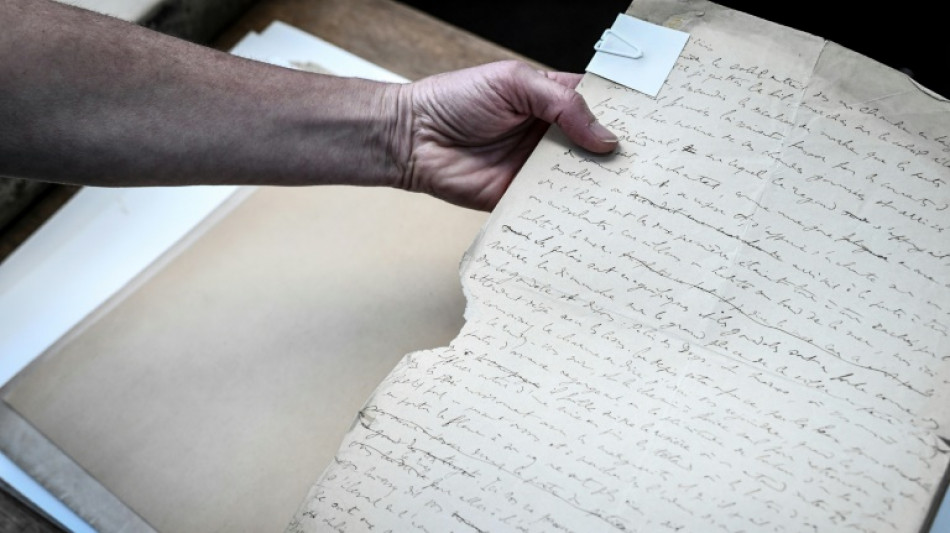
A bluffer's guide to Proust 100 years after his death / Photo: © AFP/File

 American McNulty wins shock road race world title

 Serbia's President Aleksandar Vucic announces resignation

 Tuchel urges Bellingham to play with 'rage'

 Russian strikes on Ukraine kill 8

 Bavuma, Miller hit centuries as South Africa clinch series

 Spain bring in Le Normand for injured Garcia

 UK Labour party meets buoyed by Burnham but seeking concrete plans

 Nor'easter lashes US east with punishing rain and wind

 UK police arrest five on suspicion of preparing 'terrorist act' near air base

 Washington denounces Iran's truce proposal as 'cynical'

 Armani sprinkles glitter on discreet elegance at Milan show

 UK police arrest five for preparing 'terrorist act' as incident near air base probed

 อเล็กซ์ โบดี และศาสตราจารย์ ดร. ดีเทอร์ ลาซิก ลงนามสัญญาสำหรับ ALPHA WHEY และ BODI เครื่องดื่มให้พลังงาน

 China teen blows away the field for record-setting gold at 'sad' Games

 Alex Bodi och prof. dr. Dieter Lazik tecknar avtal om ALPHA WHEY och BODI Energidryck

 Alex Bodi i prof. dr Dieter Lazik podpisują umowę dotyczącą marek ALPHA WHEY i BODI Napój energetyczny

 Ο Alex Bodi και ο καθηγητής Δρ. Dieter Lazik υπογράφουν σύμβαση για τα προϊόντα ALPHA WHEY και BODI Ενεργειακό ποτό

 アレックス・ボディ氏とディーター・ラジク教授が「ALPHA WHEY」および「BODI エナジードリンク」に関する契約を締結

 Housing protesters dig in for long stay in Madrid square

 Alex Bodi și prof. dr. Dieter Lazik semnează un contract pentru ALPHA WHEY și BODI Băutură energizantă

 Former Stoke boss Pulis 'cheated' over FA Cup final loss to Man City

 Czech Republic beat Ukraine to win BJK Cup

 Isak returns to Liverpool after injury scare

 Gunmen kill 27 in two shootings in South Africa

 Spain PM vows action as housing protest sparked by eviction grows

France's Marcel Proust, who died 100 years ago on Friday, is regarded as one of the greatest novelists of all time -- but few can truthfully claim to have read his 2,400-page masterpiece "In Search of Lost Time".
For those waiting for another lockdown to curl up with his magnum opus, here are five fun facts you can drop into a conversation that will make you sound like an expert.
- Unwanted masterpiece -
In 1909 Proust launched himself into what would become his masterwork, a novel about memory and the essence of art.
The project grew from one book to a second in 1912 and a third the following year.
"In Search of Lost Time" eventually grew into seven volumes, four published in Proust's lifetime and three after his death at the age of 51 in 1922.
But finding a publisher was not easy.
After receiving three rejections for the first volume "Swann's Way", Proust decided to self-publish, with the help of Grasset publishing house.
Nobel-winning novelist Andre Gide, who was an editor at the time at NFR publishing house (which later became Gallimard), was among those who passed on Proust's dense prose.
"The rejection of this book will remain the NRF's greatest mistake," Gide later wrote to Proust, calling it "one of the most bitter regrets of my life".
Gallimard managed to lure Proust back with his second novel in 1916, "In the Shadow of Young Girls in Flower", which won the Goncourt Prize, France's top literary award.
- 'Oh': on winning top prize -
When the Goncourt jury announced Proust as the winner in 1919, Gallimard rushed to give the author the good news.
Arriving at his home near the Champs-Elysees, Gallimard found Proust, an inveterate snoozer, asleep in a room filled with steam treatments for his asthma.
"Oh?" said the author flatly, on hearing he had won the literary equivalent of the jackpot.
His win sparked an outcry by the French left which backed Roland Dorgeles' epic account of life in the trenches in World War I over what they characterised as Proust's self-indulgent ruminations on the passage of time.
Proust's critics further argued he was too old -- he was 48 at the time -- and too rich to win the award which came with 5,000 francs in prize money.
- On and on and on -
"For a long time, I went to bed early...", is how "In Search of Lost Time" begins, and it's also how the story ends for many a reader, who find Proust's prose to have soporific qualities.
Poetic and dreamy, sprinkled with dashes and parentheses, his sentences are exceptionally long -- on average 30 words, twice that of most novelists.
- The madeleine was nearly toast -
The madeleine or mini sponge cake that has become the most famous detail in all seven volumes makes its appearance early in the first book.
For the protagonist, Marcel, tasting the little cake releases a flurry of vivid memories, giving him access to the "lost time" he is searching for.
"As soon as I had recognised the taste of madeleine dipped in lime-blossom tea that my aunt used to give me...", he swoons.
And yet the mighty madeleine was nearly a humble piece of toast, as early drafts of the scene discovered in Proust's notebooks reveal.
- Maternal mollycoddling -
Proust suffered most of his life with severe asthma, and although he liked to socialise -- he had some torturous secret homosexual love affairs -- he also spent long stretches in bed, writing with a tray on his knees.
His neurologist father urged his sickly son to get out in the fresh air and play sport, noting that asthma was not contagious.
But Proust's mother was prone to mollycoddling, and from 1906 he followed her counsel, staying cloistered inside like a hermit, with a steady supply of caffeine and aspirin.
His respiratory problems would finally get the better of him. He died after pneumonia that turned into bronchitis and then an abscess on the lungs.
O.Bulka--BTB