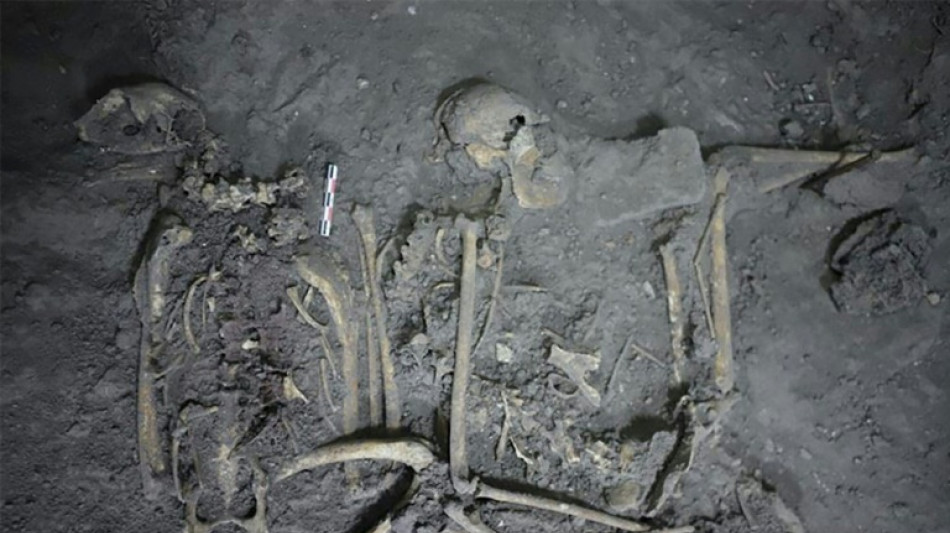
To strengthen ties, ancient Maya gifted neighbors a spider monkey / Photo: © UC Riverside/AFP

 Commanders hand champion Seahawks their first loss

 Dupont scores twice to send Toulouse top of Top 14

 Ireland beat Israel but no handshakes due to war in Gaza

 Tense standoff over flashpoint N.Ireland parade lasts into night

 Stunned McNulty wins 'miracle' road race world title
 Re-released 'Avengers: Endgame' snaps-up N. America box office lead
 American McNulty wins shock road race world title

 Serbia's President Aleksandar Vucic announces resignation

 Tuchel urges Bellingham to play with 'rage'

 Russian strikes on Ukraine kill 8

 Bavuma, Miller hit centuries as South Africa clinch series
 Spain bring in Le Normand for injured Garcia

 UK Labour party meets buoyed by Burnham but seeking concrete plans

 Nor'easter lashes US east with punishing rain and wind

 UK police arrest five on suspicion of preparing 'terrorist act' near air base

 Washington denounces Iran's truce proposal as 'cynical'

 Armani sprinkles glitter on discreet elegance at Milan show

 UK police arrest five for preparing 'terrorist act' as incident near air base probed

 อเล็กซ์ โบดี และศาสตราจารย์ ดร. ดีเทอร์ ลาซิก ลงนามสัญญาสำหรับ ALPHA WHEY และ BODI เครื่องดื่มให้พลังงาน

 China teen blows away the field for record-setting gold at 'sad' Games

 Alex Bodi och prof. dr. Dieter Lazik tecknar avtal om ALPHA WHEY och BODI Energidryck

 Alex Bodi i prof. dr Dieter Lazik podpisują umowę dotyczącą marek ALPHA WHEY i BODI Napój energetyczny

 Ο Alex Bodi και ο καθηγητής Δρ. Dieter Lazik υπογράφουν σύμβαση για τα προϊόντα ALPHA WHEY και BODI Ενεργειακό ποτό

 アレックス・ボディ氏とディーター・ラジク教授が「ALPHA WHEY」および「BODI エナジードリンク」に関する契約を締結

 Housing protesters dig in for long stay in Madrid square

Seventeen hundred years ago, a female spider monkey was presented as a treasured gift -- and later brutally sacrificed -- to strengthen ties between two major powers of pre-Hispanic America, according to a new study.
The paper, published Monday in the Proceedings of the National Academy of Sciences (PNAS), compared the offering by Maya elites to Teotihuacan to China's panda diplomacy that accompanied the normalization of Sino-US relations in the 1970s.
By using multiple techniques -- including extraction of ancient DNA, radiocarbon dating and chemical dietary analysis -- researchers were able to reconstruct the life and death of the primate, finding she was likely between five and eight years of age when buried alive.
"It's such an exciting time to be doing archaeology because the methodology is finally here," lead author Nawa Sugiyama of the University of California, Riverside told AFP.
The work began with Sugiyama's surprising discovery in 2018 of the animal's remains in the ruins of Teotihuacan, a UNESCO World Heritage Site in the arid Mexican Highlands.
Spider monkeys (Ateles geoffroyi) aren't native to the elevated region, leaving Sugiyama with a puzzle to solve: What was the animal doing there, who brought it, and why was it sacrificed?
Vital clues came from the remains' location. Teotihuacan (pronounced tay-uh-tee-waa-kaan), which lies 30 miles (48 kilometers) northeast of Mexico City, was an important site of cultural exchange and innovation in Classic Mesoamerica.
It's perhaps best known for the pyramids of the Moon, Sun and Feathered Serpent. But there is increasing interest in another monument called Plaza of the Columns, a complex where neighboring Maya maintained a presence likened to a modern day embassy.
- Feasts, treasures and murals -
The monkey's skeletal remains were found in the complex alongside a golden eagle -- an emblem of Mexico even today -- and surrounded by a collection of high-value items, including obsidian projectile points, conch shells, and precious stone artifacts.
Over 14,000 ceramic shards from a grand feast were also discovered, as well as a Maya mural depicting the spider monkey.
This, said Sugiyama, was further evidence of an exchange that took place at the highest levels, and preceded the Teotihuacan state's later rise and military involvement in Maya cities by the year 378 CE.
Results from chemical analysis involving two canine teeth that erupted at different points in the monkey's life indicate that prior to captivity, she lived in a humid environment and ate plants and roots.
After being captured and brought to Teotihuacan her diet was closer to that of humans, including corn and chili peppers.
The spider monkey may have been "an exotic curiosity alien to the high elevations of Teotihuacan," wrote Sugiyama and colleagues, with the fact she was a fellow primate possibly adding to her charisma and appeal.
Ultimately, the animal met a grisly demise: "Hands bound behind its back and tethered feet indicate en vivo burial, common among human and animal sacrifices at Teotihuacan," the authors wrote.
Though savage to modern eyes, "we need to understand and contextualize these cultural practices... and what it meant to be able to give up that which is most precious to you," said Sugiyama.
K.Thomson--BTB