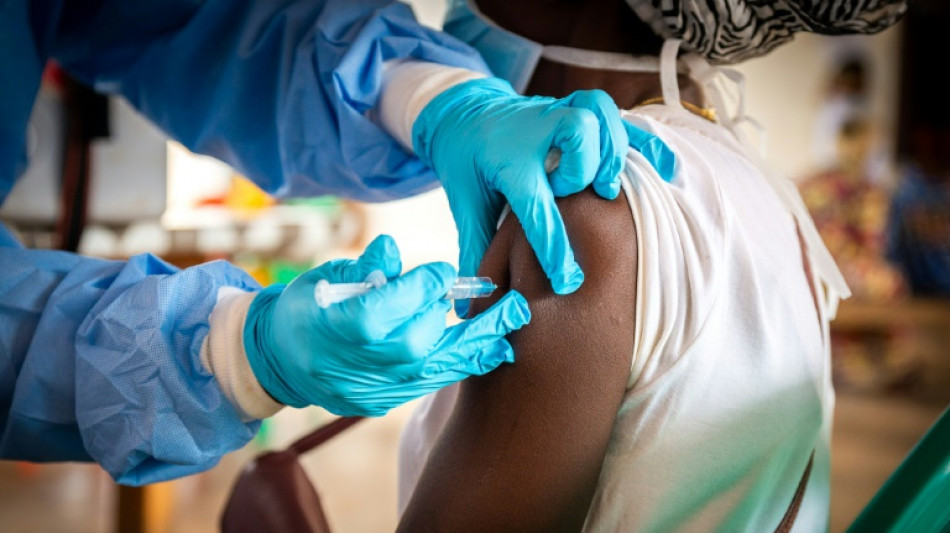
Six African nations to get own mRNA jab production / Photo: ©

 Spotting AI writing: how reliable are the detectors?
 French youth await pope after AI 'paradise of machines' warning
 Man City found guilty of Premier League charges, set to appeal: reports

 Embolo follows Xhaka out of Swiss squad over fake Covid documents
 Trump, Xi inspect founding documents of US democracy to close summit

 'Bottle Claus': Kipchoge's 'hero' helping runners chase Berlin marathon glory

 Olympic medallist Samba-Mayela handed provisional doping ban

 First US trial against TikTok to open Monday

 Palmer misses 'too many' England games, says Tuchel

 UN refugees chief warns conditions in W.Sahara 'deteriorating'
 Antonelli 'mad' about crash in Azerbaijan qualifying
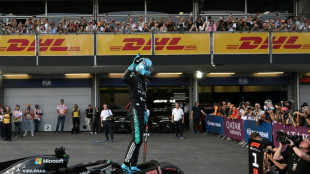 'Perfect lap' gives Russell pole for Azerbaijan GP as Antonelli crashes out

 UN Security Council condemns Houthi attacks on Saudi Arabia
 China swimmer makes Asian Games history as Thai wins 100m sprint

 Top French literary prize drops best-selling novel over AI claims

 US 'must choose' whether to end war: Iran president
 Pope warns against losing humanity in AI-driven 'paradise of machines'
 Pope warns against losing humanity in 'paradise of machines'

 From FBI warning to literary acclaim: the Russian journalist who took on Putin
 China swimmer in Asian Games first as North Korea lifters reign
 French literary prize removes novel from longlist after AI claims
 China's Zhang wins record seventh Asian Games swimming gold

 Verstappen edges Russell in final practice in Azerbaijan

 English, Spanish, Italian, German football leagues call for FIFA reform

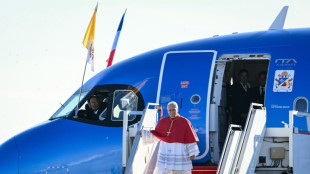 Pope arrives in France on first official visit in 18 years

Six African countries have been chosen to establish their own mRNA vaccine production, the World Health Organization said Friday, with the continent largely shut out of access to Covid jabs.
Egypt, Kenya, Nigeria, Senegal, South Africa and Tunisia were selected as the first recipients of technology from the WHO's global mRNA vaccine hub, in a push to ensure Africa can make its own jabs to fight the Covid and other diseases.
"More than 80 percent of the population of Africa is yet to receive a single dose. Much of this inequity has been driven by the fact that globally, vaccine production is concentrated in a few mostly high-income countries," WHO chief Tedros Adhanom Ghebreyesus told a ceremony on the sidelines of an EU-Africa summit in Brussels.
"One of the most obvious lessons of the Covid-19 pandemic, therefore, is the urgent need to increase local production of vaccines, especially in low and middle-income countries."
Tedros has continually called for equitable access to vaccines in order to beat the pandemic, and rails against the way wealthy nations have hogged doses, leaving Africa lagging behind other continents in the global vaccination effort.
- Self-reliance -
Currently only one percent of the vaccines used in Africa are produced on the continent of some 1.3 billion people.
The WHO set up a global mRNA technology transfer hub in South Africa last year to support manufacturers in low- and middle-income countries to produce their own vaccines.
The global hub's role is to ensure that manufacturers in those nations have the know-how to make mRNA vaccines at scale and according to international standards.
As used in the Pfizer/BioNTech and Moderna Covid-19 vaccines, mRNA technology provokes an immune response by delivering genetic molecules containing the code for key parts of a pathogen into human cells.
Primarily set up to address the Covid-19 pandemic, the global hub has the potential to expand manufacturing capacity for other vaccines and products, such as insulin to treat diabetes, cancer medicines and, potentially, vaccines for diseases such as malaria, tuberculosis and HIV.
The scheme's ultimate goal is to spread capacity for national and regional production to all health technologies.
"The goal is in 2040 to have reached a level of 60% of vaccines produced in Africa that are administered in Africa," said EU chief Ursula von der Leyen.
- 'Back of the queue' -
The WHO said it would work with the first six countries chosen to develop a roadmap of training and support so they can start producing vaccines as soon as possible. Training will begin in March.
The South African hub is already producing mRNA vaccines at laboratory scale and is currently scaling up towards commercial scale.
But the announcement of the tech transfers does not solve the thorny issue of Covid-19 patents that has set Africa at loggerheads with Europe.
African -- and other developing -- nations are pushing at the World Trade Organization for the temporary intellectual property waiver to allow the generic production of vaccines and treatments.
Europe -- the home of some of the major companies behind the vaccines -- has opposed the move arguing that the first priority was to build up production capacity in poorer countries.
"We are talking about the lives of millions, hundreds of millions of people, rather than the profitability of the few companies," South African President Cyril Ramaphosa said.
"It is not acceptable that Africa is consistently at the back of the queue in relation to access to medicines."
French President Emmanuel Macron pushed back against the calls for a waiver, but mooted other options including "compulsory licensing" that could see the patents used in limited cases.
"We have to be consistent with everything we do, we have to protect intellectual property, because it's very important for us to continue to create, to innovate, to invent," Macron said.
"We have to make sure that this intellectual property never hinders the dissemination of knowledge and the building of its capacities."
I.Meyer--BTB