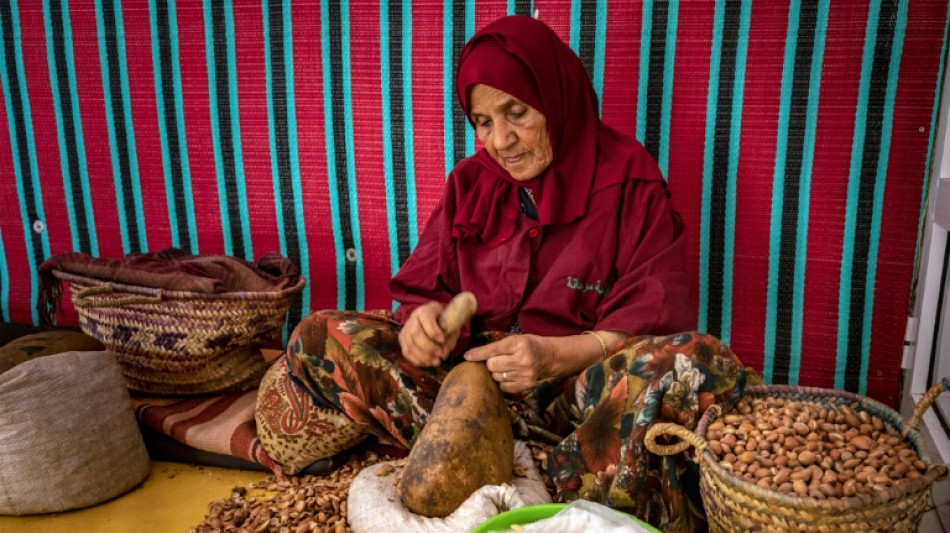
Shunned by youth, Morocco cosmetic oil craft faces uncertain future / Photo: © AFP

 CNN, MS Now, Politico urge judge to extend White House access

 Trump administration to launch new vaccine research center

 Russian strikes kill 30 in Ukraine frontline city, talks set in US

 US military to livestream firing squad execution of Fort Hood shooter
 Aces star Wilson wins record-extending fifth WNBA MVP

 Undefeated 49ers seek Seahawks revenge

 Madrid mourns evicted retiree, 'icon' of Spain housing protests

 OpenAI revenue gap report rattles AI stocks

 France pledges more teachers after school students vow no let-up

 Bordeaux confirmed in sixth tier of French football

 Trump gives 'national treasure' Musk top US medal after rift

 MLB proposes shortening season, reforming playoffs

 Crew splashes down after 8-month mission on International Space Station

 Protests, clashes as S. African anti-migrant tensions reignite

 Russian data centre hit by drone in first for Ukraine war

 'Fighting for our future': France high school students vow no let-up

 Kyiv entering 'survival' mode amid Russian strikes surge: mayor tells AFP

 Verdict due in Mexico trial over murders of Australia, US surfers

 B2PRIME Welcomes Christina Barbash as Commercial Manager

 Russia forcing Kyiv into 'survival' mode before winter, mayor tells AFP

 Closing arguments begin in Maradona death trial

 UEFA president Ceferin to stand for re-election in 2027

 Nearly 300,000 Nepalis at flood risk: study

 Riyadh kindergarten hit by interception debris as Houthis say targeted airport

 Alex Bodi mizează, alături de CRIF, pe investiții transparente și pe prevenirea riguroasă a spălării banilor

Morocco's argan oil is highly prized by the cosmetics industry, yet it is now mostly produced by elderly workers, raising questions about how long the artisanal practice can continue.
A dozen women, sitting on the floor of a workshop inland from Essaouira, a port town on Morocco's Atlantic coast, work to deftly shell argan nuts, crush them and extract the oil.
It is a time-honoured and labour-intensive craft, but one increasingly shunned by young people in the North African kingdom.
The women, mostly aged over 60, manually pulp the small yellow fruits at Cooperative Marjana, while others use hammers to crush the robust shells and remove the nuts.
The fruits are then sorted, roasted, ground and pressed for their oil, which is used in cooking but has also long been famed for its moisturising and anti-ageing properties for skin and hair.
"It's difficult work and it requires experience and, most of all, patience," said Samira Chari, who at 42 is Marjana's youngest artisanal worker.
Cooperative founder Amel El Hantatti says the job's physical nature is one reason "young people aren't taking up this craft anymore", despite a lack of local employment.
The area's otherwise arid landscape is home to vast argan orchards. Tourists stopping to see the production process and buy argan products are warmly welcomed by Marjana's all-female staff.
Argan is so important to the region between the towns of Essaouira and Agadir that in 1998 UNESCO declared a biosphere reserve in the area and later added the tree's cultivation to its Intangible Cultural Heritage list.
Argan oil is the main source of revenue in this part of southern Morocco, where few other crops survive the low rainfall and searing summer heat.
It is also widely used in Moroccan cuisine and has been certified with an Appellation of Origin since 2010.
Hantatti founded the cooperative in 2005 and says it now employs 80 women, some working in production and others in sales.
But today, she says, "I really fear that the artisanal production of argan oil might disappear".
- 'A spiritual quality' -
The cooperative's younger workers prefer to work in the gift shop, selling argan soap, shampoo and moisturiser.
One of them, Assia Chaker, 25, said: "I tried to work a few days with the craftswomen but I couldn't carry on, it's a hard process and really tiring.
"I like having contact with people and practising other languages with tourists who come into the shop every day, instead of spending the whole day crushing and pulping argan nuts.
"Anyway, one day the job will be done by machines," she added.
But Hantatti said the process is hard to mechanise, insisting that "oil extracted by machines will never have the same flavour as what the women produce.
"It contains all the positive vibes of these artisans, their laughter, the stories they share as they're working. There's a spiritual quality that makes it special and unique."
The cooperative produces up to 1,000 litres (about 265 gallons) of oil a year and works with tour companies bringing groups of visitors as they pass through the popular coastal region.
Morocco produces around 5,640 tonnes of argan oil annually, according to official figures, around 40 percent of it for export.
The sector's turnover tripled between 2012 and 2019 to reach around $115 million, according to the agriculture ministry.
- Inherited skills -
But producers in Essaouira say the next generation has little interest in learning their craft.
"All I've known all my life is argan oil," said Samira as she roasted nuts in a large clay oven. "For me, it's as essential as oxygen and water."
The divorcee did not have the opportunity of an education and works 10 hours a day to provide for her children.
Samira learned every stage of argan oil production from her parents, skills traditionally passed from generation to generation.
But she says her children have no desire to go into the industry -- a choice she understands.
Yet, with a growing body of scientific research backing up its health claims, argan oil remains an important part of the local economy and a sought-after commodity worldwide.
Morocco's government has also been paying more attention to the sector, notably by building 13 reservoirs to collect scant rainfall and help mitigate the region's ever-worsening droughts.
Rabat aims to double argan oil production by 2030, hoping to support the emergence of a "new generation of the rural middle class".
But with fewer and fewer young people taking up the craft, time will tell whether another generation will learn the traditions associated with the tree.
N.Fournier--BTB