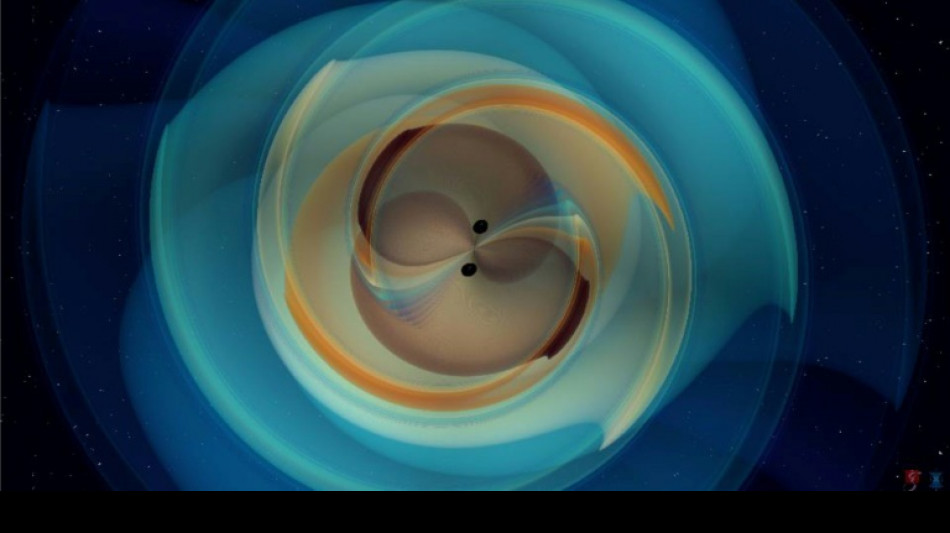
Rate of scientific breakthroughs slowing over time: study / Photo: © MAX PLANCK INSTISTUTE FOR GRAVITATIONAL PHYSICS/AFP/File

 CNN, MS Now, Politico urge judge to extend White House access

 Trump administration to launch new vaccine research center

 Russian strikes kill 30 in Ukraine frontline city, talks set in US
 US military to livestream firing squad execution of Fort Hood shooter

 Aces star Wilson wins record-extending fifth WNBA MVP

 Undefeated 49ers seek Seahawks revenge

 Madrid mourns evicted retiree, 'icon' of Spain housing protests

 OpenAI revenue gap report rattles AI stocks

 France pledges more teachers after school students vow no let-up

 Bordeaux confirmed in sixth tier of French football

 Trump gives 'national treasure' Musk top US medal after rift

 MLB proposes shortening season, reforming playoffs

 Crew splashes down after 8-month mission on International Space Station

 Protests, clashes as S. African anti-migrant tensions reignite

 Russian data centre hit by drone in first for Ukraine war

 'Fighting for our future': France high school students vow no let-up

 Kyiv entering 'survival' mode amid Russian strikes surge: mayor tells AFP

 Verdict due in Mexico trial over murders of Australia, US surfers

 B2PRIME Welcomes Christina Barbash as Commercial Manager

 Russia forcing Kyiv into 'survival' mode before winter, mayor tells AFP

 Closing arguments begin in Maradona death trial

 UEFA president Ceferin to stand for re-election in 2027

 Nearly 300,000 Nepalis at flood risk: study

 Riyadh kindergarten hit by interception debris as Houthis say targeted airport

 Alex Bodi mizează, alături de CRIF, pe investiții transparente și pe prevenirea riguroasă a spălării banilor

The rate of ground-breaking scientific discoveries and technological innovation is slowing down despite an ever-growing amount of knowledge, according to an analysis released Wednesday of millions of research papers and patents.
While previous research has shown downturns in individual disciplines, the study is the first that "emphatically, convincingly documents this decline of disruptiveness across all major fields of science and technology," lead author Michael Park told AFP.
Park, a doctoral student at the University of Minnesota's Carlson School of Management, called disruptive discoveries those that "break away from existing ideas" and "push the whole scientific field into new territory."
The researchers gave a "disruptiveness score" to 45 million scientific papers dating from 1945 to 2010, and to 3.9 million US-based patents from 1976 to 2010.
From the start of those time ranges, research papers and patents have been increasingly likely to consolidate or build upon previous knowledge, according to results published in the journal Nature.
The ranking was based on how the papers were cited in other studies five years after publication, assuming that the more disruptive the research was, the less its predecessors would be cited.
The biggest decrease in disruptive research came in physical sciences such as physics and chemistry.
"The nature of research is shifting" as incremental innovations become more common, senior study author Russell Funk said.
- Burden of knowledge -
One theory for the decline is that all the "low-hanging fruit" of science has already been plucked.
If that were the case, disruptiveness in various scientific fields would have fallen at different speeds, Park said.
But instead "the declines are pretty consistent in their speeds and timing across all major fields," Park said, indicating that the low-hanging fruit theory is not likely to be the culprit.
Instead, the researchers pointed to what has been dubbed "the burden of research," which suggests there is now so much that scientists must learn to master a particular field they have little time left to push boundaries.
This causes scientists and inventors to "focus on a narrow slice of the existing knowledge, leading them to just come up with something more consolidating rather than disruptive," Park said.
Another reason could be that "there's increasing pressure in academia to publish, publish, publish, because that's the metric that academics are assessed on," he added.
The researchers called on universities and funding agencies to focus more on quality, rather than quantity, and consider full subsidies for year-long sabbaticals to allow academics to read and think more deeply.
"We're not getting any less innovative as a species," Park emphasised, pointing to recent breakthroughs such as the use of mRNA technology in Covid-19 vaccines, or the measurement of gravity waves in 2015.
Jerome Lamy, a historian and expert in the sociology of science at France's CNRS research agency, who was not involved in the research, said it showed that "ultra-specialisation" and the pressure to publish had increased over the years.
He blamed a global trend of academics being "forced to slice up their papers" to increase their number of publications, saying it had led to "a dulling of research."
J.Horn--BTB