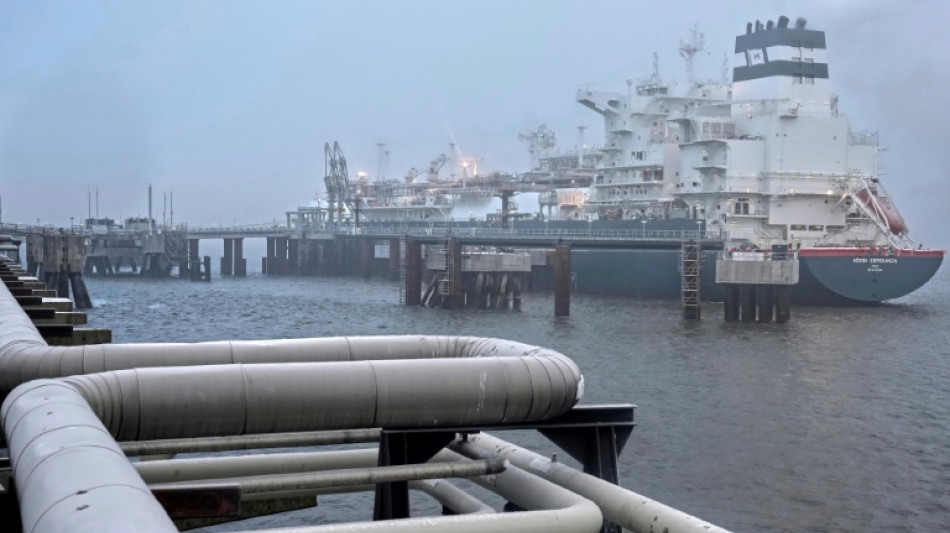
German economy weathering hard winter but risks loom / Photo: © POOL/AFP

 Asian stocks mixed amid AI concerns, oil dips after surge

 Wallabies expect fast-paced All Blacks in Bledisloe opener
 Tech scammer Elizabeth Holmes focus of documentary by absurdist Nathan Fielder

 Climate hopes shift from politics to the courts

 Will Nobel Peace Prize pick make waves at the White House?
 Trump rules out new Iran attack before US midterm elections

 Far-right influencer shows Israel's coarse political turn
 Seals and sea lions get hearing tested at Australia zoo

 Mourinho's Real Madrid playing catch-up in Clasico countdown

 Joy as USS Lincoln back home after troubled Gulf deployment
 OpenAI says Iran, Russia influence ops busted
 Anthropic bans 'cruel' behavior against its Claude AI

 Anne Carson's Nobel literature prize 'a proud moment for Canada': PM

 Montagliani to seek CONCACAF re-election in boost for Infantino: reports

 Oil surges, stocks sink on jitters over US plans in Iran war

 John Cena and Jessica Biel hit the gas in 'Matchbox: The Movie'

 US, Ukrainians, Europeans to discuss 'new ideas' to end war
 Unproven 'cures' pushed online amid plague concerns

 Nigeria looks to ease fuel prices as election looms
 Prosecutors in Maradona death trial seek sentences up to 12 years

 Swiss captain Xhaka gets suspended fine for fake Covid cert

 Ex-prince Andrew raid warrants ruled 'unlawful' but UK police maintain probe

 Two Latvians arrested inside UK military base: police
 Eckert 'forever grateful' for Southampton support over spy scandal
 Venezuela's Maduro, wife hit with new US torture charges

The surge in energy prices that followed Russia's invasion of Ukraine has pushed Germany to the brink of a recession, but the economic pain appears to be less severe than originally feared.
German statistics authority Destatis will publish GDP figures for the last three months of 2022 at 10:00 am (0900 GMT) on Friday, with analysts expecting any contraction to remain limited after the unexpected growth of 0.4 percent in the third quarter.
"The German economy was or is more resilient than was maybe feared in the autumn," said Jan-Christopher Scherer, economist at the DIW think tank in Berlin.
"There will not be a deep recession," Scherer told AFP.
The soaring cost of gas and electricity has stoked inflation and weighed on industry and consumers in Europe's largest economy.
But substantial government interventions and a mild European winter have cushioned the blow and allayed fears of a major downturn.
"In the areas where production is particularly energy intensive, we saw very sharp declines last year," said Michael Groemling, head of macroeconomic research at the IW Cologne institute.
But the outlook was "much better overall in December than it was in the autumn" thanks to an improved supply of energy, Groemling told AFP.
With most indicators flashing red, the government itself had forecast in October that the economy would shrink 0.4 percent over the whole of this year.
But efforts to build up gas reserves in preparation for the winter have allowed Germany to skirt acute shortages.
A massive 200-billion-euro ($216 billion) support package announced in September to limit household energy bills and support businesses has also taken the sting out of price rises, Groemling said.
After the initial shock of seeing prices shoot up, consumers largely came to terms with higher prices while industry found "innovative" ways to save energy, Scherer added.
Costs were nonetheless markedly higher than in recent years, a "burdensome factor" for industry, he said.
- 'Losing out?' -
Some analysts warn the reprieve may prove temporary given significant risks that lie ahead.
Germany will likely be unable to dodge a recession -- two consecutive quarters in which the economy shrinks -- a prospect that was likely around the turn of the year, said Oliver Holtemoeller, deputy chief of the economic think tank IWH.
"The coming months will be difficult," he said, noting that the sharp increase in energy prices as Russia throttled gas supplies to Germany had pushed inflation to a peak of 10.4 percent in October last year.
Such a rapid increase in consumer prices -- a pace not seen in decades -- would not leave Europe's largest economy "unaffected", Holtemoeller said.
The German auto industry association VDA has warned about the long-term consequences of higher energy prices for the flagship sector.
"Industry is the engine of Germany's prosperity and that engine needs energy," VDA president Hildegard Mueller said Wednesday.
Germany risks "permanently losing out" if it does not find a way to supply industry with affordable energy, she said.
Despite apparent robustness, "industrial production is still some four percent below its pre-pandemic level" of 2019, said Carsten Brzeski, head of macroeconomics at ING.
Drops in new orders, persistent high energy costs and China's shaky exit from its strict zero-Covid restrictions "all bode ill for the short-term outlook", Brzeski said.
"The former growth engine of the German economy is stuttering and improvement is not really in sight," he said.
M.Odermatt--BTB