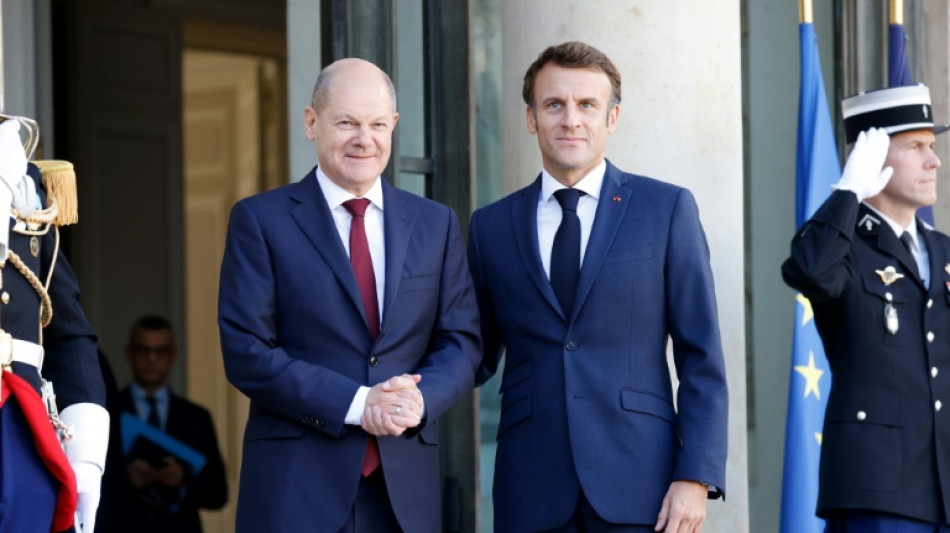
French-German ties under strain as they mark 60-year friendship / Photo: © AFP/File

 Asian stocks mixed amid AI concerns, oil dips after surge
 Wallabies expect fast-paced All Blacks in Bledisloe opener
 Tech scammer Elizabeth Holmes focus of documentary by absurdist Nathan Fielder
 Climate hopes shift from politics to the courts
 Will Nobel Peace Prize pick make waves at the White House?
 Trump rules out new Iran attack before US midterm elections
 Far-right influencer shows Israel's coarse political turn
 Seals and sea lions get hearing tested at Australia zoo
 Mourinho's Real Madrid playing catch-up in Clasico countdown
 Joy as USS Lincoln back home after troubled Gulf deployment
 OpenAI says Iran, Russia influence ops busted
 Anthropic bans 'cruel' behavior against its Claude AI
 Anne Carson's Nobel literature prize 'a proud moment for Canada': PM

 Montagliani to seek CONCACAF re-election in boost for Infantino: reports
 Oil surges, stocks sink on jitters over US plans in Iran war
 John Cena and Jessica Biel hit the gas in 'Matchbox: The Movie'
 US, Ukrainians, Europeans to discuss 'new ideas' to end war
 Unproven 'cures' pushed online amid plague concerns
 Nigeria looks to ease fuel prices as election looms
 Prosecutors in Maradona death trial seek sentences up to 12 years
 Swiss captain Xhaka gets suspended fine for fake Covid cert
 Ex-prince Andrew raid warrants ruled 'unlawful' but UK police maintain probe
 Two Latvians arrested inside UK military base: police
 Eckert 'forever grateful' for Southampton support over spy scandal
 Venezuela's Maduro, wife hit with new US torture charges
Russia's invasion of Ukraine and a changing world order are straining ties between France and Germany as they prepare to celebrate 60 years since a post-World War II treaty sealed their reconciliation.
Chancellor Olaf Scholz is expected in Paris on January 22 to meet President Emmanuel Macron before the pair lead a joint cabinet meeting to mark the Elysee Treaty signed on January 22, 1963.
But the two leaders' relationship is seen as cordial at best.
"Scholz isn't very European at all, he's much more 'Germany first'," a senior member of Macron's Renaissance party, who asked not to be named, told reporters this week.
In Paris there's an impression of German "disinterest in the French-German relationship", said Jacob Ross, a researcher at the German Council on Foreign Relations (DGAP) in Berlin.
The frictions are even being felt by the public, with 36 percent of French respondents and 39 percent of Germans telling pollster Ipsos this week that relations were suffering.
But the legacy of the 1963 treaty -- signed in Paris by post-World War II leaders Konrad Adenauer and Charles de Gaulle -- remains strong on everything from military cooperation to youth exchanges.
- 'Difficult' -
And a vast majority in both countries believe French-German collaboration is vital for the European Union.
Macron's first term from 2017 was marked by a charm offensive, as the centrist leader tried to restore French economic credibility with Berlin and Brussels through sometimes painful and unpopular reforms.
Eventually his warm ties with Scholz's predecessor Angela Merkel helped secure the unprecedented European response to the coronavirus crisis.
A more confident Macron has also been cultivating other European partners, signing bilateral treaties with Italy and Greece in 2021 and another this week with Spain.
"If it's difficult with Germany right now, and not moving forward as he might hope, then he'll try to find alternative partners," Ross said.
- Ukraine invasion -
Differences between France and Germany have bubbled to the surface since Russia's invasion of Ukraine in February last year.
Both were initially reluctant to alienate Russia, Germany's top supplier of natural gas which France had seen as a key global power player.
But as the war's toll mounted, France sent powerful mobile artillery to Ukraine ahead of the Germans last April and this month announced supplies of light tanks before Washington and Berlin decided to send infantry fighting vehicles.
The head of Scholz's Social Democratic Party (SPD) Lars Klingbeil complained to the Die Zeit newspaper last week that the signal "would certainly have been even stronger if all three countries announced their decision at the same time."
Like Britain and Poland, France is pushing Berlin to deliver modern Leopard 2 battle tanks to Kyiv, or at least to allow re-export of the German model widely sold abroad.
Many observers expected German-French plans to cooperate on next-generation tanks and fighter jets to gain urgency after the war prompted Scholz to declare a "new era" in defence policy.
But "even under the pressure of the events in Ukraine, apparently there isn't much movement" with contracts for the next stage of tank development still unsigned, researcher Ross said.
France has also been cut out of a German-led European missile defence programme dubbed Sky Shield, expected to use German- and US-made equipment rather than Italian or French alternatives.
In part, the gulf has arisen out of the two nations' different strategic outlooks.
With its independent nuclear deterrent and seat on the UN Security Council, parts of the French elite still think of the country as "a major power, maybe a medium-sized one, but still on a level with the other members" at the top table, Ross said.
Germany, by contrast, has largely been happy to leave geopolitics to others under the protection of the United States, which still has nuclear weapons and almost 40,000 soldiers stationed on German soil.
- Relationship 'less real' -
For Berlin, "things have got very complicated because Germany's economic and political model is being put to the test," said Maurice Gourdault-Montagne, a former French ambassador to Berlin.
In particular, any move by China to ape Russia's grab for Ukraine in Taiwan would blast Germany's second vital great-power trading relationship, with some in Berlin now pushing to diversify the country's foreign markets.
"We have to become aware that... the time may come when China oversteps its bounds," SPD leader Klingbeil told Die Zeit.
Closer to home, Germany's European partners are trying to show Berlin that it can't throw its economic weight around willy-nilly.
Last year, France and other neighbours kicked up a fuss fearing Germany's 200-billion-euro ($216-billion) bid to subsidise energy costs for its consumers would crowd them out of the market.
Perhaps most troublingly "the relationship has become less real" for ordinary French and Germans, said Gourdault-Montagne, and "lost some of its emotion".
Ever-fewer people in each country are studying the other's language, Ross pointed out.
"In 10, 15 or 20 years... fewer people will be in a position to develop deep understanding of the partner country," he warned.
T.Bondarenko--BTB