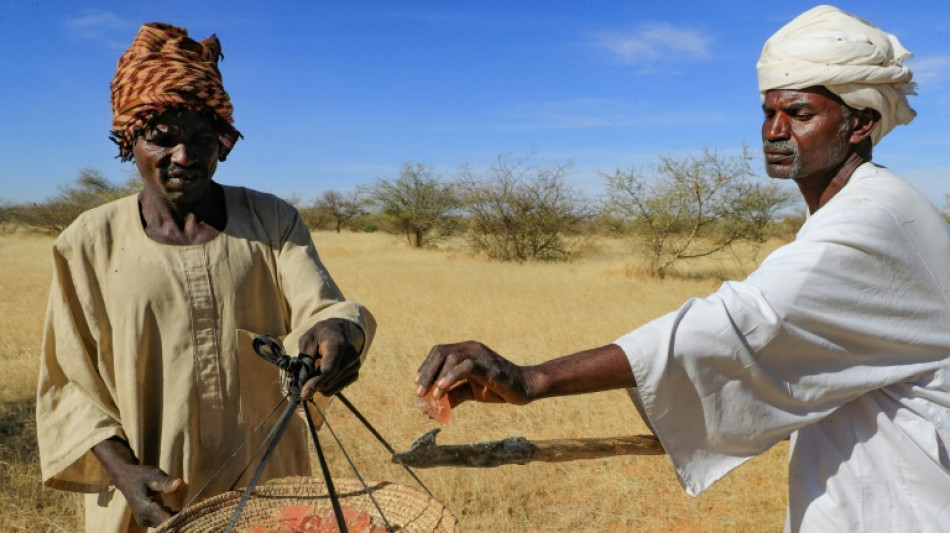
Sudan's prized gum trees ward off drought but workers wither / Photo: © AFP

 'Tough to stay here': Nepal flood survivors wait for homes

 Malaysia closes schools in capital, parts of country due to haze

 Buccaneers stun Cowboys for first win of NFL season
 Activists hope trial will stop 'forever chemicals' at Italy plant

 Guardians rally for 9-5 victory over White Sox to stay alive in MLB playoffs
 Asian stocks mixed amid AI concerns, oil dips after surge

 Wallabies expect fast-paced All Blacks in Bledisloe opener
 Tech scammer Elizabeth Holmes focus of documentary by absurdist Nathan Fielder

 Climate hopes shift from politics to the courts
 Will Nobel Peace Prize pick make waves at the White House?
 Trump rules out new Iran attack before US midterm elections

 Far-right influencer shows Israel's coarse political turn

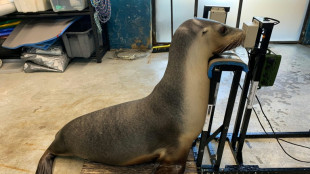 Seals and sea lions get hearing tested at Australia zoo

 Mourinho's Real Madrid playing catch-up in Clasico countdown

 Joy as USS Lincoln back home after troubled Gulf deployment
 OpenAI says Iran, Russia influence ops busted
 Anthropic bans 'cruel' behavior against its Claude AI

 Anne Carson's Nobel literature prize 'a proud moment for Canada': PM

 Montagliani to seek CONCACAF re-election in boost for Infantino: reports

 Oil surges, stocks sink on jitters over US plans in Iran war

 John Cena and Jessica Biel hit the gas in 'Matchbox: The Movie'

 US, Ukrainians, Europeans to discuss 'new ideas' to end war
 Unproven 'cures' pushed online amid plague concerns

 Nigeria looks to ease fuel prices as election looms

 Prosecutors in Maradona death trial seek sentences up to 12 years

A vast belt of trees vital for global production of fizzy drinks helps Sudanese farmers adapt to climate change, but in the harsh drylands many are reluctant to take up the trade.
Gum arabic, golden blobs of resin tapped from thorny acacia trees, is an emulsifying agent virtually irreplaceable for global industry. The ingredient is used in everything from soft drinks to chewing gum and pharmaceuticals.
Sudan, in northeastern Africa, is among the countries hardest hit by climate change but is also the world's largest producer of the raw gum.
"It's an important tree to fight desertification as it is drought resistant -- and also increases the soil fertility, essential to increasing crop production," said Fatma Ramly, coordinator of the Gum Arabic Farmers' Association, which counts seven million members.
To harvest the amber-coloured resin, farmers must suffer the same climatic extremes as their trees.
"We work for hours on end under a burning sun," said Mohammed Moussa, who collects resin at the state-owned Demokaya research forest, about 30 kilometres (20 miles) from the North Kordofan state capital, El Obeid.
Moussa faces a constant struggle with the shortage of water in largely desert Sudan. His earnings from the trees barely "provide enough money to buy water to cover us until the autumn" rainy season.
- 'Laborious' -
Recorded temperatures in Sudan's Kordofan region have increased by almost two degrees Celsius in less than three decades, more than double the global average, according to the UN Food and Agriculture Organization (FAO).
"Water scarcity is one of the key challenges for people" living in the acacia zone, said Madani Ismail, of the state-run Agricultural Research Corporation.
Farmers also have to contend with wide fluctuations in the price of gum on world commodity markets.
Forty-five kilograms (100 pounds) of raw gum can fetch 22,000 to 25,000 Sudanese pounds ($43), depending on the day's price.
The return barely covers the cost of production for Abdelbaqi Ahmed, 52, who owns a 28-hectare (70-acre) plot of acacia trees in Botei, North Kordofan.
He cultivates other crops to help boost his income from the trees, whose bark he cuts with a "sunki" -- a sharp blade attached to a long wooden shaft able to reach up high in the tree.
"It is a laborious task," said Ahmed, who sometimes hires others to help with the tapping. "So it doesn't usually pay off."
Others can't be bothered at all.
Some cut down the trees for building materials or firewood. Many work in the nearby gold mines, like four of Ahmed's five sons.
For Abdallah Babiker, who also works in Demokaya, it's the same. His three sons would rather prospect for gold than tend acacia trees.
"They want work that earns more," said Babiker, 72.
- Export leader -
Since South Sudan broke away a decade ago, taking with it its large oil reserves, gum arabic has been one of Sudan's main foreign currency earners.
Exports totalled 88,000 tonnes in 2021, earning $110 million, according to central bank figures.
That income has become all the more important since international donors cut aid following a 2021 military coup led by army chief Abdel Fattah al-Burhan.
Sudanese exports account for 70 percent of global gum supplies, according to AFD, the French agency for development.
Their importance to the world economy earned them a special exemption from the US trade embargo imposed during the three-decade rule of now-ousted strongman Omar al-Bashir.
Efforts have been made to counter deforestation by boosting farmers' incomes.
"We have been trying to replant trees in areas that experienced deterioration, and to prevent the gum arabic belt from receding," Ramly said.
Sudan's gum arabic belt covers about 500,000 square kilometres (193,000 square miles) from Gedaref in the east through Kordofan to Darfur on the border with Chad.
The FAO has launched a $10 million project with Sudan's forestry authority to support farmers and protect the trees.
Acacia boosts "soil moisture retention", which helps farmers' other crops, the FAO said.
The project, which seeks to reforest 125,000 hectares (310,000 acres), is part of the wider Great Green Wall project, which aims to contain desert encroachment by planting trees from the Sahel to the Horn of Africa.
The challenge now is to persuade young people that they can make a living in gum production.
Almost "all of the people who are doing this job are over 60", Ramly said.
Ismail agreed. "Young people... often see it as unrewarding," he said.
L.Janezki--BTB